
For a century after the Lordship of the Isles fell, this headland castle changed hands between an Ayrshire family and the MacDonalds of Dunnyveg — Kintyre passing between rival hands in miniature.
At the headland between Carradale harbour and Port Righ, low masonry marks the remains of Airds Castle above Kilbrannan Sound. The ruined walls face Arran across the water and occupy a defended point where a harbour, sea crossing and land boundary met.
That boundary mattered more than the castle’s size might suggest. For generations it stood as an outpost of the Lord of the Isles, watching over the frontier between territory answering to the Lordship and land held directly by the Scottish crown. When the Lordship’s power collapsed in the late fifteenth century, the castle and its ground passed to the king, and from there into the hands of an Ayrshire family, then a branch of Clan Donald, then back again.
What survives today is a ruin rather than a monument in the grand sense, but it has been formally protected since 1972, and its setting still explains why anyone bothered to fortify this particular rock: from the headland, the whole sweep of Kilbrannan Sound and the approach to Carradale can be watched at once.
What follows is drawn from published sources, with each claim labelled by how firmly it is established.
History
For much of the later Middle Ages, Airds Castle stood as a stronghold of the Lord of the Isles, occupying a headland between Carradale harbour and the bay of Port Righ. Held into the late 1400s, it helped guard the frontier between territory controlled by the Lordship and land answering directly to the Scottish crown, giving a small castle real strategic weight along the Kintyre coast and over the crossing to Arran.
After the Lordship of the Isles was forfeited in the late fifteenth century, Airds Castle came under royal control. In 1498 James IV granted it, with other Kintyre property, to the Ayrshire landholder Sir Adam Reid of Stairquhite and Barskimming, bringing an outside family into a stronghold formerly held by the western seaboard's rulers.
By the middle of the sixteenth century the lands around Airds Castle had become part of the barony of Bar in North Kintyre, held by the MacDonalds of Dunnyveg, a powerful branch of Clan Donald whose main seat lay at Dunyveg on Islay. Their possession of the barony shows how quickly control of this stretch of Kintyre could shift between the crown's grantees and the region's older ruling families.
The Reid family of Barskimming had recovered possession of the lands by 1605, bringing the estate back into the hands into which James IV had first placed it a little over a century earlier. No detailed record explains exactly how or when the change took place, but the reversal underlines how contested this small headland and its surrounding barony remained across the 1500s.
Airds Castle was designated a scheduled monument in 1972, giving legal protection to what by then was a ruin reduced to fragmentary walls on its headland. The designation preserved the site as physical evidence of the long contest for control of North Kintyre, from the Lordship of the Isles through royal grantees to the rival families who held the barony of Bar.
People
-
James IV of Scotland
King who granted Airds Castle and surrounding property to Sir Adam Reid in 1498, following the crown's assumption of the former Lordship of the Isles lands.
-
Sir Adam Reid of Stairquhite and Barskimming
Ayrshire landholder granted Airds Castle by James IV in 1498; his family's possession of the estate was later restored by 1605.
Cultural influences
-
Lordship of the Isles frontier
Airds was shaped by the contested coastal frontier between the Lordship of the Isles and Crown-controlled land, a role determined by its position over Kilbrannan Sound.
Connections
-
Lordship of the Isles
Airds Castle was one of its coastal strongholds, held into the late 1400s to guard the frontier between Lordship territory and land answering to the Scottish crown.
-
MacDonalds of Dunnyveg
This branch of Clan Donald, whose principal seat was Dunyveg Castle on Islay, held the barony of Bar containing Airds Castle by the mid-16th century.
-
Reid family of Barskimming, Ayrshire
Granted Airds Castle by James IV in 1498 and recorded back in possession of the estate by 1605.
What to look for
-
The headland site
The ruin occupies a rocky headland between Carradale harbour and the bay of Port Righ, chosen for its command of the sea approach and the crossing to Arran rather than for any comfort of living.
-
View across Kilbrannan Sound
From the castle site, Kilbrannan Sound opens out towards the long ridge of Arran, the same sightline that made the headland useful for watching movement along the coast.
-
Surviving fragments
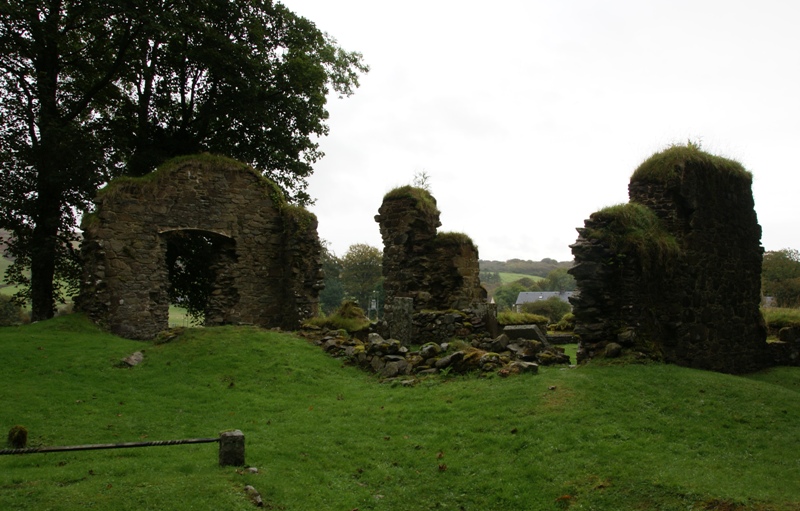
What remains today is fragmentary, ruined walling rather than a complete structure, consistent with a small medieval stronghold that has been exposed to the weather for centuries.
Plan your visit
- Location
- 55.5894°N · 5.4617°W
- Nearest settlement
- Carradale
- Access
- Open access
- Terrain
- Rough ground — reasonable boots advised
- Time needed
- About 45 minutes
- Best time
- Dry, calm daylight, when the exposed headland can be approached safely.
- What survives
- Only fragmentary walling survives on the rocky headland.
- Facilities
- No formal visitor facilities are recorded.
Opening & admission
No admission is charged; check Historic Environment Scotland's site for any current visiting guidance.
- Ruin sits atop a rocky headland above the shore, so approach involves uneven, exposed terrain
- No formal visitor facilities are recorded
Nearby places
Fortified place · Medieval
Kildonan Dun
argyll-and-bute
Most duns are round. This one is D-shaped, and its double stair up the rampart and a round wall niche both survive intact.
Building or ruin · Medieval
Saddell Abbey
Argyll and Bute
On a bluff above the confluence of Saddell Water and Allt nam Manach: the Water of the Monks: stand the fragmentary remains of a Cistercian monaste…
- Near Carradale
- Easy path

Sacred place · Prehistoric
Auchagallon Stone Circle
North Ayrshire
Auchagallon is a fifteen-stone Arran monument whose circle and central cairn, a mound of piled stones covering a burial, preserve evidence of Stone…
- Near Machrie
- Some walking

Sacred place · Prehistoric
Moss Farm Road Stone Circle
North Ayrshire
Moss Farm Road preserves a damaged Bronze Age: the period from about 2500 to 800 BC: stone-mound-and-circle monument within Arran’s wider Machrie M…
- Near Machrie
- Some walking
Questions people ask
- Where is Airds Castle?
- Airds Castle stands on a rocky headland near Carradale, Kintyre, in Argyll and Bute, between Carradale harbour and the bay of Port Righ, looking out across Kilbrannan Sound to Arran.
- When was Airds Castle built?
- No record survives of exactly when Airds Castle was first built. It appears in the historical record as an established stronghold of the Lord of the Isles before the late 1400s.
- Who owned Airds Castle after the Lordship of the Isles fell?
- After the Lordship of the Isles fell, the castle passed to the crown. In 1498 James IV granted it to Sir Adam Reid of Stairquhite and Barskimming, an Ayrshire landholder.
- Is Airds Castle a protected site?
- Yes. Airds Castle was designated a scheduled monument in 1972, giving it legal protection as a nationally important archaeological site.
- What can be seen at Airds Castle today?
- Little survives above ground beyond fragmentary ruined walls, but the headland setting still shows why the site was chosen, with wide views over Kilbrannan Sound towards Arran.
Sources
- Wikipedia: Airds Castle
- Historic Environment Scotland — Canmore
- McKerral, Andrew (1948). Kintyre in the 17th Century.
Explore more: Building or ruins · Medieval · Argyll and Bute
The Ancient Codex, in your pocket
Get the Pocket Codex app
Carry the directory with you — Airds Castle and thousands of ancient places across Britain and Ireland, offline, wherever you roam.