Auchagallon is a fifteen-stone Arran monument whose circle and central cairn, a mound of piled stones covering a burial, preserve evidence of Stone Age or Bronze Age — roughly 2500–800 BC, when metalworking spread — burial practice.
Fifteen stones stand on a slight ledge above Machrie Bay on Arran’s west-facing slope. Their red sandstone contrasts with two pale grey granite blocks, and together they form a circle up to 14.5 metres across. Known as Auchagallon Stone Circle or Auchengallon cairn, the monument overlooks the bay near Machrie at grid reference NR89293464.
The circle encloses a large central cairn and is thought to be the remains of a Neolithic or Bronze Age burial monument. Nineteenth-century antiquarians found a burial cist in the centre, though no other remains were recorded. Although now called a stone circle, its original form was probably a kerbed cairn, with the stone ring defining the burial structure.
What follows is drawn from published sources, with each claim labelled by how firmly it is established.
History
Auchagallon was built in the Neolithic or Bronze Age as a burial monument. Its present form of a circle and central cairn may be misleading: the monument was probably constructed as a kerbed cairn, where the surrounding stones helped define the edge of a mound built for burial rather than a free-standing ceremonial circle. Nineteenth-century antiquarians dug in the central cairn and found a burial cist. No other remains were recorded, but the cist confirms the monument’s funerary character and provides a material link between the circle’s surviving stones and the people who created the burial setting in prehistory.
The monument’s fifteen blocks vary from 0.5 to 2.3 metres high and make a circle with a maximum diameter of 14.5 metres. Most are red sandstone, while two are pale grey granite. This deliberate mix of material creates a visible contrast on the ledge overlooking Machrie Bay.
Cultural influences
-
The circle is probably a kerbed cairn, and the central cist found by nineteenth-century excavation confirms its funerary role.
Connections
-

Photo: Colin / Wikimedia Commons / CC BY-SA 3.0 A nearby concentration of prehistoric circles, about 2.8 km away, places Auchagallon within the wider Machrie landscape.
Discovery & excavation
Nineteenth-century excavation of the central cairn found a burial cist.
What to look for
-
The fifteen stones
Fifteen stones form the ring, with uprights reaching 2.3 metres and defining the monument’s circular setting above Machrie Bay.
-
Sandstone and granite
Red sandstone blocks contrast with two pale grey granite stones, a deliberate material variation visible within the ring’s otherwise local-looking assemblage.
-
The central cairn
The large central cairn occupies the middle of the circle, making the monument a combined stone ring and burial-focused earthwork.
-
The ledge on the slope
A slight ledge on the west-facing slope gives the circle a level platform while opening its setting toward Machrie Bay.
-
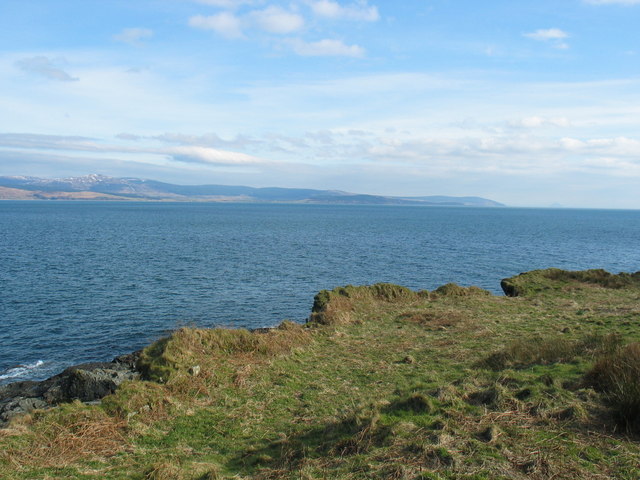
The view over Machrie Bay
The western view reaches across Machrie Bay, placing the circle in Arran’s wider coastal ritual landscape rather than on an isolated hillside.
Plan your visit
- Location
- 55.5598°N · 5.3428°W
- Nearest settlement
- Machrie
- Access
- Open access
- Terrain
- Moderate walking
- Time needed
- About 30 minutes
- Best time
- Dry daylight, when the varied red sandstone and pale granite stones can be seen against Machrie Bay.
- What survives
- Fifteen stones and the central cairn survive on a west-facing ledge above Machrie Bay.
Opening & admission
Free to visit and open all year round.
- The monument stands near Machrie on a west-facing slope above Machrie Bay.
- The 14.5-metre cairn is ringed by fifteen upright stones and is probably a kerbed burial cairn, rather than only a stone circle.
Nearby places

Sacred place · Prehistoric
Moss Farm Road Stone Circle
North Ayrshire
Moss Farm Road preserves a damaged Bronze Age: the period from about 2500 to 800 BC: stone-mound-and-circle monument within Arran’s wider Machrie M…
- Near Machrie
- Some walking

Sacred place · Prehistoric
Machrie Moor Stone Circles
North Ayrshire
Machrie Moor gathers stone circles, burials and earlier timber settings into an exceptional prehistoric (before any written account of Britain exis…
- Near Machrie
- Some walking
Building or ruin · Medieval
Airds Castle
Argyll and Bute
For a century after the Lordship of the Isles fell, this headland castle changed hands between an Ayrshire family and the MacDonalds of Dunnyveg: K…
- Near Carradale
- Rough ground

Fortified place · Iron Age
Kilpatrick Dun
North Ayrshire
Kilpatrick Dun is a substantial later Iron Age (the centuries before Rome arrived, from about 800 BC) fortified residence on Arran, with an eight-m…
- Near Blackwaterfoot
- Some walking
The setting
Near Auchagallon Stone Circle, about 25 metres away.
Photo: Sandy Gerrard / Wikimedia Commons / CC BY-SA 2.0
Near Auchagallon Stone Circle, about 131 metres away.
Photo: Trevor Littlewood / Wikimedia Commons / CC BY-SA 2.0
Questions people ask
- How many stones are at Auchagallon?
- The circle comprises fifteen blocks, ranging from 0.5 to 2.3 metres high.
- What was found in the cairn?
- Nineteenth-century antiquarians found a burial cist in the centre.
- Is it truly a stone circle?
- Although it is now called a stone circle, it was probably built as a kerbed cairn.
Sources
The Ancient Codex, in your pocket
Get the Pocket Codex app
Carry the directory with you — Auchagallon Stone Circle and thousands of ancient places across Britain and Ireland, offline, wherever you roam.