
Carved in Ogam — an alphabet devised for Irish, not Pictish, speech — the stone has anchored more than a century of scholarly argument over how far Irish influence reached into Pictish Scotland.
Straight and diagonal Ogam strokes run along one edge of the grey gneiss Lang Stane of Auquhollie, a nearly three-metre monolith rising from the south-facing slope of Meikle Carew Hill. The stone was never dressed or shaped: it was set upright with its inscription cut into the edge rather than across its face.
No record explains when the stone was raised or who cut its inscription. What is documented instead is more than a century of scholarly attention paid to those markings. In 1885 the Earl of Southesk published the first detailed study of the stone’s Ogam in the Proceedings of the Society of Antiquaries of Scotland, discussing it alongside the Brodie Stone in Moray as evidence of the same script reaching separate corners of Pictish territory. Nearly forty years later the philologist Francis C. Diack returned to the inscription, setting it within a full survey of every Ogam-carved stone then known in Scotland.
The debate those two papers opened has continued since. Irish and Scottish scholars — Eoin MacNeill, Jürgen Uhlich, Katherine Forsyth and Dauvit Broun among them — have each returned to the same handful of carved strokes, using the Auquhollie stone as evidence in a wider argument over how far Irish literacy and influence reached into Pictish Aberdeenshire. Historic Environment Scotland now records the stone as monument NO89SW 10, and the Celtic Inscribed Stones Project holds it in a database built to keep such arguments answerable to the stones themselves.
What follows is drawn from published sources, with each claim labelled by how firmly it is established.
History
No record survives of when the stone on Meikle Carew Hill was raised, or of who cut the row of notches and lines along its edge. What survives is the monolith itself, an untrimmed block of gneiss shaped only by nature, standing above the ground toward Stonehaven long before any antiquarian took an interest in its markings. In 1885 the Earl of Southesk published the first detailed study of the inscription, pairing it in the Proceedings of the Society of Antiquaries of Scotland with the Ogam-carved Brodie Stone in Moray, the two monuments treated together as evidence of the same script reaching separate parts of the Pictish north-east.
Nearly four decades later, between 1924 and 1925, the philologist Francis C. Diack returned to the stone in a paper for the same Proceedings, titled "The Old-Celtic Inscribed and Sculptured Stone at Auquhollie, Kincardineshire, and Ogam in Scotland," placing the monument within a wider survey of every known Ogam inscription in the country.
Between 1929 and 1931 the Irish scholar Eoin MacNeill examined the Auquhollie inscription's letter forms alongside other early Ogam texts in a study of archaic spellings for the Proceedings of the Royal Irish Academy, using the stone as part of the evidence for how the script had first been adapted to record Irish speech. In 1989 Jürgen Uhlich revisited the same letters in the journal Ériu, focusing on a single disputed sound value in the inscription and showing how much of the wider debate over Ogam in Scotland still turned on the reading of individual strokes cut into stones such as this one long before any consensus had been reached.
The argument reached a wider audience in 2005, when the historian Dauvit Broun cited the stone in a paper asking whether early Scotland, Alba, should be understood as a Pictish homeland or an Irish offshoot, drawing on Katherine Forsyth's then-unpublished doctoral research into Scotland's Ogam inscriptions to weigh how far Irish literacy had penetrated Pictish territory.
Today the stone is recorded by Historic Environment Scotland as monument NO89SW 10 and separately catalogued by the Celtic Inscribed Stones Project, keeping it within reach of researchers still working through the readings first proposed by Southesk and Diack more than a century ago.
People
-
Earl of Southesk
Published the first detailed study of the stone's Ogam inscription in 1885, in the Proceedings of the Society of Antiquaries of Scotland.
-
Francis C. Diack
Philologist who reassessed the inscription and its Kincardineshire context in a paper published across 1924 and 1925.
-
Eoin MacNeill
Irish scholar who examined the stone's letter forms as part of a wider study of archaic Ogam spellings between 1929 and 1931.
-
Jürgen Uhlich
Revisited the inscription's disputed letter values in a 1989 study published in the journal Ériu.
-
Dauvit Broun
Historian who cited the stone in a 2005 paper on the relationship between Pictish and Irish culture in early Scotland.
-
Katherine Forsyth
Scholar of Pictish and Ogam inscriptions whose unpublished doctoral research examined the stone.
Cultural influences
-
Ogam and Irish literacy
The inscription is part of the wider use of Ogam in early medieval Scotland, a script adapted for Irish whose presence on this Pictish stone has made it central to debates about cultural contact and literacy.
Connections
-
Brodie Stone, Moray
Studied together with the Auquhollie stone in the Earl of Southesk's 1885 paper on the Ogam inscriptions of both monuments.
-
Proceedings of the Society of Antiquaries of Scotland
Published both the Earl of Southesk's 1885 study and Francis Diack's 1924-1925 reassessment of the stone's inscription.
-
Celtic Inscribed Stones Project
Catalogues the Auquhollie stone alongside other Ogam and Celtic inscribed stones from Scotland, Ireland, Wales and the Isle of Man.
-
Historic Environment Scotland national record (Canmore)
Records the stone as monument NO89SW 10 within Scotland's national database of archaeological sites.
What to look for
-
The Ogam inscription
A row of notches and lines cut along one edge of the stone, using Ogam, an alphabet built from straight and diagonal strokes rather than conventional letters.
-
The unshaped monolith
An untrimmed block of gneiss, roughly three metres tall and three-quarters of a metre across, left in its natural rough form rather than dressed or carved.
-
Its hillside setting
Positioned on the south-facing slope of Meikle Carew Hill at about 140 metres above sea level, overlooking the surrounding Kincardineshire countryside toward Stonehaven.
Plan your visit
- Location
- 57.0053°N · 2.2897°W
- Nearest settlement
- Stonehaven
- Access
- Open access
- Terrain
- Moderate walking
- Time needed
- About 45 minutes
- Best time
- Dry, clear daylight, when the carved edge and the hillside setting can be examined safely.
- What survives
- An upright, unshaped gneiss monolith about three metres high, with Ogam cut along one edge.
- Facilities
- No visitor facilities are recorded on the hillside.
Opening & admission
No admission charge applies; check Historic Environment Scotland's website for the latest visitor information before travelling.
- The stone stands on a hillside at around 140 metres above sea level, so reaching it involves a climb over open ground.
Nearby places
Fortified place · Roman
Raedykes
Aberdeenshire
A computer model of its roughly 93-acre rampart (an encircling bank built for defence) suggests room for three legions -- some 16,000 men -- making…
- Near Stonehaven
- Some walking
Minor monument · Medieval
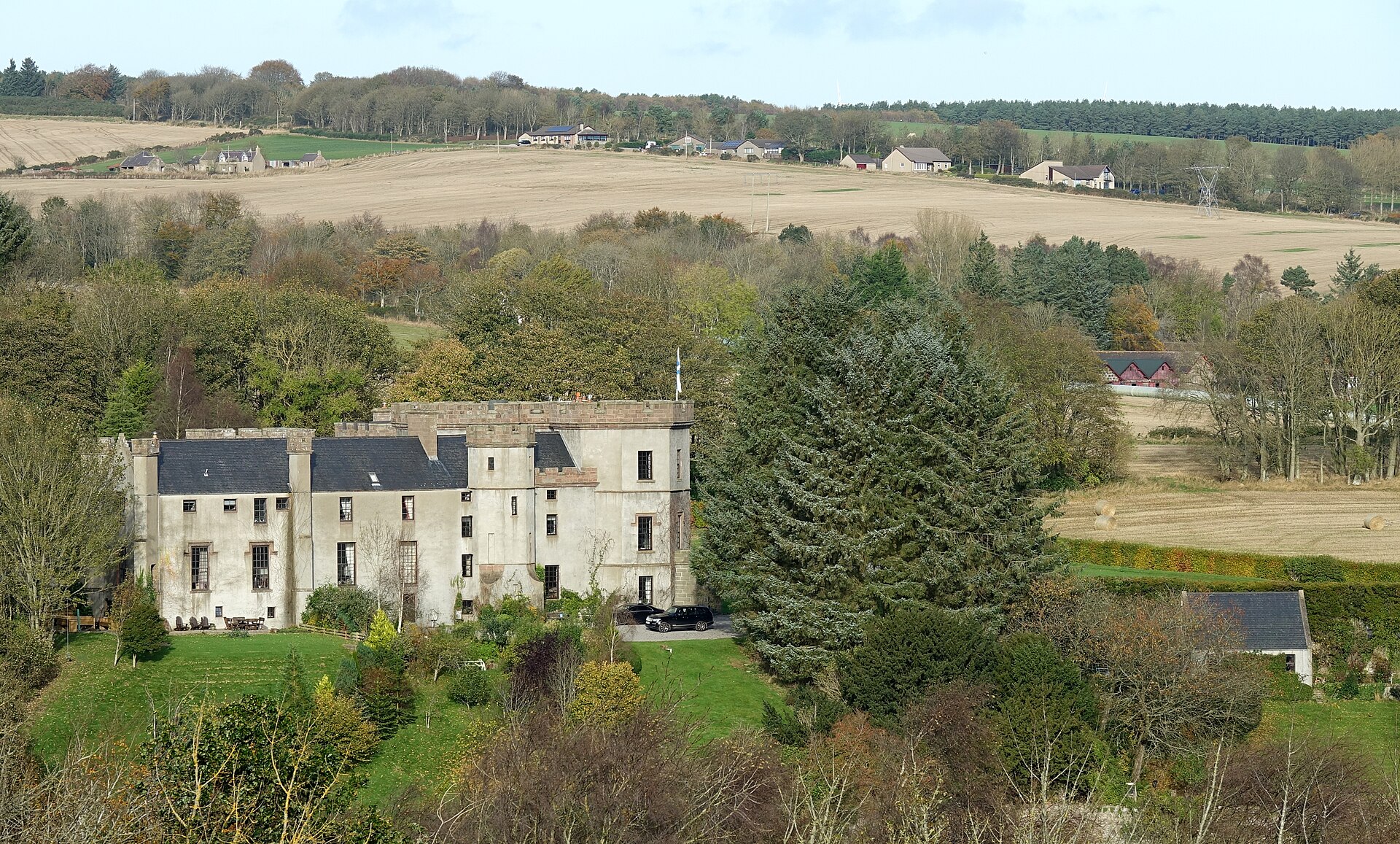
Dovecot, Fetteresso Castle
Aberdeenshire
The sixteenth-century beehive pigeon house outlasts Fetteresso Castle’s dismantling, its three rat lines preserving the working estate landscape be…
- Near Stonehaven
Carved stone · Pictish & early medieval
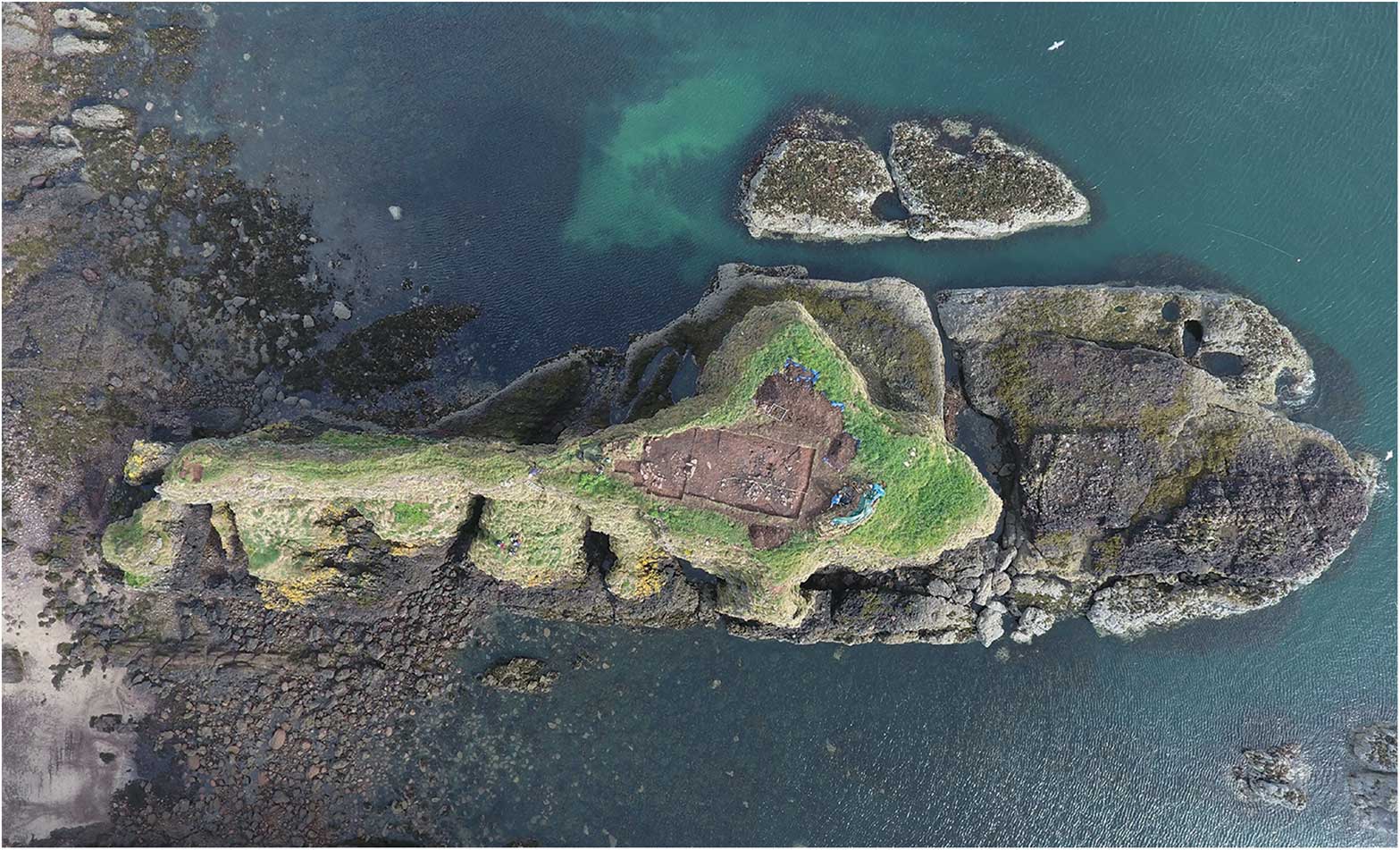
Dunnicaer
Aberdeenshire
Radiocarbon-dated rampart (the raised bank thrown up around a fortified enclosure) timbers make this eroding sea stack the earliest known Pictish (…
- Rough ground
Fortified place · Medieval
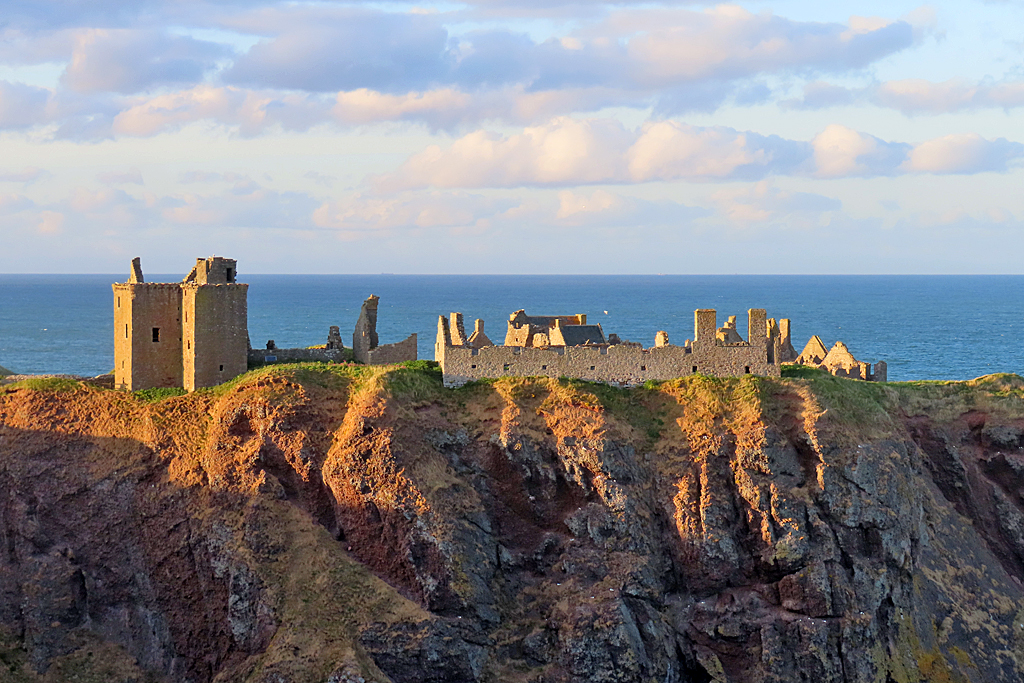
Dunnottar Castle
Aberdeenshire
The Annals of Ulster record two sieges of 'Dún Foither' in 681 and 694, possibly the earliest written references to the site; the 681 attack has be…
- Near Stonehaven
- 8 min walk from car park
The setting
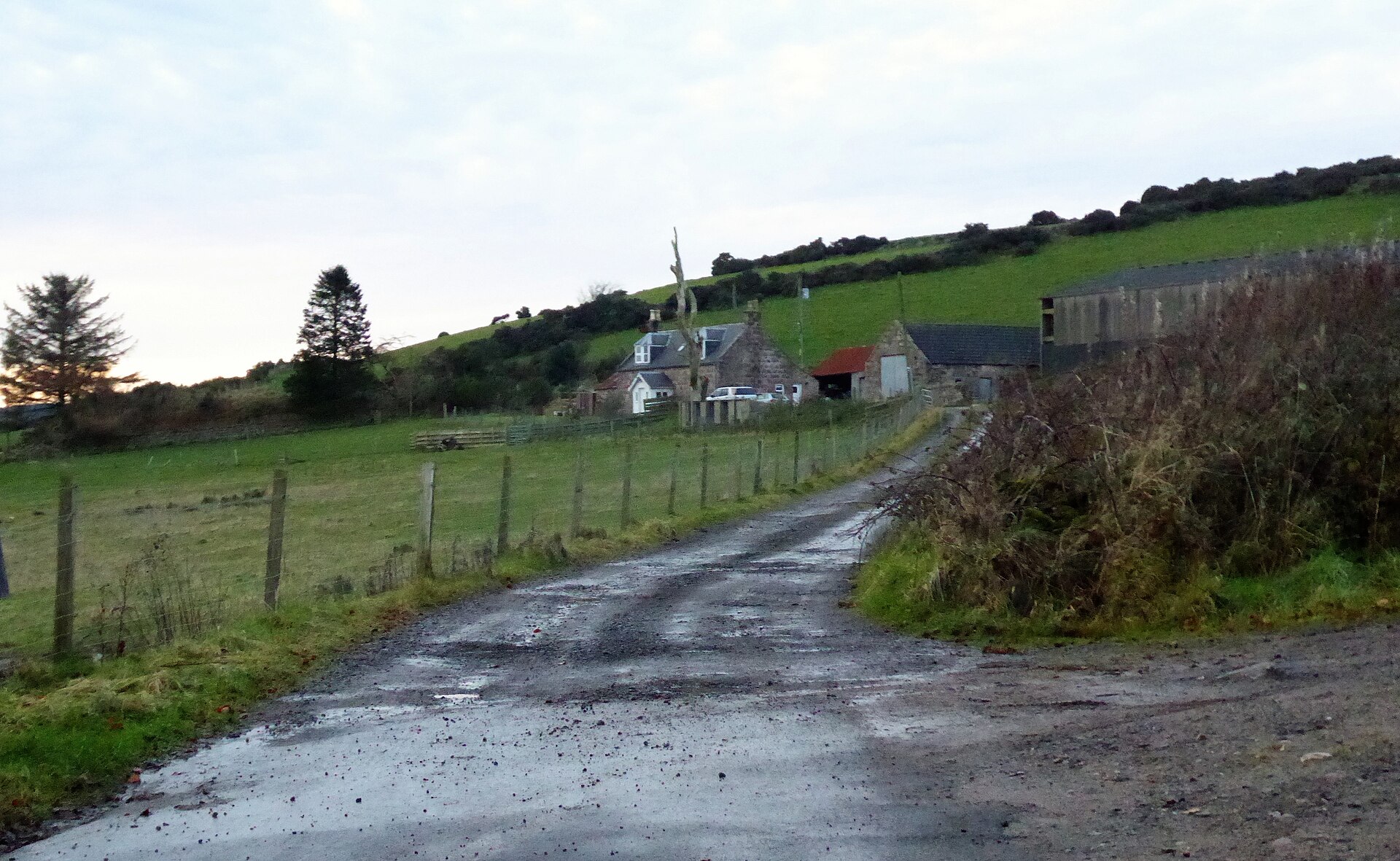
Lane and pasture by Rumbleyond Burn, near the Lang Stane of Auquhollie.
Photo: Stanley Howe / Wikimedia Commons / CC BY-SA 2.0
Pasture and Rumbleyond Burn near the Lang Stane of Auquhollie.
Photo: Stanley Howe / Wikimedia Commons / CC BY-SA 2.0
Questions people ask
- What is the Lang Stane of Auquhollie?
- An unshaped standing stone of gneiss, about three metres tall, carved with an Ogam inscription along one edge, standing on Meikle Carew Hill near Stonehaven in Aberdeenshire.
- What is Ogam?
- An early alphabet developed to write Irish, made up of straight and diagonal strokes cut along the edge of a stone rather than letters carved on its face.
- Where exactly is the stone located?
- On the south side of Meikle Carew Hill, about 140 metres above sea level, roughly six kilometres north-west of Stonehaven in Aberdeenshire.
- Why has the stone attracted scholarly attention?
- Its Ogam inscription has fed a long debate over how far Irish literacy and influence reached into Pictish Scotland, discussed from the Earl of Southesk in 1885 to Dauvit Broun in 2005.
- Is the stone officially recorded as a monument?
- Yes. Historic Environment Scotland records it as monument NO89SW 10, and it is also catalogued by the Celtic Inscribed Stones Project.
Sources
- Wikipedia: Lang Stane of Auquhollie
- Historic Environment Scotland — Canmore
- Celtic Inscribed Stones Project (CISP)
- Diack, Proceedings of the Society of Antiquaries of Scotland (1924-1925)
- Southesk, Proceedings of the Society of Antiquaries of Scotland (1885)
- Broun, "Alba: Pictish homeland or Irish offshoot?" (2005)
Explore more: Carved stones · Pictish & early medieval · Aberdeenshire
The Ancient Codex, in your pocket
Get the Pocket Codex app
Carry the directory with you — Lang Stane of Auquhollie and thousands of ancient places across Britain and Ireland, offline, wherever you roam.