Six schist slabs in a flattened ring by Loch Tay, with three cupmarks ground into the top of the northernmost.
Six upright slabs of dark grey schist stand in a pasture field south-west of Kinnell House, half a mile east of Killin at the head of Loch Tay. They form a flattened circle about ten metres across, and range from roughly 1.4 metres to 1.9 in height.
The circle is not symmetrical in effect. Its two tallest stones stand next to each other in the south-west quadrant, which gives the ring a weighted side rather than an even one — a common enough arrangement in Scottish circles, and one that is usually taken to be deliberate.
The detail worth looking for is on top of the northernmost stone: three cupmarks, small hollows ground into the rock. Cupmarks turn up on prehistoric stones in many places, and nobody has explained them to general satisfaction.
The circle is a scheduled monument.
What follows is drawn from published sources, with each claim labelled by how firmly it is established.
History
Killin Stone Circle, also called Kinnell Stone Circle, stands at the west end of Loch Tay near the village of Killin in Stirling. It is a scheduled monument, in a pasture field immediately south-west of Kinnell House about half a mile east of the village.
The circle consists of six upright slabs of dark grey schist, ranging from about 1.4 to 1.9 metres in height. They form a flattened circle roughly ten metres across, and the two tallest stand next to one another in the south-west quadrant. On the top of the northernmost stone there are three cupmarks — small hollows ground into the surface, a form of prehistoric carving that has never been satisfactorily explained.
The circle is one of the more westerly examples of a large number of stone circles in central Scotland, many of which likewise consist of six stones. It is not an isolated monument but a member of a regional group with a shared form. Its good condition may owe something to where it stands. The circle lies within the grounds of Kinnell House, which will have protected it from the agricultural clearance that removed others, and it may have been restored in the eighteenth or nineteenth century — so what is standing is not necessarily untouched.
Cultural influences
-
A central Scottish six-stone tradition
Killin belongs to a regional group of central Scottish circles, many built from six stones in the same compact form.
Connections
-

Photo: Richard Webb / Wikimedia Commons / CC BY-SA 2.0 A nearby prehistoric and early historic fortified site in the same Highland landscape.
-

Photo: Paul Hermans / Wikimedia Commons / CC BY-SA 3.0 A nearby ancient tree and historic landmark in Highland Perthshire.
Discovery & excavation
The stone circle survives as a prehistoric monument in the landscape near Killin.
What to look for
-
The six slabs
Dark grey schist, between 1.4 and 1.9 metres tall, set in a flattened circle about ten metres across.
-
The two tallest stones
Standing side by side in the south-west quadrant, which is where the circle's emphasis lies.
-
The cupmarks
Three of them ground into the top of the northernmost stone.
-
A six-stone circle among many
Central Scotland holds a large number of stone circles and a great many of them have six stones. This is one of the westerly members of that group.
Plan your visit
- Location
- 56.4653°N · 4.3120°W
- Access
- Open access
- Terrain
- Easy going
- Time needed
- About 30 minutes
- What survives
- Six dark-grey schist slabs remain upright in a flattened ten-metre circle, with cupmarks on the northern stone.
Opening & admission
The source places the circle in a pasture field near Kinnell House but gives no current visitor access or admission details.
- The circle is immediately southwest of Kinnell House.
- The monument is in a pasture field at the western end of Loch Tay.
Nearby places

Fortified place · Iron Age
Dundurn, Scotland
Perth and Kinross
The Annals of Ulster record a siege here in 683 and the death of a king in 889 - a fort of the Picts, the people of northern and eastern Scotland f…
- Near St Fillans
- Some walking

Ancient tree · Medieval
Fortingall Yew
Perth and Kinross
Fortingall Yew is a named yew tree beside the church at Fortingall in Perth and Kinross. Its precise age is not independently confirmed here.
- Near Fortingall
Sacred place · Prehistoric
Croft Moraig Stone Circle
Perth and Kinross
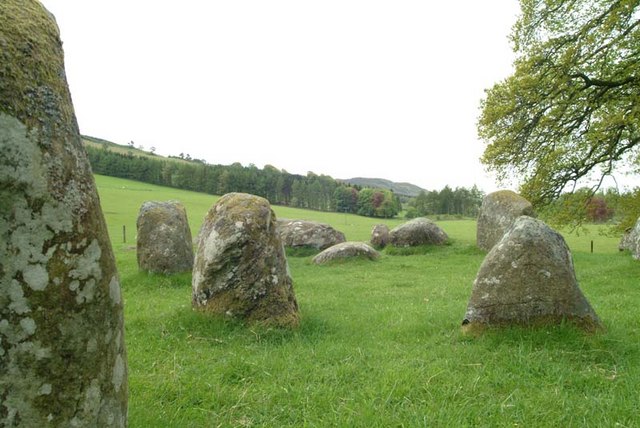
Croft Moraig is a complex multi-phase monument. Excavation in 1965 revealed three phases of construction: first a horseshoe of fourteen timber post…
- Near Kenmore
- 3.1 km from car park
- Easy path
Building or ruin · Medieval
Achallader Castle
Argyll and Bute
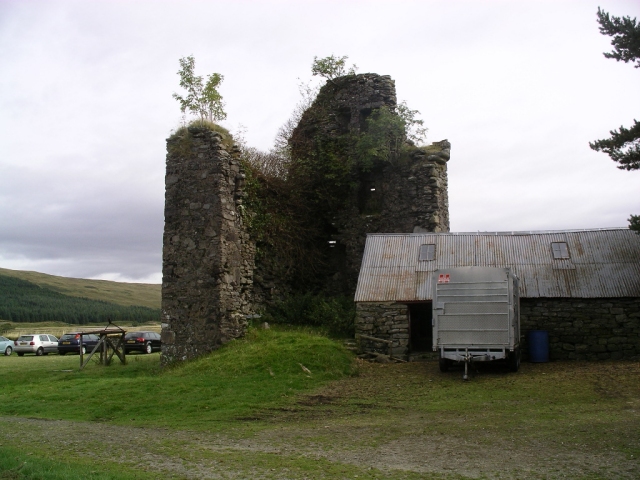
A single 1691 meeting in these ruins produced a treaty of bribes that were never paid and secret terms the negotiator later denied, brokered on the…
- Rough ground
Questions people ask
- How big is the circle?
- About ten metres across, formed of six upright slabs between roughly 1.4 and 1.9 metres tall.
- What are the cupmarks?
- Three small hollows ground into the top of the northernmost stone — a form of prehistoric carving whose purpose is unknown.
- Where is it?
- In a pasture field immediately south-west of Kinnell House, about half a mile east of Killin at the western end of Loch Tay.
- How big is the circle?
- Six upright slabs of dark grey schist, between about 1.4 and 1.9 metres high, forming a flattened circle roughly ten metres across.
- Is it in original condition?
- Not certainly. It stands in the grounds of Kinnell House, which will have sheltered it from agricultural clearance, and it may have been restored in the eighteenth or nineteenth century.
Sources
The Ancient Codex, in your pocket
Get the Pocket Codex app
Carry the directory with you — Killin Stone Circle and thousands of ancient places across Britain and Ireland, offline, wherever you roam.