
Fortingall Yew is a named yew tree beside the church at Fortingall in Perth and Kinross. Its precise age is not independently confirmed here.
A low wall built in 1785 rings the Fortingall Yew, and inside it the tree has split into several separate stems that read at first glance as a small grove rather than one trunk. They are one tree: the heartwood at the centre decayed away, and by 1770 the middle of the trunk had been reduced to ground level.
The yew stands in the churchyard at Fortingall in Perthshire and is a European yew, Taxus baccata. Its age is genuinely contested. Some estimates put it between 2,000 and 3,000 years; others suggest it may be a survival from a post-Roman Christian site and so around 1,500 years old; others again propose 5,000 to 9,000 years. Forestry and Land Scotland take it to be 5,000 years old, which would make it one of the oldest known non-clonal trees in Europe and possibly the oldest tree in Britain. The comparison usually drawn — the Norway spruce Old Tjikko in Sweden, whose root system is at least 9,500 years old — is not a like-for-like one, because that tree is clonal.
What makes the age so hard to settle is the same decay that gives the tree its present shape. The rings that would date it are simply gone from the centre. When the trunk was first recorded in writing, in 1769, its girth was measured at 52 feet, about 16 metres, and the head then stood at a height nobody recorded.
The tree has also been actively damaged. By 1833 it was noted that large arms had been removed, and even masses of the trunk carried off, to be made into drinking cups and other curiosities. The wall of 1785 was put up to protect it, and it can still be seen easily from outside.
Despite all of that the yew remains in good health and may stand for centuries yet. It is male, though one branch has begun to bear berries. Clippings have been taken to the Royal Botanic Garden Edinburgh to form part of a mile-long hedge — the Yew Conservation Hedge Project, which exists to preserve the DNA of ancient British Taxus baccata at a time when yews worldwide are threatened by felling and disease.
Its visitors are now part of the risk. In 2019 the Tree Warden for Fortingall and the coordinator of the Tayside Biodiversity Community Partnership both raised concerns that tourist activity on and around the tree was threatening its survival.
What follows is drawn from published sources, with each claim labelled by how firmly it is established.
History
The Fortingall Yew stands in the churchyard of the village of Fortingall in Perthshire, and it is generally reckoned among the oldest trees in Britain. Forestry and Land Scotland put it at five thousand years, which would make it one of the oldest non-clonal trees anywhere in Europe. That figure is one of several. Some estimates come down at two to three thousand years; another reading treats the tree as a survivor of a post-Roman Christian site and gives it about fifteen hundred; others have proposed anything up to nine thousand. Yews defeat ordinary dating because the heartwood that would carry the rings is the first part to rot away.
The trunk was first recorded in writing in 1769, when its girth was measured at 52 feet, or 16 metres. Nothing of that size survives today. The heartwood decayed and the centre of the trunk went entirely, leaving the outer stems standing separately. That decay is why the tree now reads at first glance as a small grove rather than as one plant. The stems around the empty middle are all parts of a single yew, and the space between them marks where the trunk used to be.
A low wall was built around the tree in 1785, after a long period in which visitors had been cutting pieces from it for souvenirs and for tinder. Enclosing an ancient tree to protect it from admirers is an early instance of a problem heritage sites still have. The yew is male, but one branch has begun to bear berries — an unusual and well-documented change in a species whose trees are normally one sex or the other throughout.
People
-
James MacGregor
16th-century minister at the Fortingall church and author of the Book of the Dean of Lismore.
Cultural influences
-
The yew may have formed the focus of an Iron Age cult place later Christianised in the Early Middle Ages, and its genetic material is now conserved through the Yew Conservation Hedge Project.
Connections
-
Fortingall Yew
The entry records Fortingall Yew as a distinct feature within its named landscape.
-
Fortingall Church
The yew stands within Fortingall Church’s churchyard, where the historic Christian setting frames the tree and its separate surviving stems.
Discovery & excavation
The tree’s 16-metre girth was first recorded in 1769; in 2015 scientists identified a small branch on the otherwise male tree that had begun to bear berries.
In culture
-
Clippings from the yew were used in the Royal Botanic Garden Edinburgh’s Yew Conservation Hedge Project, preserving DNA from ancient British yews.
What to look for
-
Recorded identity
The girth recorded in 1769, and the empty middle where that trunk used to stand, are the two things this tree can be measured against.
What is said
Folklore and tradition, recorded as what is said — not as established fact.
-
Local legend says Pontius Pilate was born in the yew’s shade and played there as a child, an account described by a historian as an embellished myth.
Plan your visit
- Location
- 56.5981°N · 4.0509°W
- Nearest settlement
- Fortingall
- Access
- Reached on a public path
- What survives
- Living-tree condition and access should be checked against current local guidance before any visit copy is expanded.
Nearby places
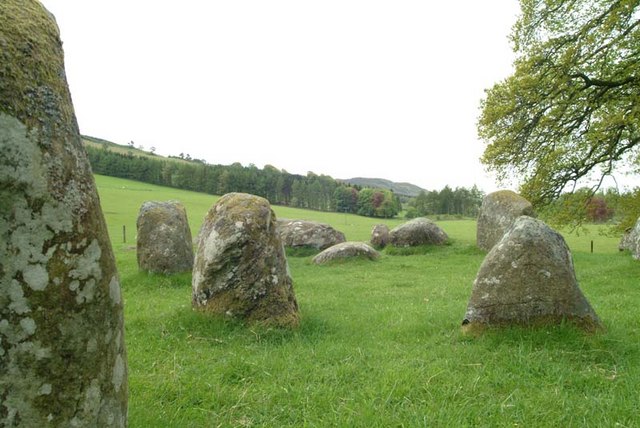
Sacred place · Prehistoric
Croft Moraig Stone Circle
Perth and Kinross
Croft Moraig is a complex multi-phase monument. Excavation in 1965 revealed three phases of construction: first a horseshoe of fourteen timber post…
- Near Kenmore
- 3.1 km from car park
- Easy path

Fortified place · Medieval
Castle Menzies
Perth and Kinross
A sixteenth-century Z-plan seat of the Menzies chiefs, sold off in pieces after 1910 and bought back by the clan society half a century later.
- Near Weem
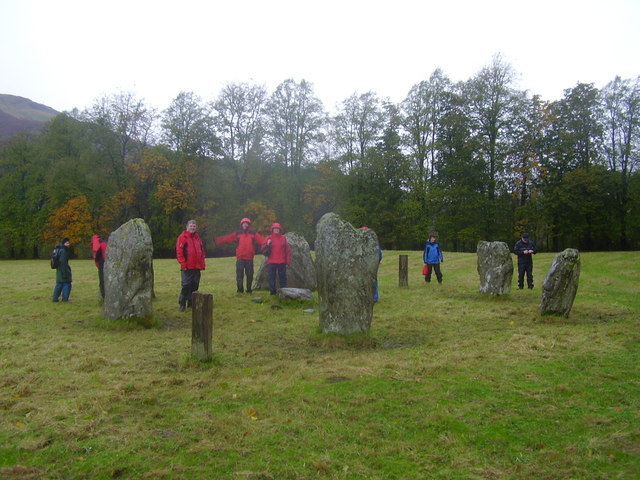
Sacred place · Prehistoric
Killin Stone Circle
Stirling
Six schist slabs in a flattened ring by Loch Tay, with three cupmarks ground into the top of the northernmost.
- Easy path

Fortified place · Medieval
Blair Castle
Perth and Kinross
The ancestral home of Clan Murray and historic seat of the Dukes of Atholl.
- Near Blair Atholl
The setting
Near Fortingall Yew, about 0 metres away.
Photo: Euan Nelson / Wikimedia Commons / CC BY-SA 2.0
Near Fortingall Yew, about 0 metres away.
Photo: Euan Nelson / Wikimedia Commons / CC BY-SA 2.0
Near Fortingall Yew, about 0 metres away.
Photo: Jim Barton / Wikimedia Commons / CC BY-SA 2.0
Near Fortingall Yew, about 10 metres away.
Photo: Richard Sutcliffe / Wikimedia Commons / CC BY-SA 2.0
Near Fortingall Yew, about 10 metres away.
Photo: Julian Paren / Wikimedia Commons / CC BY-SA 2.0
Near Fortingall Yew, about 10 metres away.
Photo: Colin Park / Wikimedia Commons / CC BY-SA 2.0
Questions people ask
- Why does the yew look like several trees?
- It is one tree. The heartwood at the centre decayed away, and by 1770 the middle of the trunk had gone entirely, leaving the surviving outer stems standing apart.
- What is the wall around it?
- A low enclosing wall built in 1785 to protect the tree, which had been suffering from souvenir-taking.
- How old is it?
- No reliable figure can be given. Yews of this kind resist dating because the heartwood that would carry the rings is the first part to go.
Sources
The Ancient Codex, in your pocket
Get the Pocket Codex app
Carry the directory with you — Fortingall Yew and thousands of ancient places across Britain and Ireland, offline, wherever you roam.