
A sixteenth-century Z-plan seat of the Menzies chiefs, sold off in pieces after 1910 and bought back by the clan society half a century later.
In 1913 the contents of Castle Menzies were auctioned. The following year the family papers went to Sotheby’s, where a letter written by Mary Queen of Scots in 1566 fetched £300 and a set of proposals signed by Charles I at Holmby in 1647 fetched £56. In 1918 the castle itself and 11,600 acres of estate went for £69,000. Sir Neil Menzies, 8th Baronet, had died without heirs in 1910, and within eight years the seat his family had held for over five hundred years had been sold off in three separate lots.
The castle stands a little west of Weem, near Aberfeldy, close to the site of the Weem Castle destroyed around 1502 that it replaced. It was built in the sixteenth century to a Z-plan — a central block with towers at diagonally opposite corners, so that each tower could rake two faces of the main range. Charles McKean placed it as an example of the architectural transition between the older tradition of rugged fortresses and the later one of lightly defensible chateaux, which is a fair description of a building that has the shape of a fortification and the windows of a house.
The walls are random rubble, originally harled with roughcast, but the quoins, the turrets and the surrounds of the doors and windows are cut from finely carved blue freestone. The stone weathers extremely hard, and the same quarry supplied the architectural detail and monuments at the nearby Old Kirk of Weem, which the Menzies family built and where their monuments and funeral hatchments still hang.
Above the original entrance is a marriage stone installed by James Menzies in 1371, recording his marriage to Barbara Stewart, daughter of the 3rd Earl of Atholl. It is nearly two centuries older than the wall it is set into.
Being strategically placed in the Highlands meant being involved in Highland history, generally against the household’s wishes. In 1598 John Dow MacWilliam, alias MacGregor, broke in to free a thief called Donald Menzies from the dungeons; Alexander Menzies of Weem then had the further indignity of complaining that John Murray of Tullibardine had taken in both the thief and his rescuer as household servants. In 1746 Bonnie Prince Charlie rested here two nights on his way north to Culloden.
Two later residents are worth knowing about. In 1840 an entirely new wing went up, designed by William Burn and built from the same quarry on the south side of Loch Tay as the original — which is why the Victorian work sits so quietly against the sixteenth-century. And from 1855 to 1858 the castle housed Duleep Singh, last maharajah of the Sikh Empire, exiled from the Punjab the year before and formally the ward of Sir John Spencer Login and Lady Login, who took the lease for him. A deposed Indian sovereign spent three years of his childhood in a Perthshire tower house.
The castle nearly burned in 1878. A man passing on the road spotted fire in the roof at about seven on a Sunday evening; local effort had it almost out by ten, when the engine finally arrived from Taymouth Castle. Sir Robert and Lady Menzies were away at Farleyer and hurried back. The excitement was held to have affected Lady Menzies’s health, and she died the following month.
What saved the place was the clan. The Menzies Clan Society took it on and began restoration after 1957, work that started in earnest in 1972 with a £40,000 project part-funded by a £10,000 grant from the Historical Buildings Council. It ran nearly ten years under Dr Bill Dewar and got the building open to the public. A further grant of £135,900 came in 1991 towards a £230,000 final phase on the Victorian west wing, which produced the ballroom now called the Dewar Room. The restoration meant pulling down a badly decayed eighteenth-century wing; the large Victorian ballroom was kept. The Menzies Charitable Trust was set up in 1994 to look after the castle, the walled garden and the Old Kirk of Weem.
The castle was designated Category A listed in 1971 and the grounds were added to the Inventory of Gardens and Designed Landscapes in Scotland in 1987. In front of the building sits a lifting stone of 115 kilograms known as the Chieftain’s Stone, or the Menzies Stone, open to anyone who cares to try it. By the standards of Scottish lifting stones it is not especially heavy. It is round and it is smooth, and that defeats most people who attempt it.
What follows is drawn from published sources, with each claim labelled by how firmly it is established.
History
A marriage stone above the original entrance was installed by James Menzies in 1371 to record his marriage to Barbara Stewart, daughter of John Stewart, 3rd Earl of Atholl, and Jean Forbes. It sits above the door of a building raised long after the wedding it commemorates. The sixteenth-century castle was built to a Z-plan — a central block with towers set at diagonally opposite corners, so that each tower could cover two faces of the main range with fire. It was the seat of the chiefs of Clan Menzies for over five hundred years.
In 1598 John Dow MacWilliam, alias MacGregor, broke into the castle to free a thief named Donald Menzies from the dungeons. The owner, Alexander Menzies of Weem, complained that John Murray of Tullibardine had then taken in both the escaped man and his rescuer as household servants. Bonnie Prince Charlie rested two nights at the castle in 1746 on his way to Culloden. The stop is recorded without further detail; what it establishes is that the Menzies seat lay on the road the rising took north.
An entirely new wing was added in 1840, designed by William Burn using stone from the same quarry on the south side of Loch Tay as the original work. Matching the quarry rather than merely the colour is the reason the Victorian addition does not read as an intrusion. Duleep Singh, the last maharajah of the Sikh Empire, lived at Castle Menzies between 1855 and 1858 after his exile from the Punjab in 1854. He was formally the ward of Sir John Spencer Login and Lady Login, who leased the castle for him.
Fire broke out in the roof at about seven in the evening on Sunday 21 April 1878, spotted by a man passing along the road. Local effort had it nearly out by ten, when the fire engine arrived from Taymouth Castle. Lady Menzies, who had hurried back from Farleyer, was thought to have been affected by the excitement and died the following month.
Sir Neil Menzies, 8th Baronet, inherited in 1903 and died without heirs in 1910. The contents were auctioned in 1913 and the papers sold at Sotheby's in 1914 for £1,160 — a letter of Mary Queen of Scots dated 31 August 1566 fetched £300, and proposals signed by Charles I at Holmby in 1647 fetched £56. The castle and 11,600 acres followed in 1918 for £69,000.
People
-
James Menzies
Placed the 1371 marriage stone above the entrance to record his marriage to Barbara Stewart.
-
Duleep Singh
The last maharajah of the Sikh Empire, who lived here in exile from 1855 to 1858.
-
Bonnie Prince Charlie
Stayed at Castle Menzies for two nights in 1746 on his way to Culloden.
Cultural influences
-
The sixteenth-century central block and diagonal towers allowed each tower to cover two faces of the castle.
Connections
-

Photo: Eusebius / Wikimedia Commons / CC BY 3.0 Government troops occupied Castle Menzies and Blair Castle during the 1746 Jacobite campaign to secure the Tay crossing and the Atholl region.
-
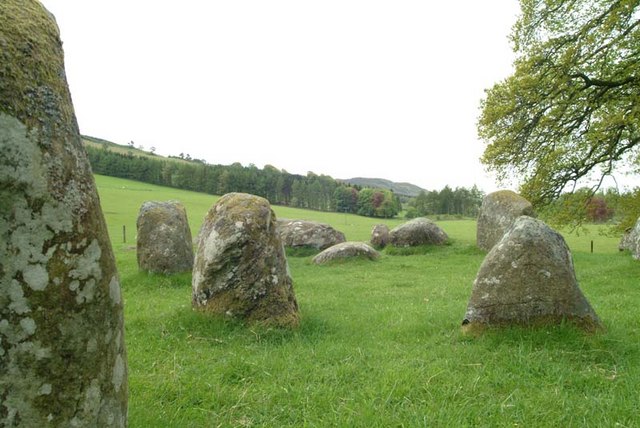
Photo: Dave Farmer / Wikimedia Commons / CC BY-SA 2.0 The castle and stone circle represent different periods of monument building and power in the Highland landscape around the Tay valley.
-

Photo: Paul Hermans / Wikimedia Commons / CC BY-SA 3.0 The Menzies family’s historic territory around Fortingall connects Castle Menzies with the older Highland landscape and its long-standing traditions.
Discovery & excavation
The marriage stone above the original entrance preserves a 1371 family record that predates the sixteenth-century castle itself.
What to look for
-
The 1371 marriage stone
Set above the original entrance by James Menzies to record his marriage to Barbara Stewart. It predates the castle it stands on by nearly two centuries.
-
The blue freestone dressings
The walls are random rubble, originally harled with roughcast, but the quoins, turrets and door and window surrounds are finely carved blue freestone — a hard-weathering stone also used at the nearby Old Kirk of Weem.
-
The Chieftain's Stone
A historic lifting stone weighing 115 kilograms sits in front of the castle, open to anyone who wants to try it. It is not among the heavier stones, but its round shape and smooth surface defeat experienced lifters.
-
The retained Victorian ballroom
Restoration meant demolishing a badly decayed eighteenth-century wing, but the large Victorian ballroom was kept — a decision about which layer of the building's history was worth saving.
Plan your visit
- Location
- 56.6239°N · 3.8971°W
- Nearest settlement
- Weem
- Time needed
- About 60 minutes
- Best time
- Daylight hours
- What survives
- A restored sixteenth-century Z-plan clan seat with its marriage stone, blue freestone dressings, Victorian ballroom and Chieftain’s Stone.
Opening & admission
Castle Menzies is a public visitor attraction during its open season; current dates, admission and access arrangements should be confirmed directly with the castle before travel.
- The official site identifies an open season from April through early November, with the remainder of the year described as closed season.
- Public visitors are normally admitted until 16:30 and usually leave by 17:30; events and private hire can restrict access to parts or all of the castle.
Nearby places
Sacred place · Prehistoric
Croft Moraig Stone Circle
Perth and Kinross
Croft Moraig is a complex multi-phase monument. Excavation in 1965 revealed three phases of construction: first a horseshoe of fourteen timber post…
- Near Kenmore
- 3.1 km from car park
- Easy path

Ancient tree · Medieval
Fortingall Yew
Perth and Kinross
Fortingall Yew is a named yew tree beside the church at Fortingall in Perth and Kinross. Its precise age is not independently confirmed here.
- Near Fortingall

Fortified place · Medieval
Blair Castle
Perth and Kinross
The ancestral home of Clan Murray and historic seat of the Dukes of Atholl.
- Near Blair Atholl
.jpg?width=800)
Ancient tree · Medieval
Neil Gow's Oak
Perth and Kinross
A bench beneath this oak was engraved with a line from a Michael Marra song about sitting under it with Niel Gow's ghost. A falling branch destroye…
- Near Dunkeld
Questions people ask
- What is a Z-plan castle?
- A central block with towers at diagonally opposite corners, so each tower commands two faces of the main range. Castle Menzies is a sixteenth-century example, and Charles McKean treats it as a transition between the older rugged fortress and the lighter, barely defensible chateau.
- Who was Duleep Singh?
- The last maharajah of the Sikh Empire, exiled from the Punjab in 1854. He lived at Castle Menzies from 1855 to 1858 as the ward of Sir John Spencer Login and Lady Login, who leased the castle for him.
- Did Bonnie Prince Charlie stay here?
- Yes, for two nights in 1746 on his way to Culloden.
- Who owns it now?
- The Menzies Charitable Trust, established in 1994 to look after the castle, the walled garden and St Cuthbert's Old Kirk of Weem. The Menzies Clan Society began restoring the castle after 1957 and it is open to the public.
Sources
- Canmore site 25670
- Wikipedia: Castle Menzies
- Wikipedia: Castle Menzies
- Historic Environment Scotland — Castle Menzies designed landscape (accessed 2026-08-30)
- Siege of Blair Castle (accessed 2026-08-30)
Explore more: Fortified places · Medieval · Perth and Kinross
The Ancient Codex, in your pocket
Get the Pocket Codex app
Carry the directory with you — Castle Menzies and thousands of ancient places across Britain and Ireland, offline, wherever you roam.