The ancestral home of Clan Murray and historic seat of the Dukes of Atholl.
Lord John Murray besieged his own home. In July 1689 his father’s factor, Patrick Stewart of Ballechin, was holding Blair Castle for King James and refused the heir entry, and Murray sat down outside the walls of the house he was due to inherit. General Mackay was coming up to join him and take the place for William. Viscount Dundee relieved it instead, and rather than retreat and hand it over he stood and fought at Killiecrankie — a battle brought on by a castle, in which the Jacobites won and Dundee was killed.
The place was contentious from the start. Blair is said to have been begun in 1269 by John Comyn, Lord of Badenoch, who put up a tower on his neighbour’s land while the Earl of Atholl was away on crusade. The earl came home, complained to Alexander III, got his ground back, and built the interloper’s tower into his own castle.
After that it passed by forfeiture and royal grant for two centuries — David Strathbogie lost it for rebelling against Bruce in 1308, James II gave the earldom to his half-brother in 1457 — until John Murray was created Earl of Atholl in 1629. It has been Murray ground ever since, through Cromwell’s army taking it in 1650, a marquessate at the Restoration and a dukedom in 1703.
It stands in Glen Garry commanding the main route through the central Highlands, now the A9. It is category A listed, and its grounds are on the national inventory of significant gardens.
What follows is drawn from published sources, with each claim labelled by how firmly it is established.
History
The castle is said to have begun in 1269 with an act of trespass. John I Comyn, Lord of Badenoch, started building on the land of his neighbour David I Strathbogie, Earl of Atholl, while the earl was away on crusade. On returning, Strathbogie complained to Alexander III, recovered his land, and simply incorporated Comyn's tower into a castle of his own.
David II Strathbogie forfeited the titles and estates after rebelling against Robert the Bruce in 1308, and the king granted them to Niall mac Cailein. The earldom then passed through a succession of hands until 1457, when James II gave it to his half-brother John Stewart. John Murray, son of the second Earl of Tullibardine, was created Earl of Atholl in 1629, and the title has stayed with the Murrays since.
The Murrays backed the Royalist cause in the Wars of the Three Kingdoms, and Blair was taken by Cromwell's army after the invasion of 1650. At the Restoration Charles II created John Murray, 2nd Earl, Marquess of Atholl, and the dukedom followed for the 2nd Marquess in 1703.
The first Jacobite rising split the household. When Viscount Dundee rose in April 1689 Atholl stayed loyal to the government, though two of his sons went out for the Jacobites, and his own factor, Patrick Stewart of Ballechin, held the castle for King James. In July Ballechin refused entry to Atholl's whiggish heir, Lord John Murray, who then laid siege to his own family seat.
That siege caused the battle of Killiecrankie. General Mackay was marching to join Murray and take the castle for the Williamites; Dundee relieved it, and fought rather than retreat and give it up. He held a council of war with his officers and clan chiefs in the castle on the eve of the battle, 26 July 1689. The Jacobites won the next day and Dundee was killed. Blair stayed in Jacobite hands for some while afterwards and went on mattering. In August the Jacobite Highland chiefs swore a bond together at the castle to continue the rising.
People
-
John I Comyn
Lord of Badenoch who began a tower on disputed Atholl land in 1269 while Earl David Strathbogie was away on crusade.
-
David I Strathbogie
Earl of Atholl who recovered his land after 1269 and incorporated John Comyn’s unfinished tower into Blair Castle.
-
John Murray
Created Earl of Atholl in 1629, beginning the Murray family’s enduring association with Blair and the Atholl title.
Cultural influences
-
A castle at the centre of Atholl power
Blair was repeatedly shaped by the contest for the Atholl earldom and by Jacobite and government conflict, including the 1689 events before Killiecrankie.
Connections
-

Photo: Anne Burgess / Wikimedia Commons / CC BY-SA 2.0 Both are major Highland castles, preserving different expressions of medieval and early-modern aristocratic residence in Perthshire.
-
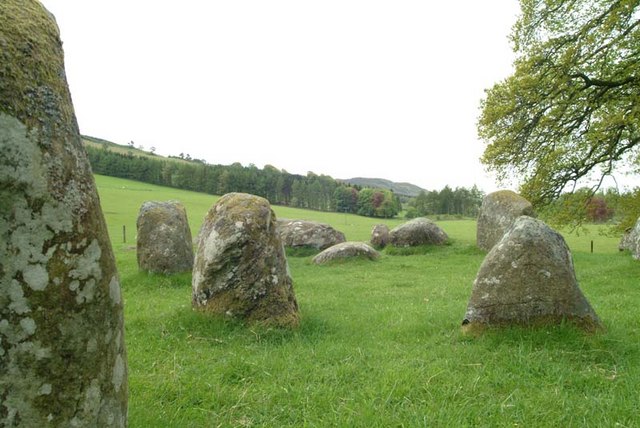
Photo: Dave Farmer / Wikimedia Commons / CC BY-SA 2.0 The castle and stone circle represent different periods of monument building in the Highland landscape around the Tay valley.
-

Photo: Paul Hermans / Wikimedia Commons / CC BY-SA 3.0 The castle and ancient yew are landmarks in the same long-occupied Highland landscape, linking later estate power with older tradition.
Discovery & excavation
A standing-building survey recorded Blair Castle’s South Wing in July 2021 before refurbishment. It documented the wing’s successive alterations and recommended photographing any architectural elements newly exposed during the works.
What to look for
-
Comyn’s first tower
The castle began with John Comyn’s 1269 tower, incorporated by David Strathbogie after the Atholl land dispute was resolved.
-
The Killiecrankie council
Jacobite officers and clan chiefs met at Blair on 26 July 1689, before Dundee relieved the siege and fought at Killiecrankie.
-
The Murray stronghold
Blair remained the Atholl seat through Royalist, Jacobite and government conflicts, with the Murray family holding the title from 1629.
Plan your visit
- Location
- 56.7734°N · 3.8575°W
- Nearest settlement
- Blair Atholl
- Time needed
- About 90 minutes
- What survives
- The castle preserves a medieval core begun in 1269 and later additions associated with the Earls and Dukes of Atholl.
Nearby places

Fortified place · Medieval
Castle Menzies
Perth and Kinross
A sixteenth-century Z-plan seat of the Menzies chiefs, sold off in pieces after 1910 and bought back by the clan society half a century later.
- Near Weem
Sacred place · Prehistoric
Croft Moraig Stone Circle
Perth and Kinross
Croft Moraig is a complex multi-phase monument. Excavation in 1965 revealed three phases of construction: first a horseshoe of fourteen timber post…
- Near Kenmore
- 3.1 km from car park
- Easy path

Ancient tree · Medieval
Fortingall Yew
Perth and Kinross
Fortingall Yew is a named yew tree beside the church at Fortingall in Perth and Kinross. Its precise age is not independently confirmed here.
- Near Fortingall
.jpg?width=800)
Ancient tree · Medieval
Neil Gow's Oak
Perth and Kinross
A bench beneath this oak was engraved with a line from a Michael Marra song about sitting under it with Niel Gow's ghost. A falling branch destroye…
- Near Dunkeld
Questions people ask
- How did the castle begin?
- With an act of trespass, it is said. In 1269 John I Comyn, Lord of Badenoch, started building on the land of his neighbour David I Strathbogie, Earl of Atholl, while the earl was away on crusade. Strathbogie returned, complained to Alexander III, recovered his land and simply took Comyn's work into his own.
- How did the Murrays come by it?
- The Strathbogie titles and estates were forfeited after David II rebelled against Robert the Bruce in 1308, and Robert granted them to Niall mac Cailein. The earldom then changed hands repeatedly until 1457, when James II gave it to his half-brother John Stewart.
- What part did the castle play at Killiecrankie?
- General Mackay was marching to take it for the Williamites when Viscount Dundee relieved it and chose to fight rather than retreat and give it up. Dundee held his council of war with officers and clan chiefs in the castle on the eve of the battle, 26 July 1689.
Sources
The Ancient Codex, in your pocket
Get the Pocket Codex app
Carry the directory with you — Blair Castle and thousands of ancient places across Britain and Ireland, offline, wherever you roam.