
A bench beneath this oak was engraved with a line from a Michael Marra song about sitting under it with Niel Gow's ghost. A falling branch destroyed the bench in 2012.
A bench once stood beneath this oak, engraved with a line from a Michael Marra song — “sit beneath the fiddle tree, with the ghost of Niel Gow next to me”. In 2012 a storm brought down branches from the tree above it and destroyed the bench. A replacement was unveiled the following March by Marra’s widow.
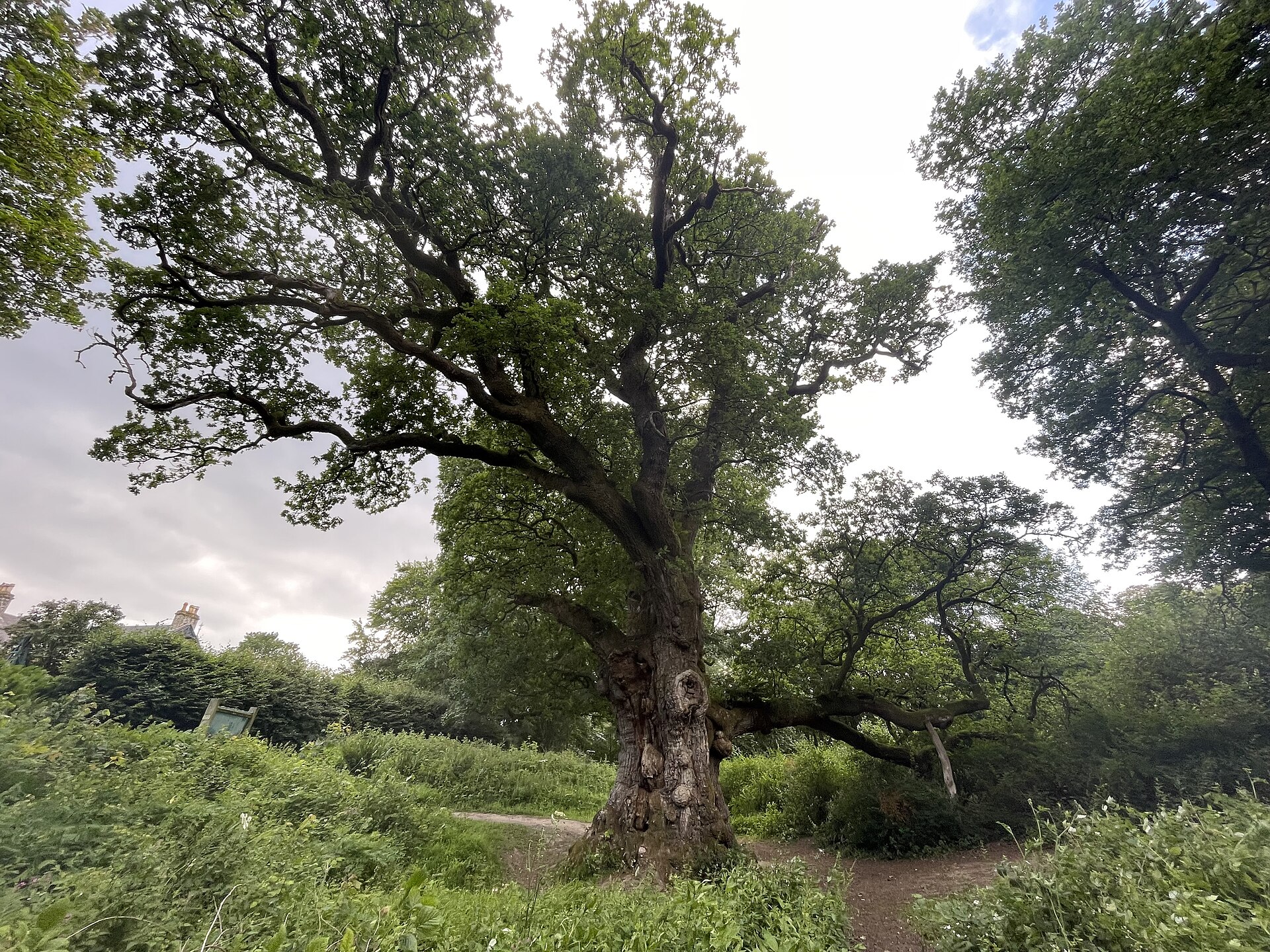
The oak is a sessile oak of around three hundred years, growing within Craigvinean Forest on the south bank of the River Tay, between Dunkeld and Birnam. It lies on the Inver Walk footpath, part of the Dunkeld Path Network, in a field grazed by sheep and horses, with the path on one side and the riverbank on the other.
Niel Gow lived from 1727 to 1807 in nearby Inver and composed a large body of Scottish country dance tunes. He is said to have sat beneath this tree to write many of his best-known pieces. The claim is old rather than recent: it appears in print in the Illustrated London News in 1855, less than fifty years after Gow’s death, and again in a journal article of 1881. Whatever its truth, it was not invented by the tourist trade.
One story attached to the tree explains how Gow came to be paid for what he played there. His music, carrying from the tree across the water, is said to have reached John Murray, 4th Duke of Atholl, on the far bank of the Tay. The duke was impressed enough to put Gow on a retainer to play at family functions. A habit of composing outdoors turned, in that telling, into employment.
The Forestry Commission owns both the tree and the ground it stands on, and it was the Commission that installed the original engraved bench in recognition of the connection. The tree has had a difficult recent history: it was badly damaged by a storm in December 2011, and struck again in 2012 when the falling branches took the bench with them.
It has nonetheless been repeatedly put forward as a tree worth notice. In 2014 it became the first Scottish entry in the European Tree of the Year competition, finishing seventh out of ten with 1,740 votes, and in 2016 it reached the six-strong shortlist for Scotland’s Tree of the Year.
What follows is drawn from published sources, with each claim labelled by how firmly it is established.
History
Niel Gow lived from 1727 to 1807 at Inver, close to this tree, and composed a great many Scottish country dance tunes. He is said to have sat beneath the oak to write some of his best-known music, and the tree has carried his name ever since. The link between the fiddler and the tree can be traced in print to at least 1855, when it appeared in an article in the Illustrated London News. It was repeated in a journal article of 1881, so the association was already well established within fifty years of Gow's death rather than being a modern invention.
The story goes that Gow's playing beneath the tree carried across the Tay to the far bank, where John Murray, 4th Duke of Atholl, heard it. The duke is said to have been sufficiently impressed to pay Gow a retainer to play at family functions, which turned an informal habit into paid employment. The Forestry Commission, which owns the tree and the land it stands on, put a bench beneath it in recognition of the connection. It was engraved with the words "sit beneath the fiddle tree, with the ghost of Niel Gow next to me", taken from the song "Niel Gow's Apprentice" by the Scottish singer-songwriter Michael Marra.
A storm in December 2011 badly damaged the tree, and a second storm in 2012 brought down branches that destroyed the carved bench beneath it. A replacement bench was unveiled on 25 March 2013 by Michael Marra's widow, some months after his death. In 2014 the oak was entered for the European Tree of the Year award, the first Scottish entry in that competition. It finished seventh of ten with 1,740 votes, and in 2016 it made the six-strong shortlist for Scotland's Tree of the Year.
People
-
Niel Gow
Scottish fiddler and composer, 1727 to 1807, who lived at nearby Inver and is said to have composed beneath the tree.
-
John Murray, 4th Duke of Atholl
Said to have heard Gow playing from the far bank of the Tay and paid him a retainer to play at family functions.
-
Michael Marra
Scottish singer-songwriter whose song "Niel Gow's Apprentice" supplied the line engraved on the bench beneath the tree.
Cultural influences
-
Scottish fiddle music
The oak preserves the long-standing association with Niel Gow, whose Scottish country-dance tunes form a major part of the nation’s fiddle-music tradition.
Connections
-
Inver, Perth and Kinross
Niel Gow's home village, close enough to the tree that he is said to have walked out to it to compose.
-
River Tay
The oak stands between the Inver Walk footpath and the riverbank; Gow's playing is said to have carried across the water to the Duke of Atholl.
-
Craigvinean Forest
The tree lies within the forest, on its south-bank edge, on land owned by the Forestry Commission.
In culture
-
Niel Gow's Apprentice
Michael Marra's song supplied the line "sit beneath the fiddle tree, with the ghost of Niel Gow next to me", engraved on the Forestry Commission bench beneath the oak.
What to look for
-
The bench and its inscription
The replacement bench, unveiled in March 2013, stands where the original engraved one was destroyed by a falling branch the year before.
-
The plaque
A plaque marks the connection between the tree and Niel Gow, alongside the engraved bench.
-
The riverbank position
The oak lies between the Inver Walk path and the bank of the Tay, in a field grazed by sheep and horses.
What is said
Folklore and tradition, recorded as what is said — not as established fact.
-
Music across the Tay
A local story says Gow’s playing beneath the oak carried across the River Tay to John Murray, 4th Duke of Atholl, who then put him on a retainer.
Plan your visit
- Location
- General area near Dunkeld, Perth and Kinross
- Nearest settlement
- Dunkeld
- Access
- Reached on a public path
- What survives
- Living-tree condition and access should be checked against current local guidance before any visit copy is expanded.
This is a sensitive or fragile site, so we show only its general area. Please check official heritage sources for access before visiting, and take care not to disturb it.
Nearby places

Sacred place · Medieval
Dunkeld Cathedral
Perth and Kinross
A cathedral begun in 1260 and finished in 1501, standing on a Columban monastery whose reused red sandstone still shows as a streak across the east…
- Near Dunkeld
Ancient tree · Medieval
Birnam Sycamore
Perth and Kinross
Birnam Sycamore stands near Birnam Oak on the south bank of the River Tay and is associated with the surviving edge of Birnam Wood.
- Near Birnam

Ancient tree · Medieval
Birnam Oak
Perth and Kinross
Birnam Oak, sometimes known as Macbeth's Oak, stands on the south bank of the River Tay and is associated with the surviving edge of Birnam Wood.
- Near Birnam

Ancient tree
Lady's Tree
Perth and Kinross
An osprey called Lady nested in this Scots pine for twenty-four years, laid 71 eggs and raised 50 chicks. The tree is named after the bird.
- Near Perth and Kinross
The setting
Near Neil Gow's Oak, about 130 metres away.
Photo: Rob Burke / Wikimedia Commons / CC BY-SA 2.0
Near Neil Gow's Oak, about 70 metres away.
Photo: Les Hull / Wikimedia Commons / CC BY-SA 2.0
Near Neil Gow's Oak, about 76 metres away.
Photo: Gordon Hatton / Wikimedia Commons / CC BY-SA 2.0
Near Neil Gow's Oak, about 100 metres away.
Photo: Gordon Hatton / Wikimedia Commons / CC BY-SA 2.0
Near Neil Gow's Oak, about 106 metres away.
Photo: M J Richardson / Wikimedia Commons / CC BY-SA 2.0
Near Neil Gow's Oak, about 107 metres away.
Photo: M J Richardson / Wikimedia Commons / CC BY-SA 2.0
Questions people ask
- Who was Niel Gow?
- A Scottish fiddler and composer who lived from 1727 to 1807 at Inver, near Dunkeld, and wrote a great many Scottish country dance tunes.
- How old is the tree?
- The oak is a sessile oak of around 300 years, which places its beginning in the early eighteenth century, roughly within Gow's own lifetime.
- Can the tree be visited?
- It is accessible to the public and lies on the Inver Walk footpath, part of the Dunkeld Path Network, between the path and the riverbank.
- What happened to the original bench?
- Branches brought down by a storm in 2012 destroyed it. A replacement was unveiled by Michael Marra's widow on 25 March 2013.
- How far back does the association with Gow go?
- To at least 1855, when it appeared in the Illustrated London News, and it was repeated in an 1881 journal article.
Sources
The Ancient Codex, in your pocket
Get the Pocket Codex app
Carry the directory with you — Neil Gow's Oak and thousands of ancient places across Britain and Ireland, offline, wherever you roam.