
Birnam Oak, sometimes known as Macbeth's Oak, stands on the south bank of the River Tay and is associated with the surviving edge of Birnam Wood.
Birnam Wood came to Dunsinane, and this is what is left of Birnam Wood. The oak stands in a narrow strip of trees on the south bank of the Tay, propped on struts because its limbs have grown too heavy to carry themselves, and it is called Macbeth’s Oak by people who know exactly one thing about it.
The girth is 5.5 metres. Nobody has fixed the age precisely, but a trunk that size on a sessile oak suggests something like six hundred years, which would make it a mature tree already when Shakespeare is presumed to have come through Perthshire in 1589. That is the claim the tree’s whole reputation rests on, and it is a reasonable one rather than a proven one.
Forestry and Land Scotland counts it among the most famous oaks in the country, and the Woodland Trust carries it on the Ancient Tree Inventory. What draws people is not its size, considerable though that is, but the idea that a line of poetry has a surviving witness.
What follows is drawn from published sources, with each claim labelled by how firmly it is established.
History
The Birnam Oak is a sessile oak, Quercus petraea, standing in a strip of woodland on the south bank of the River Tay at Birnam. Its trunk measures 5.5 metres round, and its great spreading limbs have latterly had to be propped on struts to stop them breaking under their own weight. Its exact age is unknown, but the girth points to something in the region of six hundred years. If that is right the tree was already mature when Shakespeare is presumed to have visited Perthshire in 1589, which is the whole basis of its fame.
The oak is held to be a relic of Birnam Wood — the wood that comes to Dunsinane in Macbeth — and is sometimes called Macbeth's Oak on that account. It is the surviving fragment of a forest that exists in most people's minds as a stage direction. Forestry and Land Scotland lists it among Scotland's most famous oak trees, and the Woodland Trust records it on the Ancient Tree Inventory as tree 2422 — the register of notable and ancient trees maintained for Britain as a whole, on which a tree's entry is the nearest thing it has to a listing.
People
-
William Shakespeare
The oak’s association with Birnam Wood comes through Shakespeare’s Macbeth; the tree is often called Macbeth’s Oak, but it cannot date from the eleventh-century events of the story.
Cultural influences
-
A living marker of Shakespeare’s Birnam Wood
The oak’s reputation as a remnant of Birnam Wood makes a real veteran tree the focal point for the literary landscape created by Macbeth, while the claimed link to Macbeth himself remains a tradition rather than a fact.
Connections
-
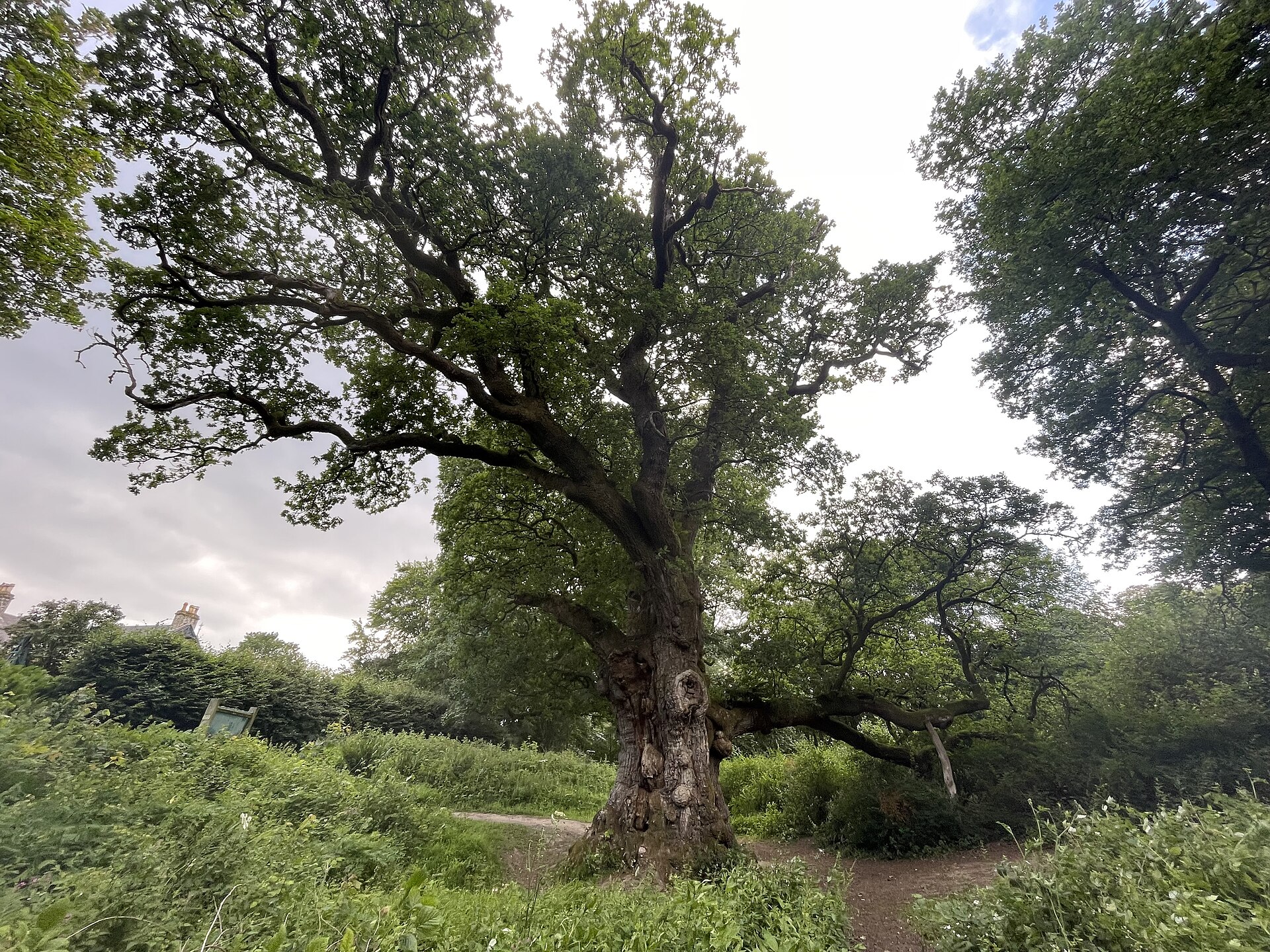
Photo: Ralph Greig / Wikimedia Commons / CC BY-SA 2.0 The Birnam Oak and Sycamore stand together on the Tay’s south bank and appear consecutively as Ancient Tree Inventory entries 2422 and 2423.
In culture
-
Macbeth
The tree is associated with Birnam Wood in Shakespeare’s Macbeth and has become known as Macbeth’s Oak through that literary connection.
What to look for
-
The struts under the limbs
The great spreading branches have had to be propped to stop them tearing away under their own weight. Support of that kind is the standard intervention on a veteran tree, and it is the most visible sign of how old this one is.
-
A trunk 5.5 metres round
The girth is the only real evidence for the tree's age, since nothing else dates it. On a sessile oak, 5.5 metres suggests something around six centuries.
-
A sessile oak, not a pedunculate one
The species is Quercus petraea, named for acorns that sit against the twig without stalks. It is the oak of the north and west, which is what would be expected of a relic of a Perthshire wood.
-
The riverside strip
The tree stands in a narrow band of woodland on the south bank of the Tay — the remaining sliver of what the play made famous, hemmed in by everything that came afterwards.
-
Its neighbour
The Birnam Sycamore stands beside it, and the two are recorded together on the Ancient Tree Inventory as 2422 and 2423. Most visitors come for the pair.
-
Recorded identity
The feature’s name and documented place are the clearest elements supported by the available record.
What is said
Folklore and tradition, recorded as what is said — not as established fact.
-
Macbeth’s Oak
The oak is reputed to be one of the surviving trees of Birnam Wood. Its age means it cannot have witnessed the eleventh-century events associated with Macbeth, but the association is central to its modern identity.
Plan your visit
- Location
- 56.5612°N · 3.5756°W
- Nearest settlement
- Birnam
- Access
- Reached on a public path
- What survives
- Living-tree condition and access should be checked against current local guidance before any visit copy is expanded.
Nearby places
Ancient tree · Medieval
Birnam Sycamore
Perth and Kinross
Birnam Sycamore stands near Birnam Oak on the south bank of the River Tay and is associated with the surviving edge of Birnam Wood.
- Near Birnam

Sacred place · Medieval
Dunkeld Cathedral
Perth and Kinross
A cathedral begun in 1260 and finished in 1501, standing on a Columban monastery whose reused red sandstone still shows as a streak across the east…
- Near Dunkeld

Ancient tree
Lady's Tree
Perth and Kinross
An osprey called Lady nested in this Scots pine for twenty-four years, laid 71 eggs and raised 50 chicks. The tree is named after the bird.
- Near Perth and Kinross
.jpg?width=800)
Ancient tree · Medieval
Neil Gow's Oak
Perth and Kinross
A bench beneath this oak was engraved with a line from a Michael Marra song about sitting under it with Niel Gow's ghost. A falling branch destroye…
- Near Dunkeld
The setting
Near Birnam Oak.
Photo: Stevanhogg / Wikimedia Commons / CC BY-SA 4.0
Near Birnam Oak.
Photo: Stevanhogg / Wikimedia Commons / CC BY-SA 4.0
Near Birnam Oak.
Photo: Stevanhogg / Wikimedia Commons / CC BY-SA 4.0
Questions people ask
- Is this really the Birnam Wood of Macbeth?
- It is held to be a relic of it. Birnam Wood was a real wood on the Tay, and the oak is old enough — around six hundred years on the evidence of its girth — to have been standing when Shakespeare is presumed to have visited Perthshire in 1589. Nothing proves the connection, and the tree's reputation rests on that reasonable inference rather than on record.
- How old is the tree?
- Not established. The trunk measures 5.5 metres round, and on a sessile oak that suggests roughly six centuries, but no direct dating has been done.
- Why are the branches propped up?
- Because they have outgrown their own strength. The large spreading limbs have latterly been carried on struts to stop them collapsing under their weight, which is the usual treatment for a veteran tree of this size.
- What kind of oak is it?
- A sessile oak, Quercus petraea, named for acorns that sit directly against the twig rather than hanging on stalks. It is the oak of the higher and wetter ground of the north and west.
- Is there anything else to see there?
- The Birnam Sycamore stands alongside it, and the two are recorded together on the Woodland Trust's Ancient Tree Inventory as trees 2422 and 2423. Most people come to see the pair.
Sources
The Ancient Codex, in your pocket
Get the Pocket Codex app
Carry the directory with you — Birnam Oak and thousands of ancient places across Britain and Ireland, offline, wherever you roam.