
A cathedral begun in 1260 and finished in 1501, standing on a Columban monastery whose reused red sandstone still shows as a streak across the east gable.
There is a streak of red running through the grey of the eastern gable at Dunkeld, irregular and unmistakable once it has been pointed out. Those stones came from the ninth-century cathedral that stood here before this one, built of reddish sandstone by Causantin mac Fergusa, who declared Dunkeld to hold the primacy of the faith in Alba. They are the oldest thing on the site that can still be seen, and they are in the wall by accident of reuse rather than by any intention to preserve them.
Before Causantin’s building there was a monastery, founded in the sixth or early seventh century after an expedition by Saint Columba into the land of Alba. It began as a collection of wattle huts on the north bank of the Tay. Relics of Columba, his bones among them, were said to have been kept here until the Reformation, when they were taken to Ireland; there are those who believe Columban relics remain buried somewhere in the grounds.
One relic certainly did not stay. The Celtic bell thought to have belonged to the monastery ended up not in the cathedral but in Little Dunkeld Church, the parish church of the lesser district across the river. The explanation offered is that the later canons regarded Culdeeism — the practice of the early Scottish monastic communities — as heresy, and would not house relics of it. If so, the building displaced the very tradition it grew out of, while keeping its stones in the gable.
The cathedral proper was begun in 1260 and completed in 1501. Two hundred and forty years is a very long build even by medieval standards, and the result is a structure in which Gothic and Norman elements are intermingled throughout rather than separated into legible phases. It is built in square-stone style of predominantly grey sandstone.
It is not, strictly, a cathedral any more. The Church of Scotland has neither cathedrals nor bishops, and Dunkeld is one of several former cathedrals that simply kept the name. In the seventeenth century the bishopric became an appendage of the Crown and afterwards descended to the Earls of Fife. Today the building is Crown property held through Historic Environment Scotland and is a scheduled monument, partly in ruins, and still the town’s parish church, with services every Sunday — though the congregation retreats to the smaller Little Dunkeld through the winter.
It has been fought over. In 1689 the Battle of Dunkeld was contested around the building between Jacobite Highland clans loyal to James VII and II, deposed the previous year in the Glorious Revolution, and a government force supporting William. The government side held the town.
Inside is a collection of the dead worth a slow circuit. Alexander Stewart, Earl of Buchan, remembered as the Wolf of Badenoch, was buried here in 1394 under a tomb surmounted by his armoured effigy, which survives. Bishops of Dunkeld lie here across four centuries — Geoffrey de Liberatione, Richard de Inverkeithing who was chamberlain to Alexander II, William Sinclair, Michael de Monymusk, Robert Cockburn. So does the 1st Earl of Atholl, and so does Charles Edward Stuart, Count Roehenstart, who died in 1854 and claimed descent from the Stuart line that the battle fought outside these walls had been about.
The small Chapter House Museum holds relics from the monastic and medieval periods together with local history exhibits — which is the closest thing the site has to an account of itself, on ground that has been in continuous religious use for something close to fourteen hundred years.
What follows is drawn from published sources, with each claim labelled by how firmly it is established.
History
The original monastery at Dunkeld dates from the sixth or early seventh century, founded after an expedition by Saint Columba into the land of Alba. It began as a simple collection of wattle huts on the north bank of the River Tay. During the ninth century Causantin mac Fergusa built a more substantial cathedral of reddish sandstone here and declared Dunkeld to hold the primacy of the faith in Alba — the centre of the Scottish church. Stones from that earlier Culdee monastery can still be picked out as an irregular reddish streak in the eastern gable of the present building.
Relics of Saint Columba, including his bones, were said to be kept at Dunkeld until the Reformation, when they were removed to Ireland. Some hold that Columban relics remain undiscovered within the cathedral grounds. The cathedral proper was begun in 1260 and finished in 1501. A construction period of two hundred and forty years produced a building of mixed architecture, with Gothic and Norman elements intermingled throughout rather than kept to separate phases.
The Celtic bell thought to have been used at the monastery is not preserved in the cathedral but in Little Dunkeld Church, the parish church of the lesser district. One suggestion is that the later canons regarded Culdeeism as heresy and refused to house relics of that discipline. In 1689 the Battle of Dunkeld was fought around the cathedral between Jacobite Highland clans loyal to the deposed James VII and II and a government force supporting William. The government side won. The building had stood for four centuries by then and was fought over as a strongpoint.
In the seventeenth century the Bishopric of Dunkeld became an appendage of the Crown and afterwards descended to the Earls of Fife. The cathedral is Crown property today, held through Historic Environment Scotland, and is a scheduled monument. Alexander Stewart, Earl of Buchan — the Wolf of Badenoch — was buried here after his death in 1394, and his tomb with its armoured effigy can still be seen. Later burials include Charles Edward Stuart, Count Roehenstart, who died in 1854.
People
-
Saint Columba
Associated with the early monastic foundation at Dunkeld.
-
Causantin mac Fergusa
Built the ninth-century sandstone cathedral whose reused stones remain visible in the east gable.
-
Alexander Stewart, Earl of Buchan
The Wolf of Badenoch, buried beneath an armoured effigy in the cathedral.
Cultural influences
-
The later cathedral incorporates masonry from an earlier Culdee foundation, while Gothic and Norman work mingle across its long construction.
Connections
-
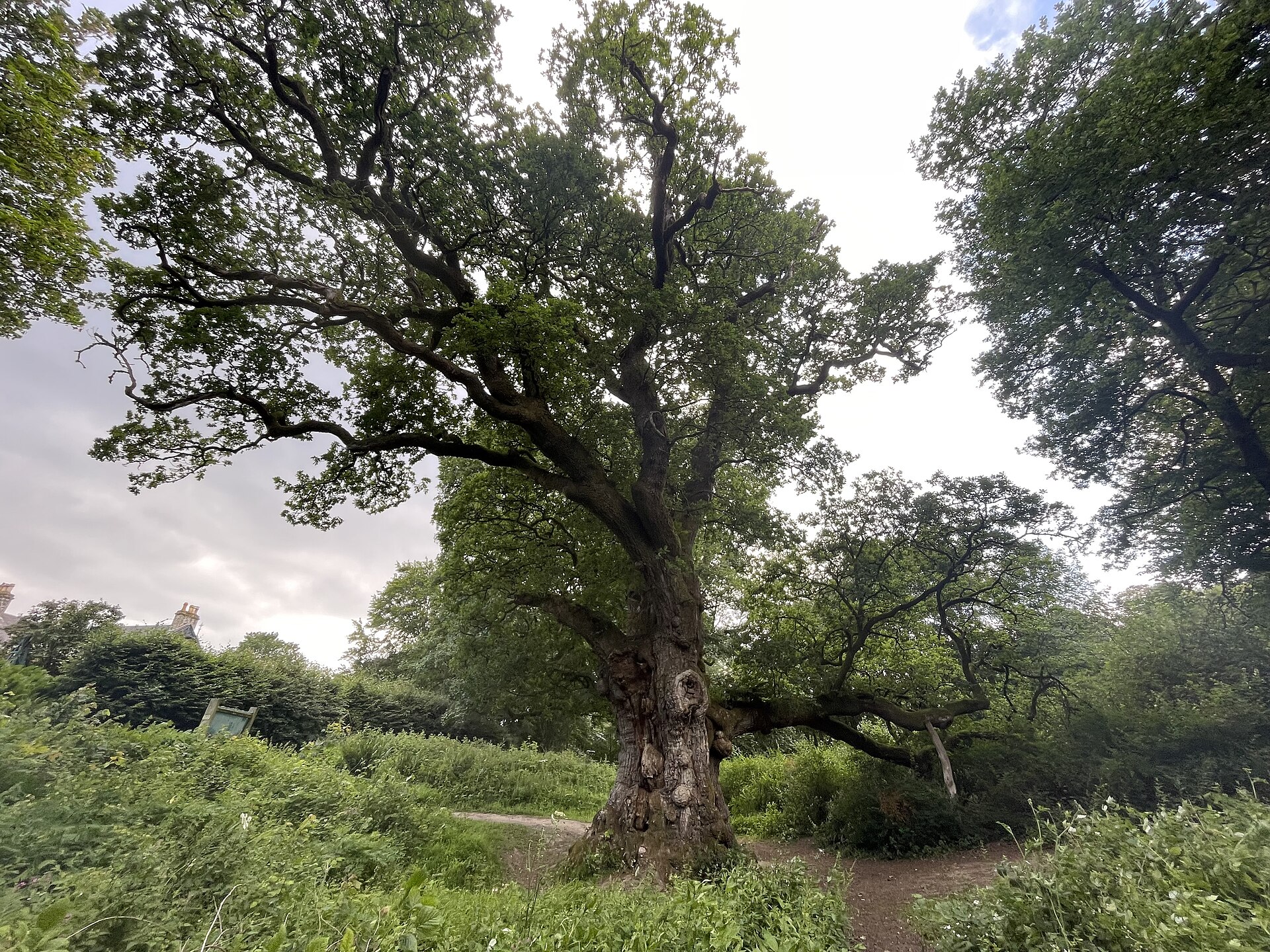
Photo: Ralph Greig / Wikimedia Commons / CC BY-SA 2.0 The cathedral and ancient tree are landmarks of the Dunkeld and Birnam landscape, linking the town’s medieval religious centre with a natural monument of local tradition.
-

Photo: Gordon Hatton / Wikimedia Commons / CC BY-SA 2.0 The cathedral and oak together define the historic Dunkeld-Birnam landscape associated with medieval worship and later literary tradition.
-
.jpg?width=320)
Photo: Gordon Hatton / Wikimedia Commons / CC BY-SA 2.0 The cathedral and oak are historic landmarks around Dunkeld, linking the area’s ecclesiastical heritage with its musical and cultural traditions.
Discovery & excavation
An irregular red sandstone streak in the east gable identifies stone reused from the ninth-century Culdee monastery.
What to look for
-
The reddish streak in the east gable
Stones from the ninth-century Culdee monastery were reused in the later building and show as an irregular band of red in the eastern gable — the oldest fabric on the site, hiding in plain sight.
-
The Wolf of Badenoch's tomb
Alexander Stewart, Earl of Buchan, died in 1394 and lies under an armoured effigy. He is remembered chiefly for burning Elgin Cathedral, which makes his resting place in another one worth a moment.
-
Gothic and Norman side by side
Two and a half centuries of building left the two styles intermingled through the structure rather than divided into phases, so the architecture has to be read piecemeal.
-
The Chapter House Museum
A small museum holding relics from monastic and medieval times alongside local history exhibits.
Plan your visit
- Location
- 56.5651°N · 3.5899°W
- Nearest settlement
- Dunkeld
- Time needed
- About 60 minutes
- Best time
- Daylight hours
- What survives
- A riverside cathedral of mixed Gothic and Norman fabric, retaining reused early monastic stone, the Wolf of Badenoch’s tomb and a chapter-house museum.
Opening & admission
- From April to September, the cathedral and grounds are open daily from 09:30 to 17:30.
- From October to March, the cathedral and grounds are open from 10:00 to 16:00.
- It is a working church; services, events or safety restrictions may limit access to areas of the building and grounds.
Nearby places
Ancient tree · Medieval
Birnam Sycamore
Perth and Kinross
Birnam Sycamore stands near Birnam Oak on the south bank of the River Tay and is associated with the surviving edge of Birnam Wood.
- Near Birnam

Ancient tree · Medieval
Birnam Oak
Perth and Kinross
Birnam Oak, sometimes known as Macbeth's Oak, stands on the south bank of the River Tay and is associated with the surviving edge of Birnam Wood.
- Near Birnam
.jpg?width=800)
Ancient tree · Medieval
Neil Gow's Oak
Perth and Kinross
A bench beneath this oak was engraved with a line from a Michael Marra song about sitting under it with Niel Gow's ghost. A falling branch destroye…
- Near Dunkeld

Ancient tree
Lady's Tree
Perth and Kinross
An osprey called Lady nested in this Scots pine for twenty-four years, laid 71 eggs and raised 50 chicks. The tree is named after the bird.
- Near Perth and Kinross
The setting
Near Dunkeld Cathedral, about 0 metres away.
Photo: Elisa.rolle / Wikimedia Commons / CC BY-SA 3.0
Near Dunkeld Cathedral, about 6 metres away.
Photo: thejackrustles / Wikimedia Commons / CC BY-SA 2.0
Near Dunkeld Cathedral, about 9 metres away.
Photo: Colin Smith / Wikimedia Commons / CC BY-SA 2.0
Near Dunkeld Cathedral, about 17 metres away.
Photo: Michael Garlick / Wikimedia Commons / CC BY-SA 2.0
Near Dunkeld Cathedral, about 17 metres away.
Photo: thejackrustles / Wikimedia Commons / CC BY-SA 2.0
Near Dunkeld Cathedral, about 17 metres away.
Photo: thejackrustles / Wikimedia Commons / CC BY-SA 2.0
Questions people ask
- Is it really a cathedral?
- Not formally. The Church of Scotland has neither cathedrals nor bishops today, but Dunkeld is one of a number of former cathedrals that has kept the name.
- How old is the site?
- The monastery dates from the sixth or early seventh century, founded after an expedition by Saint Columba. The building standing now was begun in 1260 and completed in 1501.
- Is it still used?
- Yes. It remains the town's Church of Scotland parish church, with services every Sunday, though the congregation uses the smaller Little Dunkeld Church through the winter. It is partly ruined and open to the public.
- What happened here in 1689?
- The Battle of Dunkeld was fought around the cathedral between Jacobite Highland clans loyal to the deposed James VII and II and a government force supporting William. The government force won.
Sources
The Ancient Codex, in your pocket
Get the Pocket Codex app
Carry the directory with you — Dunkeld Cathedral and thousands of ancient places across Britain and Ireland, offline, wherever you roam.