
A hillfort whose outer defences are stronger than its inner ones — and an eight-metre gap that shows which were built first.
The strongest defences at Northshield Rings are the outer ones, and that is the puzzle the site sets.
Ordinarily a hillfort is strengthened from the inside out: the original enclosure is kept and new banks are thrown up beyond it. Here the inner rampart is the slightest work on the hill, rising only half a metre above the interior and 1.5 metres above its external ditch, while the outer ramparts are considerably more substantial, with external quarry-ditches — the trenches dug to supply material for the banks — creating a defensive depth of up to 20 metres.
The spacing settles the argument. The gap between the inner rampart and the outer defences is up to eight metres wide, and that gap would not exist if a builder had simply added new works outside an existing circuit; new ramparts are placed close, to keep the defence continuous. A wide empty band between the two means they belong to different schemes, and the likeliest reading is that the outer ramparts came first and the inner rampart was added later, inside them. At least two phases of construction are represented.
The fort itself sits on a rounded hill a short distance south of Portmore Loch, near Eddleston and about ten kilometres north of Peebles. The inner enclosure measures 73 metres north-north-west to south-south-east by 64 metres, taking in 0.35 hectares, and there are three entrances — north-west, south and south-east.
Inside, seven slight depressions between six and nine metres in diameter have been found, and these are thought to be the sites of timber round-houses. That is the usual way such buildings survive: not as walls but as hollows, where the ground was scooped level for a floor and never quite filled back in.
The defences are described as well preserved, which for a Borders hillfort means the shape of the whole thing can be walked and read without much guessing. The site is a Scheduled Monument.
No excavation has dated either phase, so the sequence rests entirely on the geometry of the earthworks. That is a common position for Borders hillforts, and it is worth stating plainly: the argument here is about spacing and relative strength, not about anything recovered from the ground.
What can be said without any excavation at all is that this hill was fortified twice, that somebody at some point decided a smaller enclosure inside the existing works was worth building, and that seven timber round-houses stood within it. For a site known only from its surface, that is a reasonably full account.
What follows is drawn from published sources, with each claim labelled by how firmly it is established.
History
Northshield Rings is a prehistoric hillfort near Eddleston, about ten kilometres north of Peebles in the Scottish Borders, and a Scheduled Monument. It stands on a rounded hill a short distance south of Portmore Loch, and its defences are well preserved. The inner rampart measures 73 metres north-north-west to south-south-east by 64 metres, enclosing 0.35 hectares. Two further ramparts lie outside it, and there are three entrances, in the north-west, the south and the south-east.
Within the inner enclosure seven slight depressions have been found, between six and nine metres in diameter, thought to be the sites of timber round-houses. Depressions rather than upstanding remains are the usual trace such buildings leave, the ground having been scooped level for a floor and never quite filled back in. The inner rampart rises only half a metre above the interior and 1.5 metres above an external ditch, so it is by some way the slighter of the fort's defences despite being the innermost.
The outer ramparts are much more substantial, with external quarry-ditches — the trenches dug to supply material for the banks — providing a defence up to 20 metres deep. A fort whose outer works are stronger than its inner ones is unusual and needs explaining. At least two phases of construction are thought to be represented. The space between the inner rampart and the outer defences is up to eight metres wide, and that gap would not exist if the defences had simply been strengthened by adding outwards — which suggests the outer ramparts were built first.
Cultural influences
-
A hillfort whose outer defences may be older than its core
Northshield Rings has substantial outer ramparts and quarry-ditches beyond a slighter inner enclosure, suggesting at least two building phases.
Connections
-
Eddleston
Northshield Rings lies in the Eddleston area, adding a multi-rampart prehistoric enclosure to the village’s surrounding upland archaeology.
-
Peebles
The hillfort lies north of Peebles in the Scottish Borders, part of the defended upland landscape beyond the Tweed valley town.
-
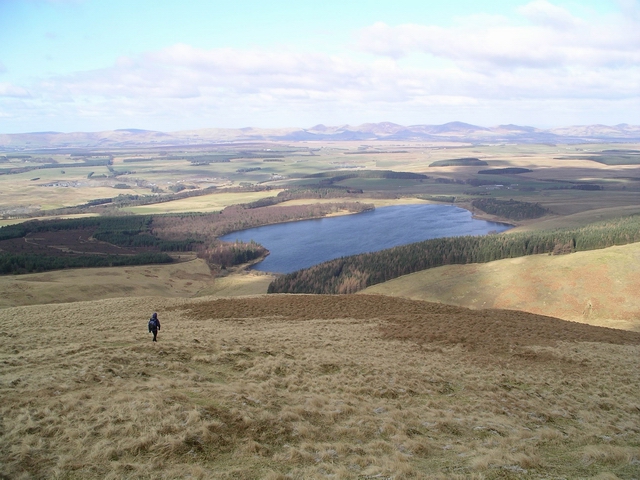
Photo: Chris Eilbeck / Wikimedia Commons / CC BY-SA 2.0 Portmore Loch
Northshield Rings stands on a rounded hill just south of Portmore Loch, using the raised ground above this distinctive Borders waterbody.
What to look for
-
The seven house depressions
Seven slight hollows between six and nine metres across mark the sites of timber round-houses inside the inner enclosure.
-
The outer ramparts
More substantial than the inner one, with external quarry-ditches giving a defensive depth of up to 20 metres. They are thought to be the earlier work.
-
The eight-metre gap
The space between the inner rampart and the outer defences is up to eight metres wide. That gap is the evidence for the sequence — it would not be there if the fort had been strengthened by building outwards.
-
Three entrances
In the north-west, the south and the south-east. Three ways in is generous for a fort of this size.
Plan your visit
- Location
- 55.7317°N · 3.1844°W
- Access
- Open access
- Terrain
- Rough ground — reasonable boots advised
- Time needed
- About 60 minutes
- What survives
- The three ramparts, external quarry-ditches and seven slight round-house hollows are well preserved on the rounded hill.
Opening & admission
- Hillfort earthworks on a rounded hill; follow responsible access and avoid disturbing banks.
Nearby places

Fortified place · Iron Age
Milkieston Rings
Scottish Borders
A small hillfort of the Iron Age, roughly 800 BC until the Roman conquest: a settlement defended by banks and ditches on high ground: with up to si…
- Rough ground
Fortified place · Iron Age
White Meldon
Scottish Borders
Four concentric rampart (the raised bank thrown up around a fortified enclosure) lines and at least 29 round-house platforms make this one of the l…
- Rough ground

Fortified place · Iron Age
Black Meldon
Scottish Borders
A hillfort whose seven round houses survive as ring-grooves: and five of them stand in a deliberate straight line.
- Rough ground
Fortified place · Medieval
Neidpath Castle
Scottish Borders
A single L-plan tower rebuilt almost nowhere else in its 750-year life, whose carved archway still names both families that shaped it: the Hays' go…
The setting
A track through the heather in the setting of Northshield Rings hillfort.
Photo: Jim Barton / Wikimedia Commons / CC BY-SA 2.0
Questions people ask
- Which defences came first?
- Probably the outer ones. They are more substantial than the inner rampart, and the eight-metre gap between the two would not exist if the fort had been strengthened by adding new works outside the old — so the inner rampart appears to be the later addition.
- What is inside the fort?
- Seven slight depressions between six and nine metres in diameter, thought to be the sites of timber round-houses.
- How big is it?
- The inner rampart encloses 0.35 hectares, measuring 73 metres north-north-west to south-south-east by 64 metres, with two further ramparts outside it.
Sources
The Ancient Codex, in your pocket
Get the Pocket Codex app
Carry the directory with you — Northshield Rings and thousands of ancient places across Britain and Ireland, offline, wherever you roam.