The weathervane on top is a model of the East Indiaman General Elliot, which Captain Robert Drummond commanded from her launch in 1783 — at the age of twenty-two.
The weathervane turning above this dovecot is a ship. Specifically, according to Baroness Strange, it is a model of the East Indiaman General Elliot — the vessel Captain Robert Drummond commanded from her launching in 1783, when he was twenty-two years old. He built the courtyard beneath it on his retirement from the East India Service, and put his own first command on the roof.
The courtyard is dated 1807, a quadrangular Gothic range of single storey and loft, with pointed and ogee-arched openings, multi-pane diamond glazing, and glazed cinquefoil loft openings between the bays. A cross finial in the north gablehead is carved with the date split around his initials, as 19 RD 07. The dovecot at its corner is hexagonal and of two stages, roughly coursed rubble with ashlar margins, an open pointed-arch arcade below and a bellcast roof under broad eaves. A broad arch faces south with a row of tiny flight holes above it, the central one larger than its neighbours, and diamond-shaped leaded openings sit on the flanking faces.
The east range is older than the rest and made of estate brick. It was built with local brick fired by John Larchme, who was employed by John Drummond MP in 1714 at a cost of four shillings and sixpence sterling per thousand — the kind of accounting detail that rarely survives alongside a building.
The south range has had the strangest career of anything here. It began, possibly in the eighteenth century, as a storehouse. It became a brewery, then a bakery, then a slaughterhouse. In the 1930s it was converted into a flat and a recording studio, home to Great Scot Records. In 1937 it became a film studio. Through the Second World War it was a granary. Afterwards it was renovated and turned into a hall for family weddings, which is what it remains. Photographs of about 1875 show it with ogee-headed windows at first-floor level, one of which has since been squared off.
The group is listed together with its M-gabled screen wall and polygonal finialled gatepiers, and it sits within a wider estate that includes a chapel, a Gothic arch, an ice house, Kennels Cottage, Kingdom Farmhouse, the north lodges, the walled gardens, Wardheads and the West Lodge — each of them listed in its own right.
What follows is drawn from published sources, with each claim labelled by how firmly it is established.
History
The stable courtyard is dated 1807 and was built for Captain Robert Drummond on his retirement from the East India Service. It is a quadrangular Gothic range, single storey and loft, incorporating an earlier range to the east, with pointed and ogee-arched openings throughout and a cross finial in the gablehead carved with the divided date 19 RD 07. The dovecot itself is hexagonal and of two stages, with an open pointed-arch arcade to the lower stage and a bellcast roof under broad eaves. It is built of roughly coursed rubble with ashlar margins and some droved quoins, and its openings are Gothic-arched to match the courtyard around it.
A broad arched opening faces south with a row of tiny flight holes above it, the middle one larger than the rest. The flanking faces carry diamond-shaped openings with diamond-pattern leaded glazing, and a narrow opening to the north has a boarded timber door beneath a decoratively astragalled head. Topping the dovecot is an ironwork galleon finial. According to Baroness Strange it is a model of the East Indiaman General Elliot, the ship Drummond captained from her launching in 1783, when he was twenty-two years old, and it serves as the courtyard's weathervane.
The earlier east range is built of local brick made by John Larchme, who was employed by John Drummond MP in 1714. The bricks cost four shillings and sixpence sterling per thousand, a figure recorded in the estate's own accounts. The south range began as a storehouse, possibly in the eighteenth century, and has been through an unusual sequence of uses since — brewery, bakery and slaughterhouse, then in the 1930s a flat and a recording studio when Great Scot Records was based here.
In 1937 the same range became a film studio, and during the Second World War it served as a granary. After the war it was renovated and converted into a hall used for family weddings, which is roughly where a building that started as a storehouse has ended up. Photographs of about 1875 show the building with ogee-headed windows at first-floor level. The wider Megginch Castle estate includes a chapel, a Gothic arch, an ice house, Kennels Cottage, Kingdom Farmhouse, the north lodges, the walled gardens, Wardheads and the West Lodge, each listed separately.
People
-
Captain Robert Drummond
Retired from the East India Service and built the stable courtyard in 1807; captained the East Indiaman General Elliot from her launch in 1783, aged 22.
-
John Larchme
Brickmaker employed by John Drummond MP in 1714, whose bricks built the earlier east range.
-
Baroness Strange
Supplied the information identifying the dovecot's galleon weathervane as a model of the General Elliot.
Connections
-
The East Indiaman General Elliot
Captain Robert Drummond commanded the ship from her launch in 1783; a model of her tops the dovecot as a weathervane.
-
Megginch Castle
The dovecot and stable courtyard belong to the castle estate, which also takes in a chapel, ice house, walled gardens and several lodges, all listed separately.
-
Great Scot Records
The record label was based in the courtyard's south range in the 1930s, when the former storehouse served as a flat and recording studio.
In culture
-
Great Scot Records
The south range housed the label's recording studio in the 1930s, before becoming a film studio in 1937 and a granary during the war.
What to look for
-
The galleon weathervane
An ironwork finial in the form of a ship, identified as the East Indiaman General Elliot, turning above the dovecot roof.
-
The carved cross finial
In the gablehead of the north range, carved with the date split around initials as 19 RD 07.
-
The flight holes
A row of tiny openings above the broad south arch of the dovecot, with the central one noticeably larger.
-
The early local brick
The east range is built of brick made on the estate by John Larchme in 1714, at four shillings and sixpence per thousand.
Plan your visit
- Location
- 56.4080°N · 3.2308°W
- Access
- Visible from a public way
Nearby places
.jpg?width=800)
Minor monument · Medieval
Perth Mercat Cross, Fingask Castle
Perth and Kinross
A cross assembled out of loose window tracery, standing beside a font carried here from Kinnaird: both given nineteenth-century dates that the ston…
- Near Perth
- Easy path
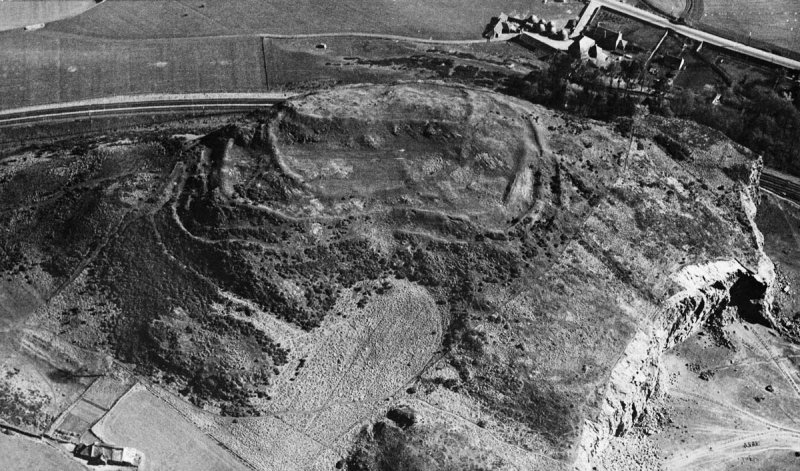
Fortified place · Iron Age
Clatchard Craig
Fife
Clatchard Craig was an important stronghold of the Picts, the people of northern and eastern Scotland from about AD 300 to 900, with evidence of el…
- Some walking
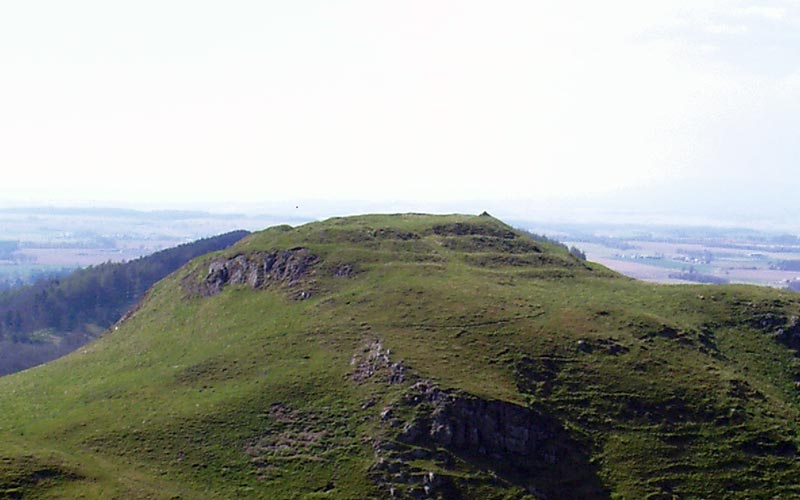
Fortified place · Iron Age
Dunsinane Hill
Perth and Kinross
Nineteenth-century antiquarians came here because of Macbeth and dug the hill fort apart. Little of value was learned.
- Some walking
Building or ruin · Roman
Carpow Roman Fort
Perth and Kinross
A thirty-acre Roman fort at the meeting of the Tay and the Earn, held from the late second century into the early third.
- Near Carpow
Questions people ask
- What is the ship on top of the dovecot?
- A model of the East Indiaman General Elliot, which Captain Robert Drummond commanded from her launching in 1783 at the age of twenty-two. It acts as the weathervane.
- When was the courtyard built?
- It is dated 1807 and was built for Captain Robert Drummond on his retirement from the East India Service, incorporating an earlier range to the east.
- What has the south range been used for?
- Storehouse, brewery, bakery and slaughterhouse, then a flat and recording studio in the 1930s, a film studio from 1937, a granary during the war, and a wedding hall since.
- How old is the brickwork?
- The earlier east range uses local brick made by John Larchme, employed by John Drummond MP in 1714 at four shillings and sixpence per thousand bricks.
Sources
The Ancient Codex, in your pocket
Get the Pocket Codex app
Carry the directory with you — Dovecot, Megginch Castle and thousands of ancient places across Britain and Ireland, offline, wherever you roam.