Three generations of MacLeod chiefs are buried in the walls of this building, in tombs they had prepared for themselves while alive. The church at Rodel on Harris was built for them in the last Catholic generation, before the sixteenth-century break with Rome reached the islands.
Three generations of MacLeod chiefs are buried in the walls of this building, in tombs they had prepared for themselves while they were still alive.
Alasdair Crotach MacLeod, the 8th Chief, had his made in 1528 on the south side of the choir — a wall tomb crowned by an arch and carved with biblical scenes, and possibly the finest medieval example in Scotland. His son William, the 9th Chief, prepared his own in the south wall of the nave in 1539. A third, in the south transept, probably belongs to John MacLeod of Minginish.
The church that holds them was built for the family at Rodel on Harris in the late fifteenth or early sixteenth century and dedicated to Pope Clement I; in Gaelic it is Tùr Chliamhainn, Clement’s Tower. Its architectural style belongs essentially to the years 1520 to 1550, which places the whole building in the last generation before the Reformation — the sixteenth-century break with Rome that ended Catholic worship in Scotland — reached the islands.
It is built of Lewisian gneiss quarried locally — among the oldest rock in Europe, and hard, unforgiving stone to carve, which makes the detail of the tombs more remarkable rather than less. The plan is cruciform, with a tower at the west end reached through a door at the west end of the nave and then by a succession of stone stairs and wooden ladders. The choir and sanctuary with the high altar stand at the east end, once divided from the nave by a wooden screen, and chapels open off the transepts on both sides.
What follows is drawn from published sources, with each claim labelled by how firmly it is established.
The name
The Gaelic name Tùr Chliamhainn means Clement’s Tower.
History
St Clement's Church at Rodel on Harris — Tùr Chliamhainn in Gaelic, meaning Clement's Tower — is a late fifteenth or early sixteenth-century church built for the Chiefs of the MacLeods of Harris and dedicated to Pope Clement I. A church of that date on Harris is a considerable statement of a chief's standing. It is built of Lewisian gneiss quarried locally, which is among the oldest rock in Europe. Using stone of that age for a late medieval church is an accident of geology rather than of intent, but it is worth noticing. Gneiss is hard, unforgiving stone to work, which makes the carved detail inside more remarkable.
The ground plan is cruciform, with a tower at the west end reached through a door at the west end of the nave and then by a succession of stone staircases and wooden ladders. The choir and sanctuary with the high altar stand at the opposite, eastern end. Ladders and stairs in sequence is an awkward ascent and suggests the tower was built for display rather than use.
A wooden screen once separated the choir and sanctuary from the nave. Chapels open off the transepts on both sides, and the entrance door faces north and leads into the nave. The architectural style belongs essentially to the years 1520 to 1550. Those dates place the building squarely in the last generation before the Reformation reached the islands. In 1528 Alasdair Crotach MacLeod, 8th Chief, prepared a wall tomb for himself on the south side of the choir. Crowned by an arch and ornamented with carvings of biblical design, it is possibly the finest medieval wall tomb in Scotland.
His son William, the 9th Chief, had his own grave prepared in the south wall of the nave in 1539. A third grave in the south transept probably belongs to John MacLeod of Minginish, so three generations of the family are buried in the building they built.
People
-
Alasdair Crotach MacLeod
Eighth Chief of the MacLeods of Harris, who prepared his carved wall tomb in 1528.
-
William MacLeod
Ninth Chief of the MacLeods of Harris, who prepared his grave in the nave wall in 1539.
-
John MacLeod of Minginish
Probably commemorated by the third MacLeod grave in the south transept.
Cultural influences
-
The cruciform church uses locally quarried Lewisian gneiss and preserves late medieval MacLeod patronage in its tombs and carved detail.
Connections
-
Rodel
St Clement's Church stands in Rodel, Harris.
-
Harris
St Clement's Church was built for the Chiefs of the MacLeods of Harris.
What to look for
-
Alasdair Crotach's wall tomb
The 8th Chief of the MacLeods prepared a wall tomb for himself on the south side of the choir in 1528, crowned by an arch and carved with biblical scenes. It is possibly the finest medieval wall tomb in Scotland.
-
Three MacLeod graves
The 9th Chief, William, had his grave prepared in the south wall of the nave in 1539, and a third grave in the south transept probably belongs to John MacLeod of Minginish.
-
Local gneiss
The church is built of Lewisian gneiss quarried locally — among the oldest rock in Europe used for a late medieval building.
-
The tower at the west end
A tower stands at the west end, reached through a door at the west end of the nave and a succession of stone staircases and wooden ladders.
Plan your visit
- Location
- 57.7409°N · 6.9633°W
- Nearest settlement
- Rodel
- Access
- Open access
- Terrain
- Easy going
- Time needed
- About 45 minutes
- Best time
- Daylight hours
- What survives
- The cruciform church retains its west tower, choir, sanctuary, transept chapels and three MacLeod wall tombs carved into the south walls.
- Facilities
- No dedicated visitor facilities are documented at the church; plan to use facilities in nearby settlements.
Opening & admission
Free entry; currently open daily, subject to short-notice closures.
- Historic Environment Scotland describes the church as an isolated medieval building close to the sea.
Nearby places

Fortified place · Iron Age
Dun an Sticir
Outer Hebrides
Three stone causeways lace across Loch an Sticir on North Uist, carrying a single line of dry ground from the B893 road to a broch (a tall circular…
- Some walking

Fortified place · Iron Age
Dun Borrafiach
Highland
A drystone tower on Skye's Waternish coast still stands over two and a half metres high, with its internal gallery wall exposed to view along the e…
- Near Halistra
- Rough ground
Tomb or burial place · Prehistoric
Barpa Langass
Outer Hebrides
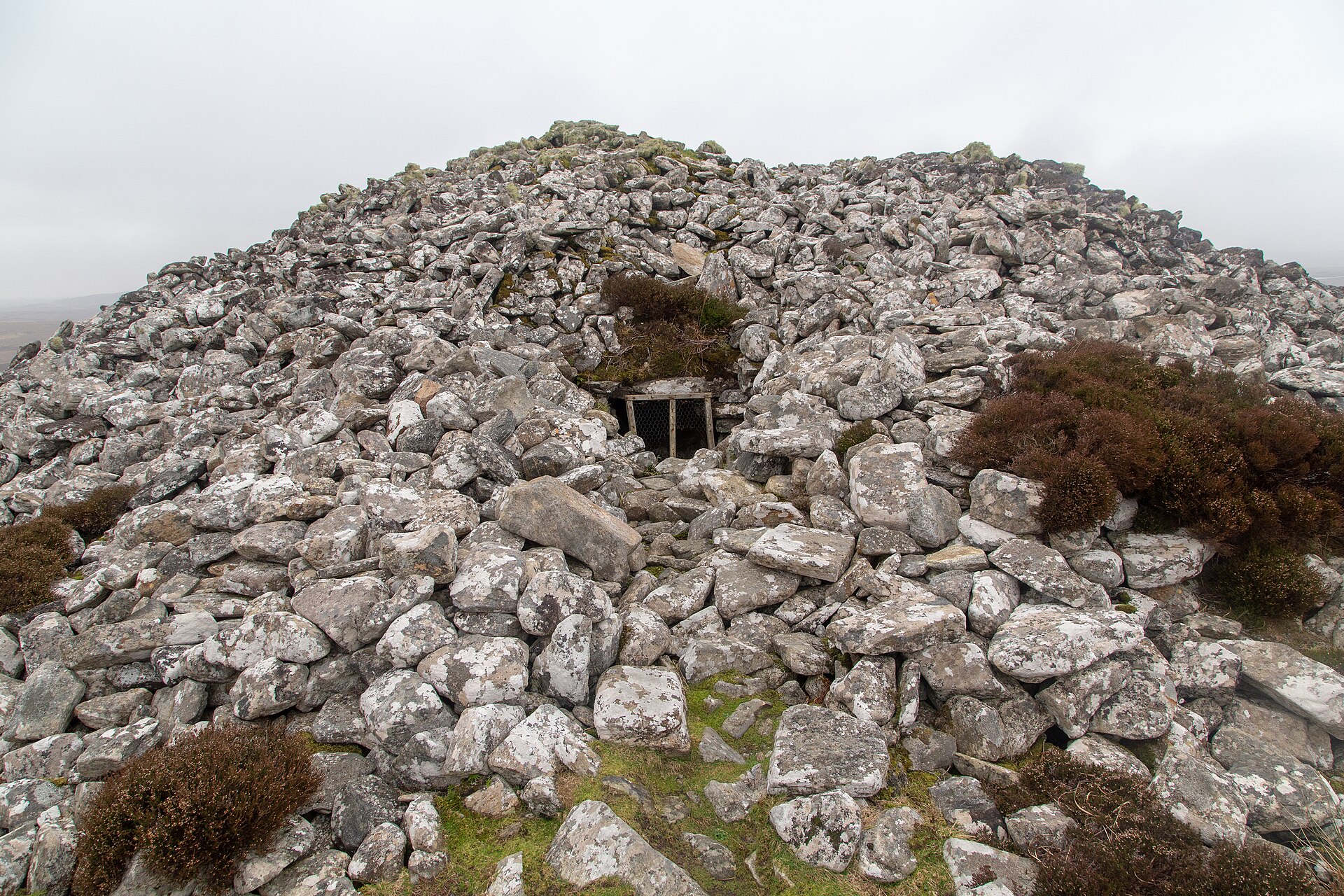
Two massive slabs form the roof of Barpa Langass, with a third slab laid on top of them, capping a stone burial mound on the Isle of North Uist tha…
- Easy path

Sacred place · Prehistoric
Pobull Fhinn
Outer Hebrides
At least two dozen stones stand in an oval on the south side of Ben Langass on North Uist, eight of them on the northern arc and sixteen on the sou…
- Easy path
Questions people ask
- Why is St Clement's Church, Rodel significant?
- Three generations of MacLeod chiefs are buried in its walls, in tombs they had prepared while still alive, in a church built for them in the last Catholic decades before the Reformation reached the islands.
- What should a reader focus on?
- The tombs, and the stone. The church is built of locally quarried Lewisian gneiss, among the oldest rock in Europe and hard, unforgiving material to carve.
- How certain is the interpretation?
- The building is dated to the late fifteenth or early sixteenth century and its patrons are documented. Details of its construction sequence depend on the fabric itself.
Sources
The Ancient Codex, in your pocket
Get the Pocket Codex app
Carry the directory with you — St Clement's Church, Rodel and thousands of ancient places across Britain and Ireland, offline, wherever you roam.