
At least two dozen stones stand in an oval on the south side of Ben Langass on North Uist, eight of them on the northern arc and sixteen on the southern, with long stretches between where stones have gone missing entirely. The setting measures about 120 feet from east to west and 93 feet from north to south — an oval rather than a true circle — and probably dates from the second millennium BC. A single tall stone stands a few feet inside the eastern edge, and two slabs lie fallen beyond the western perimeter, evidence of a monument that has shifted and lost pieces over roughly four thousand years.
At least two dozen stones stand in an oval on the south side of Ben Langass on North Uist, eight of them on the northern arc and sixteen on the southern, with long stretches between where stones have gone missing entirely. The setting measures about 120 feet from east to west and 93 feet from north to south — an oval rather than a true circle — and probably dates from the second millennium BC. A single tall stone stands a few feet inside the eastern edge, and two slabs lie fallen beyond the western perimeter, evidence of a monument that has shifted and lost pieces over roughly four thousand years.
The name carries more debate than certainty. Pobull Fhinn has been spelled pobull, poball, pobul, and, in a plural form now thought unlikely to be correct, pobuill; the phrase has been read as “Fionn’s people”, “the white or fair people”, or “Finn’s tent”. Locals also know the stones as Sòrnach a’ Phobaill, “the fireplace of the People”, echoing the fuller name Sòrnach Coir’ Fhinn, “the fireplace of Fionn’s cauldron” — a name shared, in close variants, by stone settings near Kensaleyre on Skye and on Arran, all tied to the legendary hunter Fionn mac Cumhaill and the cauldron in which he was said to cook the deer his hunts brought down.
Of the several stone circles scattered across North Uist, Pobull Fhinn is the most conspicuous, reached on foot either from the Langass Lodge Hotel or from the path to the chambered cairn of Barpa Langass off the A867 southwest of Lochmaddy. Its stones stand silhouetted against Loch Langass, Loch Eport, and the peak of Eaval, a combination that has made it one of the most visited and most photographed sites on the island.
What follows is drawn from published sources, with each claim labelled by how firmly it is established.
The name
The first element of the name has been spelled pobull, poball, pobul, and, as a plural, pobuill, and the whole is usually translated as "Fionn's people", "the white or fair people", or "Finn's tent"; the plural form Pobuill Fhinn, "Fionn's peoples", is thought unlikely to be correct. The stones were probably named after the legendary Gaelic hero Fionn mac Cumhaill, known in English as Finn or Fingal, and the present name may be a modern rationalisation of Pùball Fhinn, "Fionn's tent", a phrase common in the Fenian cycle of Gaelic lore denoting his nomadic hunting camp, now obsolete in colloquial Scottish Gaelic. The stones are also called Sòrnach Coir' Fhinn, "the fireplace of Fionn's cauldron", or locally Sòrnach a' Phobaill, "the fireplace of the People" — names that echo Sòrnaichean Coir' Fhinn near Kensaleyre on Skye and Suidhe Coire Fhionn on Arran, all referring to Coire Fhinn, the cauldron in which Fionn and his fellow hunters were said to cook the deer they had killed.
History
In the second millennium BC (c. 2000–1000 BCE), on a natural plateau on the south side of Ben Langass, an oval setting of stones was raised measuring some 120 feet from east to west and 93 feet from north to south. Its builders cut into the northern side of the enclosed area to a depth of about 4 feet, levelling ground that fell away from the plateau, and set at least two dozen stones around the perimeter — eight surviving on the northern half and sixteen on the southern half, with other stretches now empty. A tall single stone stands about 4 feet inside the eastern edge of the circle, and two slabs lie fallen some 7 feet beyond the western perimeter.
During the centuries in which the Fenian cycle of Gaelic lore circulated across the Highlands and Hebrides, the stones acquired their association with Fionn mac Cumhaill, the legendary hunter-warrior known in English as Finn or Fingal. Pùball Fhinn, "Fionn's tent", was a common phrase in that tradition, denoting his nomadic hunting camp, and the site's name Pobull Fhinn is thought to be a later rationalisation of that older phrase, by now obsolete in colloquial Gaelic. Locally the stones were also called Sòrnach Coir' Fhinn, "the fireplace of Fionn's cauldron", or Sòrnach a' Phobaill, "the fireplace of the People" — the cauldron, Coire Fhinn, being the vessel in which Fionn and his fellow hunters were said to have cooked the deer they killed.
In 1911 the antiquarian Erskine Beveridge described the site in his survey North Uist, published in Edinburgh by William Brown & Co., giving one of the earliest detailed accounts of the stones' arrangement. In 1967 the engineer and archaeoastronomer Alexander Thom included Pobull Fhinn in his study Megalithic Sites in Britain, published by Oxford's Clarendon Press, as part of his wider survey of stone circles across Britain.
People
-
Fionn mac Cumhaill
Legendary Gaelic hunter-warrior, known in English as Finn or Fingal, whose traditional camp gave the stones their name.
-
Erskine Beveridge
Antiquarian whose 1911 North Uist survey supplied an early detailed account of the stones’ arrangement.
-
Alexander Thom
Engineer and archaeoastronomer who included Pobull Fhinn in his 1967 Megalithic Sites in Britain survey.
Cultural influences
-
Neolithic ceremonial landscape
Pobull Fhinn is part of North Uist’s prehistoric landscape of stone settings and burial monuments.
Connections
-
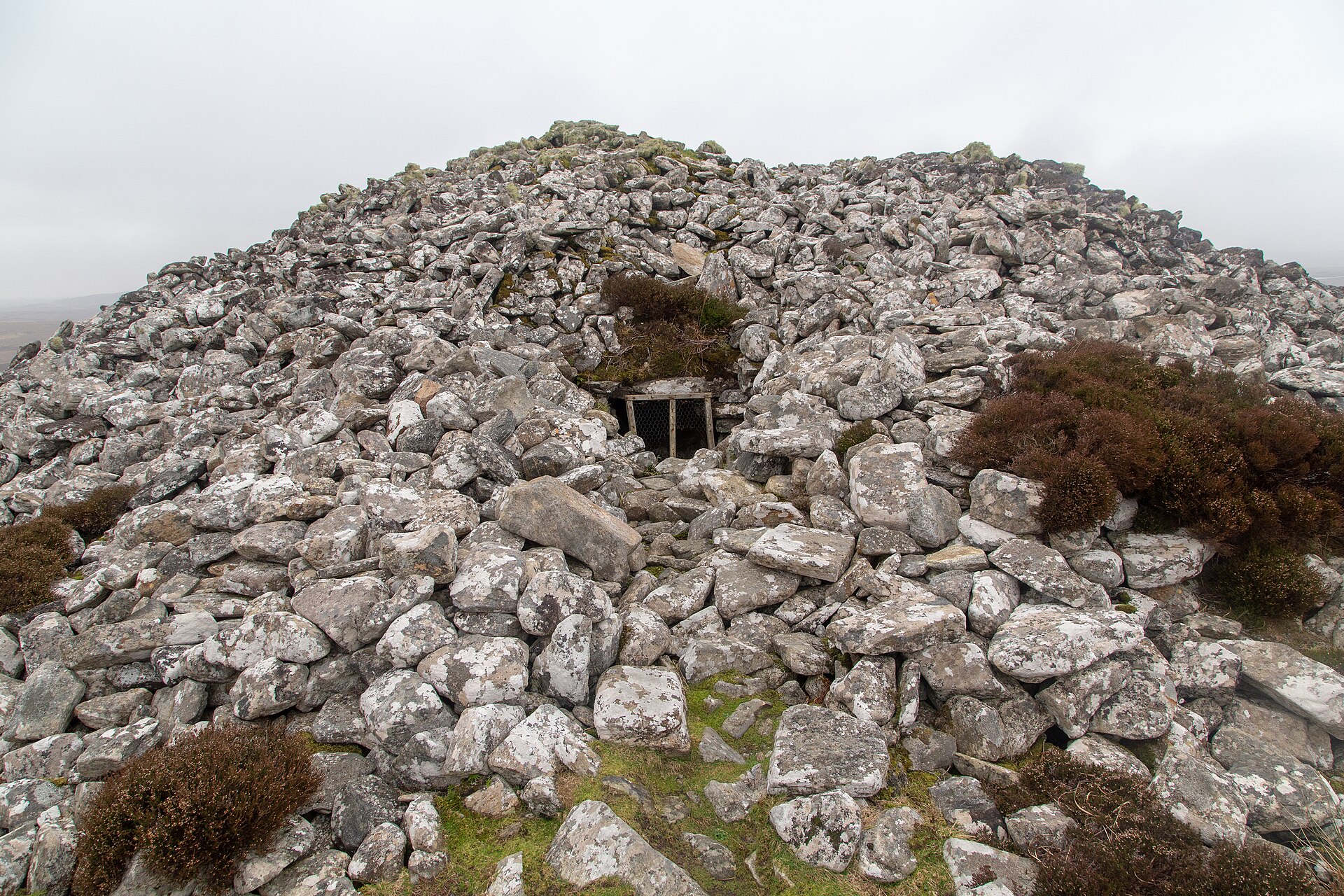
Photo: Tom Parnell / Wikimedia Commons / CC BY-SA 2.0 Chambered cairn three-quarters of a mile up Ben Langass from Pobull Fhinn, reached by the same footpath from the A867.
-
Sòrnaichean Coir’ Fhinn (Kensaleyre, Skye)
Skye site whose near-identical Fionn’s-cauldron name preserves the same Gaelic naming tradition invoked at Pobull Fhinn.
-
Suidhe Coire Fhionn (Arran)
Arran site sharing the Fionn’s-cauldron naming tradition that connects the stones to Gaelic Fenian lore.
What to look for
-
The oval setting
An oval rather than a true circle, measuring about 120 feet (37 metres) east to west and 93 feet (28 metres) north to south, with at least two dozen stones surviving — eight on the northern half and sixteen on the southern half.
-
The excavated northern edge
The natural plateau on which the circle sits has been cut away on the north side to a depth of about 4 feet (1.2 metres), levelling the enclosed ground.
-
The tall east stone
A single tall stone stands about 4 feet (1.2 metres) inside the circle on its eastern side.
-
The fallen western slabs
Two slabs lie fallen roughly 7 feet (2.1 metres) beyond the western edge of the circle.
-
The loch and mountain views
The stones stand silhouetted against Loch Langass, Loch Eport, and the mountain Eaval, a view that makes the site one of the most photographed on North Uist.
What is said
Folklore and tradition, recorded as what is said — not as established fact.
-
Fionn's cauldron
Local tradition holds that Coire Fhinn, Fionn's cauldron, was the vessel in which the legendary hunter and his companions cooked the deer they killed, giving the stones their alternative names Sòrnach Coir' Fhinn and Sòrnach a' Phobaill — "the fireplace of Fionn's cauldron" and "the fireplace of the People".
Plan your visit
- Location
- 57.5642°N · 7.2818°W
- Access
- Open access
- Terrain
- Easy going
- Time needed
- About 45 minutes
Nearby places
Tomb or burial place · Prehistoric
Barpa Langass
Outer Hebrides
Two massive slabs form the roof of Barpa Langass, with a third slab laid on top of them, capping a stone burial mound on the Isle of North Uist tha…
- Easy path

Fortified place · Iron Age
Dun an Sticir
Outer Hebrides
Three stone causeways lace across Loch an Sticir on North Uist, carrying a single line of dry ground from the B893 road to a broch (a tall circular…
- Some walking

Fortified place · Medieval
Borve Castle, Benbecula
Outer Hebrides
On the machair at the south-west tip of Benbecula, in the Western Isles, the ruined shell of a three-storey tower house stands with its north wall…

Tomb or burial place · Prehistoric
St Clement's Church, Rodel
Outer Hebrides
Three generations of MacLeod chiefs are buried in the walls of this building, in tombs they had prepared for themselves while alive. The church at…
- Near Rodel
- Easy path
Questions people ask
- What does the name Pobull Fhinn mean?
- The Gaelic name has been translated as "Fionn's people", "the white or fair people", or "Finn's tent", and has been spelled variously as pobull, poball, pobul, and pobuill; it is thought to derive from Pùball Fhinn, "Fionn's tent", a phrase used in the Fenian cycle of Gaelic lore for the hero's nomadic hunting camp.
- How old is Pobull Fhinn?
- The circle probably dates from the second millennium BC, though, as with most British stone circles, no precise date is recorded.
- How big is the stone setting, and how many stones survive?
- It measures about 120 feet (37 metres) from east to west and 93 feet (28 metres) from north to south, and is technically an oval rather than a true circle. At least two dozen stones survive, eight on the northern half and sixteen on the southern half, with other sections now empty.
- Why is Pobull Fhinn also called Sòrnach Coir' Fhinn?
- Locally the stones are known as Sòrnach a' Phobaill, "the fireplace of the People", and more fully as Sòrnach Coir' Fhinn, "the fireplace of Fionn's cauldron" — a reference to Coire Fhinn, the cauldron in which the legendary hero Fionn mac Cumhaill was said to cook the deer killed on his hunts.
- How is Pobull Fhinn reached?
- It can be reached on foot from a footpath near the Langass Lodge Hotel, or via the path to the chambered cairn of Barpa Langass, which starts from the A867 about five miles (eight kilometres) southwest of Lochmaddy; Barpa Langass itself lies a three-quarter-mile walk further up Ben Langass.
Sources
- Wikipedia: Pobull Fhinn
- Beveridge, Erskine (1911). North Uist. Edinburgh: William Brown & Co.
- Thom, A. (1967). Megalithic Sites in Britain. Oxford: Clarendon Press.
Explore more: Sacred places · Prehistoric · Outer Hebrides
The Ancient Codex, in your pocket
Get the Pocket Codex app
Carry the directory with you — Pobull Fhinn and thousands of ancient places across Britain and Ireland, offline, wherever you roam.