
A thirty-metre stone causeway crosses the water of Loch Bharabhat to reach the islet on which Dun Bharabhat stands, its walls rising above the loch on the island of Great Bernera, close to the west coast of Lewis. The name is pronounced 'Varavat', and the structure is classed as an Iron Age galleried dun, sometimes described as a "semi-broch" — a form that shares the double-walled, gallery-riddled construction of a true broch without reaching the same overall scale.
A thirty-metre stone causeway crosses the water of Loch Bharabhat to reach the islet on which Dun Bharabhat stands, its walls rising above the loch on the island of Great Bernera, close to the west coast of Lewis. The name is pronounced ‘Varavat’, and the structure is classed as an Iron Age galleried dun, sometimes described as a “semi-broch” — a form that shares the double-walled, gallery-riddled construction of a true broch without reaching the same overall scale.
The building is D-shaped in plan, with a wall of uneven thickness, measuring 17 metres by 13 metres externally. Its walls survive to a maximum height of 3.4 metres, and although the structure is badly ruined and strewn with rubble, with its northwest entrance now obscured, Dun Bharabhat is nevertheless regarded as one of the best preserved of all the duns on the island.
What gives the ruin its particular interest is the amount of internal structure still legible within the thickness of the wall itself. At the east end of the high wall a ground-level gallery is visible through a small opening, alongside a stairway, while the upper wall preserves the remains of two superimposed galleries stacked one above the other. At the west end, near the entrance, the opening of a further longitudinal gallery or cell running northeast can still be traced. Taken together, these intramural passages are evident even when viewed from the shore.
What follows is drawn from published sources, with each claim labelled by how firmly it is established.
History
Dun Bharabhat was built during the Iron Age as a galleried dun on an islet in Loch Bharabhat, a defensible position reached only by a causeway roughly 30 metres long that still connects the site to the shore of Great Bernera.
As a "semi-broch", the building was constructed with the hallmark double-wall-and-gallery technique associated with the Atlantic roundhouse tradition, but on a plan — D-shaped rather than circular, and of uneven wall thickness — that sets it apart from a classic tower broch. Within the thickness of the high wall its builders incorporated a ground-level gallery and stairway at the east end, and a second, longitudinal gallery or cell opening northeast from the entrance area at the west end, with two further galleries superimposed above.
The structure has since fallen into ruin, its walls reduced to a maximum surviving height of 3.4 metres and its interior strewn with rubble, while its original northwest entrance is no longer visible. Despite this, enough of the wall core survives — including the intramural galleries traceable from the shore — for Dun Bharabhat to be counted among the best-preserved of the duns scattered across Great Bernera and the wider island landscape.
The site is distinct from another, unrelated structure of the same name — a second Dun Bharabhat situated on a small loch near the northernmost point of Lewis — and the two are conventionally distinguished by their locations.
Cultural influences
-
The D-shaped, double-walled construction shares the gallery system of a broch on a smaller scale.
Connections
-
Dun Bharabhat, Lewis (near the northernmost point of the island)
A separate, unrelated site sharing the same name, situated on a different small loch on Lewis; the two are distinguished by location to avoid confusion.
What to look for
-
The causeway
A roughly 30-metre stone causeway crosses the water of Loch Bharabhat, linking the shore of Great Bernera to the islet on which the dun stands.
-
The D-shaped wall
Rather than the circular plan of a classic broch, Dun Bharabhat's wall traces a D-shape of uneven thickness, measuring 17 by 13 metres externally and standing to a maximum height of 3.4 metres.
-
Ground-level gallery and stairway
At the east end of the high wall, an opening reveals part of a ground-level intramural gallery, with a stairway also present in this section of the building.
-
Superimposed upper galleries
The upper part of the wall retains the remains of two galleries built one above the other, part of the double-wall construction typical of the broch and semi-broch tradition.
-
Longitudinal gallery at the west end
Near the (now-obscured) entrance at the west end of the high wall, the opening of a longitudinal gallery or cell running northeast is still visible.
Plan your visit
- Location
- 58.2166°N · 6.8451°W
- Access
- Open access
- Terrain
- Moderate walking
- Time needed
- About 90 minutes
Nearby places

Sacred place · Prehistoric
Callanish VIII
Outer Hebrides
Four standing stones rise in a semicircle along a cliff edge on the southern side of Great Bernera, looking out over the narrow strait that separat…
- Easy path
Fortified place · Iron Age
Loch na Berie
Outer Hebrides
Loch na Berie sits some 400 yards from the shore of the Isle of Lewis, its broch (a tall circular tower of unmortared stone, found only in Scotland…
- Some walking
Sacred place · Prehistoric
Calanais Standing Stones
Outer Hebrides
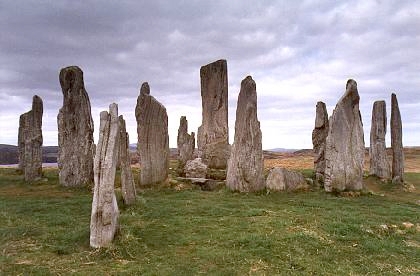
Erected around 2750 BC, before Stonehenge, and laid out so that none of its three stone rows actually points at the centre of its own circle.
- Near Calanais
- 107 metres from car park
- Easy path

Fortified place · Iron Age
Dun Carloway
Outer Hebrides
On the south side of Dun Carloway the original wall still stands to 9.2 metres, and on the east side sections of the old wall reach close to nine m…
- Some walking
Questions people ask
- What kind of structure is Dun Bharabhat?
- It is an Iron Age galleried dun on Great Bernera, near Lewis, sometimes described as a "semi-broch" for its double-walled, gallery-filled construction on a D-shaped rather than fully circular plan.
- Where exactly is Dun Bharabhat located?
- It stands on an islet in Loch Bharabhat on the island of Great Bernera, close to Lewis's west coast, at grid reference NB15583555, and is reached from the shore by a causeway around 30 metres long.
- How big is the structure and how well preserved is it?
- The D-shaped broch measures 17 by 13 metres externally, with walls of uneven thickness surviving to a maximum height of 3.4 metres. It is badly ruined and rubble-strewn, but is nevertheless considered one of the best-preserved duns on the island.
- What internal features can still be seen?
- A ground-level gallery and stairway are visible at the east end of the high wall, the upper wall preserves two superimposed galleries, and a longitudinal gallery or cell opening northeast is traceable at the west end near the entrance. The intramural galleries can be made out from the shore.
- Is there another site called Dun Bharabhat?
- Yes. A separate, unrelated Dun Bharabhat sits on a different small loch near the northernmost point of Lewis, and the two sites are distinguished by their locations to avoid confusion.
Sources
- Dun Bharabhat, Great Bernera — Wikipedia
- Dun Bharabhat, Great Bernera — Wikidata (Q18150929)
- Media related to Dun Bharabhat, Great Bernera — Wikimedia Commons
Explore more: Fortified places · Iron Age · Outer Hebrides
The Ancient Codex, in your pocket
Get the Pocket Codex app
Carry the directory with you — Dun Bharabhat, Great Bernera and thousands of ancient places across Britain and Ireland, offline, wherever you roam.