
Four standing stones rise in a semicircle along a cliff edge on the southern side of Great Bernera, looking out over the narrow strait that separates the island from the Isle of Lewis. Locally the site is known as Tursachan, the Gaelic word for standing stones, and it takes its official name, Callanish VIII, from the modern numbering system archaeologists use to distinguish the many stone settings scattered across the wider Callanish (Calanais) complex.
Four standing stones rise in a semicircle along a cliff edge on the southern side of Great Bernera, looking out over the narrow strait that separates the island from the Isle of Lewis. Locally the site is known as Tursachan, the Gaelic word for standing stones, and it takes its official name, Callanish VIII, from the modern numbering system archaeologists use to distinguish the many stone settings scattered across the wider Callanish (Calanais) complex.
Unlike several of the other Callanish monuments, which form complete rings, Callanish VIII appears to have been built deliberately as a semicircle. The tallest of its four stones stands nearly 3 m high, and the curve of the setting along the cliff-edge axis implies an original diameter of around 20 m. The stones are slabs of Lewisian gneiss, the ancient metamorphic rock underlying Lewis and the surrounding islands, drawn from nearby outcrops or glacial deposits and left with the rough natural surfaces typical of the stone.
Beside the stones lies a shallow natural basin in the exposed bedrock, which fills with rainwater to form a small pool next to the monument. Together the stones and basin sit on peat-covered moorland scattered with patches of bare rock, one small element within a much larger network of prehistoric sites built around Loch Roag during the Neolithic.
What follows is drawn from published sources, with each claim labelled by how firmly it is established.
The name
Tursa, plural Tursachan, is the Gaelic term for standing stones, menhirs or monoliths, so the local name simply means "the standing stones" of the area. The same word, in the form Tursachan Chalanais, is used for the main Calanais Stones as well as for this smaller setting on Great Bernera, reflecting a long-standing Gaelic tradition of naming prehistoric stones this way across the Hebrides. Another Gaelic name recorded for the monument is Cleitir. The designation Callanish VIII itself is a modern archaeological convention, used to distinguish this setting from the many other stone groups in the Calanais landscape.
History
Callanish VIII was raised during the Neolithic as one of a scatter of stone settings built across the moorland of western Lewis around Loch Roag, part of a wider network of monuments rather than an isolated structure. In modern times, as archaeologists surveyed and catalogued the many stone groups around the best-known circle, Callanish I, the site on Great Bernera was assigned the number VIII within that system, fixing its place in the sequence of Callanish monuments alongside sites such as Callanish II, III and IV.
Cultural influences
-
The deliberately semicircular setting uses Lewisian gneiss above the strait between Great Bernera and Lewis.
Connections
-
Callanish I
The best-known and largest stone circle in the Callanish complex, near which Callanish VIII and the other numbered settings are grouped.
-

Photo: Original uploader was Tumulus at en.wikipedia / Wikimedia Commons / CC BY-SA 3.0 Another stone setting within a few kilometres of Callanish I, part of the same wider group of monuments around Loch Roag.
-
Loch Roag
The sea loch above which most of the Callanish monuments, including Callanish VIII, stand on low ridges and gentle slopes.
What to look for
-
The semicircle of four stones
Unlike many other Callanish sites, the setting appears to have been intentionally built as a semicircle rather than a complete ring, arranged along the edge of the cliff.
-
The tallest stone
The tallest stone in the group stands nearly 3 m (9.8 ft) high; the others vary in height and stand either upright or leaning slightly.
-
The rock basin
A shallow natural hollow in the exposed bedrock beside the stones often fills with rainwater, forming a small pool next to the monument.
-
The cliff-edge setting
The stones stand on the southern side of Great Bernera overlooking the narrow strait that separates the island from the Isle of Lewis.
-
Lewisian gneiss
The stones are slabs of Lewisian gneiss, the ancient metamorphic bedrock of Lewis and its surrounding islands, retaining the rough natural surfaces typical of the rock.
Plan your visit
- Location
- 58.2055°N · 6.8291°W
- Access
- Open access
- Terrain
- Easy going
- Time needed
- About 90 minutes
Nearby places
Fortified place · Iron Age
Dun Bharabhat, Great Bernera
Outer Hebrides
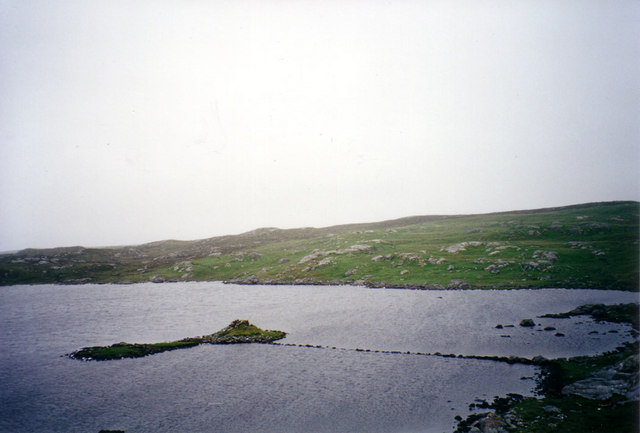
A thirty-metre stone causeway crosses the water of Loch Bharabhat to reach the islet on which Dun Bharabhat stands, its walls rising above the loch…
- Some walking
Sacred place · Prehistoric
Calanais Standing Stones
Outer Hebrides
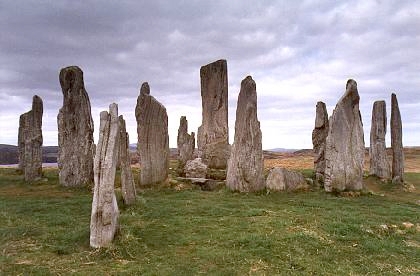
Erected around 2750 BC, before Stonehenge, and laid out so that none of its three stone rows actually points at the centre of its own circle.
- Near Calanais
- 107 metres from car park
- Easy path

Sacred place · Prehistoric
Callanish II
Outer Hebrides
Seven thin standing stones rise from a ridge overlooking Loch Roag, on the western side of Lewis, set out in an ellipse measuring 21.6 by 18.9 metr…
- Easy path
Fortified place · Iron Age
Loch na Berie
Outer Hebrides
Loch na Berie sits some 400 yards from the shore of the Isle of Lewis, its broch (a tall circular tower of unmortared stone, found only in Scotland…
- Some walking
Questions people ask
- What does the name Callanish VIII mean?
- Callanish VIII is a modern archaeological designation distinguishing this stone setting from others in the wider Calanais complex. Locally it is known as Tursachan, the Gaelic word for standing stones, and another recorded Gaelic name for it is Cleitir.
- How many stones make up Callanish VIII, and how tall are they?
- The setting consists of four large standing stones. The tallest stands nearly 3 m (9.8 ft) high, and the arrangement along the cliff edge suggests an original diameter of about 20 m (66 ft).
- Is Callanish VIII a complete stone circle?
- No. Unlike many of the other Callanish monuments, Callanish VIII appears to have been intentionally built as a semicircle rather than a full ring, with the stones arranged along the edge of a cliff.
- What is the rock basin beside the stones?
- It is a shallow, naturally occurring hollow in the exposed bedrock next to the setting, which often fills with rainwater to form a small pool beside the monument.
- How does Callanish VIII relate to the main Callanish stone circle?
- Callanish VIII is one of several smaller stone settings scattered across the moorland of western Lewis around Loch Roag, in addition to the much better-known Callanish I circle and other numbered sites such as Callanish II, III and IV. Together they are thought to have formed part of a wider ceremonial landscape rather than standing as isolated monuments.
Sources
- Callanish VIII, Wikipedia
- Callanish VIII, Wikidata
- Photos of Callanish VIII on the Ancient Scotland site
Explore more: Sacred places · Prehistoric · Outer Hebrides
The Ancient Codex, in your pocket
Get the Pocket Codex app
Carry the directory with you — Callanish VIII and thousands of ancient places across Britain and Ireland, offline, wherever you roam.