
Seven thin standing stones rise from a ridge overlooking Loch Roag, on the western side of Lewis, set out in an ellipse measuring 21.6 by 18.9 metres. Five stones still stand, ranging from 2 to 3.3 metres in height; two have fallen. A slab 1.4 metres long lies in front of the westernmost stone, pointing towards the centre of the circle, where a cairn (a mound of piled stones, often covering a burial) 8.5 metres across sits within the ring, itself only about 90 metres from the water.
Seven thin standing stones rise from a ridge overlooking Loch Roag, on the western side of Lewis, set out in an ellipse measuring 21.6 by 18.9 metres. Five stones still stand, ranging from 2 to 3.3 metres in height; two have fallen. A slab 1.4 metres long lies in front of the westernmost stone, pointing towards the centre of the circle, where a cairn 8.5 metres across sits within the ring, itself only about 90 metres from the water.
The circle stands just a few hundred metres from Callanish III and within sight of the larger, better-known Callanish I. When around a metre of peat was stripped from the site in 1848, workers uncovered four holes cut into the ground beneath — three arranged in an arc to the north-west, one to the south-west — packed with wood charcoal. Archaeologists read the holes as the remains of an earlier timber circle roughly 10 metres across, raised on the same spot before the stone circle replaced it.
Callanish II is generally interpreted as one part of a wider ceremonial landscape spread across the moorland above Loch Roag, a network of stone circles, settings and alignments now known collectively as the Callanish monuments. The cairn built within the circle has been taken as evidence that the site acquired funerary or commemorative significance in a later phase of its use, while proposed alignments between the stones and the horizon — possibly tied to lunar events — remain debated among researchers.
What follows is drawn from published sources, with each claim labelled by how firmly it is established.
History
During the Neolithic, before any stones were raised at the site, a timber circle roughly 10 metres in diameter stood on the same ridge above Loch Roag, its posts later leaving behind holes packed with wood charcoal. Later in the Neolithic, the timber structure was replaced by a stone circle of seven thin standing stones set out in an ellipse 21.6 by 18.9 metres, following a pattern seen at other prehistoric sites across Great Britain and Ireland where wooden monuments gave way to stone settings.
At some point after the stones were raised, a small cairn 8.5 metres across was built within the centre of the circle, a change archaeologists read as evidence that the monument had acquired funerary or commemorative significance during a later phase of its use. In 1848, around a metre — three feet — of peat was removed from the site, exposing four holes in the ground beneath: three grouped in an arc to the north-west and a fourth to the south-west, the buried traces of the earlier timber circle.
Since that discovery, archaeologists have increasingly read Callanish II not as an isolated monument but as one element within the wider Callanish complex — the network of stone circles, settings and alignments on the ridges above Loch Roag that turned this stretch of western Lewis into a place of ritual gathering during the late Neolithic.
Cultural influences
-
Callanish ceremonial landscape
Callanish II’s timber-circle predecessor, stone ring and later central cairn show its changing role within the wider ceremonial landscape of western Lewis.
Connections
-
Callanish I
The larger, better-known stone circle nearby; Callanish II is understood as part of the same ceremonial landscape and is within sight of it.
-
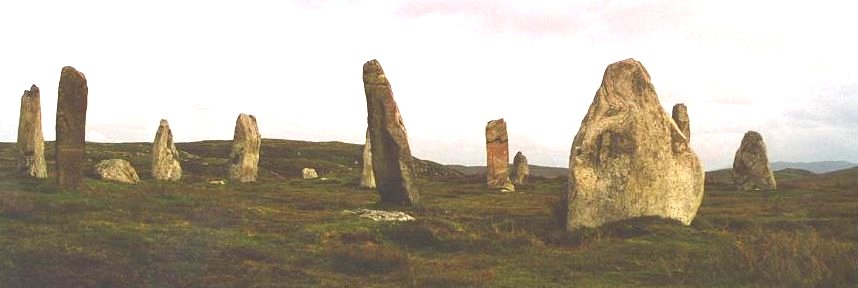
Photo: Tumulus at English Wikipedia / Wikimedia Commons / CC BY-SA 3.0 A stone circle standing just a few hundred metres from Callanish II, part of the same cluster of monuments above Loch Roag.
-

Photo: Tumulus at English Wikipedia / Wikimedia Commons / CC BY-SA 3.0 One of the other minor stone settings scattered across the moorland of western Lewis alongside Callanish II.
-
Loch Roag
The sea loch beside which Callanish II and the wider group of Callanish monuments were built, roughly 90 metres from the stone circle itself.
Discovery & excavation
In 1848, around a metre (three feet) of peat was removed from the site, exposing four holes cut into the ground: three grouped in an arc at the north-west and one at the south-west. Wood charcoal recovered from the holes suggested they had held the timber posts of an earlier circle roughly 10 metres in diameter, built on the site before the standing stones were raised.
What to look for
-
The elliptical stone setting
Seven thin standing stones arranged in an ellipse measuring 21.6 by 18.9 metres; five remain upright, standing between 2 and 3.3 metres tall, while two have fallen.
-
The pointing slab
A slab 1.4 metres long lies in front of the westernmost stone, oriented so that it points towards the centre of the circle.
-
The central cairn
A cairn 8.5 metres in diameter sits within the ring of standing stones, thought to reflect a later funerary or commemorative phase of the site's use.
-
Sightlines to neighbouring monuments
From the ridge, other elements of the Callanish complex — including Callanish III and the main Callanish I circle — can be seen, a visibility that researchers suggest may have been deliberate.
Plan your visit
- Location
- 58.1944°N · 6.7289°W
- Access
- Open access
- Terrain
- Easy going
- Time needed
- About 30 minutes
Nearby places
Sacred place · Prehistoric
Callanish III
Outer Hebrides
Two concentric ellipses of stone stand on the moor above Loch Roag on the Isle of Lewis, forming Callanish III: Gaelic name Cnoc Fillibhir Bheag. T…
- Easy path
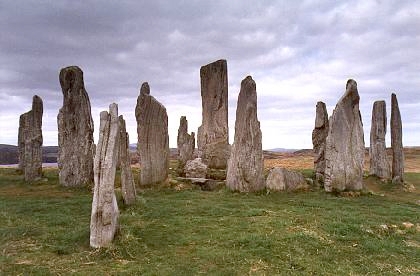
Sacred place · Prehistoric
Calanais Standing Stones
Outer Hebrides
Erected around 2750 BC, before Stonehenge, and laid out so that none of its three stone rows actually points at the centre of its own circle.
- Near Calanais
- 107 metres from car park
- Easy path

Sacred place · Prehistoric
Callanish IV
Outer Hebrides
Five stones stand today at Callanish IV, arranged in a pronounced oval measuring 13.3 by 9.5 metres on open moorland southeast of the main Callanis…
- Easy path

Sacred place · Prehistoric
Callanish VIII
Outer Hebrides
Four standing stones rise in a semicircle along a cliff edge on the southern side of Great Bernera, looking out over the narrow strait that separat…
- Easy path
Questions people ask
- How many stones make up Callanish II and how are they arranged?
- Seven thin standing stones are arranged in an ellipse measuring 21.6 by 18.9 metres. Five remain standing, ranging from 2 to 3.3 metres in height, while two have fallen.
- What was found when peat was removed from the site in 1848?
- Workers removing around a metre of peat uncovered four holes in the ground — three in an arc to the north-west and one to the south-west — containing wood charcoal, evidence of an earlier timber circle about 10 metres across.
- How is Callanish II related to Callanish I?
- Callanish II is one of several smaller monuments scattered around the larger, better-known Callanish I stone circle. Archaeologists interpret it as part of the same wider ceremonial landscape above Loch Roag rather than as an isolated site.
- Was there an earlier monument on the site before the stone circle?
- Yes. Excavation revealed that the stone circle was built over an earlier timber circle roughly 10 metres in diameter, suggesting the location held ceremonial importance before the stones were raised.
- What was Callanish II used for?
- Its precise purpose is uncertain. Archaeologists generally interpret it as part of a wider ceremonial landscape, with the central cairn suggesting a later funerary or commemorative role, and some researchers have proposed possible alignments with lunar events, though this remains debated.
Sources
- Callanish II — Wikipedia
- Callanish II — Wikidata
- Photos of Callanish II on the Ancient Scotland site
Explore more: Sacred places · Prehistoric · Outer Hebrides
The Ancient Codex, in your pocket
Get the Pocket Codex app
Carry the directory with you — Callanish II and thousands of ancient places across Britain and Ireland, offline, wherever you roam.