
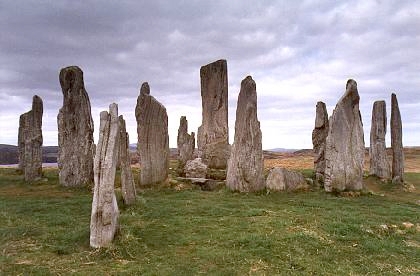
Two concentric ellipses of stone stand on the moor above Loch Roag on the Isle of Lewis, forming Callanish III — Gaelic name Cnoc Fillibhir Bheag. The outer ring, about 13.7 by 13.1 metres across, once held thirteen stones; eight still stand, five have fallen, and there is no trace of a central mound or cairn (a mound of piled stones, often covering a burial). Within it sits a tighter, markedly oval inner ring measuring 10.5 by 6.6 metres, of which only four stones survive, the tallest reaching 2.1 metres.
Two concentric ellipses of stone stand on the moor above Loch Roag on the Isle of Lewis, forming Callanish III — Gaelic name Cnoc Fillibhir Bheag. The outer ring, about 13.7 by 13.1 metres across, once held thirteen stones; eight still stand, five have fallen, and there is no trace of a central mound or cairn. Within it sits a tighter, markedly oval inner ring measuring 10.5 by 6.6 metres, of which only four stones survive, the tallest reaching 2.1 metres.
Callanish III is one of several megalithic groupings scattered across the moorland of western Lewis, all of them smaller and less visited than the well-known Callanish I nearby. Excavation showed that the stone circle was not the first structure on the site: postholes found beneath the stones belong to an earlier timber monument, meaning the ground had already been chosen as a gathering place before anyone raised a single slab of stone.
The monoliths themselves were cut from Lewisian gneiss, the same ancient metamorphic rock that still breaks through the peat across the surrounding moor, and were set upright in prepared pits with packing stones wedged around their bases to hold them steady.
What follows is drawn from published sources, with each claim labelled by how firmly it is established.
The name
The monument's Scottish Gaelic name is Cnoc Fillibhir Bheag, distinct from the more widely known Calanais I a short distance away.
History
Callanish III is generally dated to the late Neolithic, most likely between about 3000 and 2500 BC, the period when many of the stone settings scattered across the Isle of Lewis were erected. It forms part of the wider group of prehistoric sites known collectively as the Callanish monuments, scattered across the ridges above Loch Roag, which together make up one of the most concentrated ceremonial landscapes of prehistoric Great Britain.
Before the stones were raised, the site already carried meaning for the people who used it. Excavation revealed that the circle was built on the location of an earlier timber monument: postholes found beneath the standing stones show that wooden posts once occupied the same spot, evidence that the ground had already been chosen for gathering or ceremony long before any stone arrived. Comparable sequences — timber structures later replaced by stone — are known at several other prehistoric sites across Great Britain and Ireland.
When the builders came to raise the stone circle, they worked with slabs of Lewisian gneiss, the ancient metamorphic bedrock of Lewis, pieces of which still break through the peat across the surrounding moor. Suitable slabs were likely selected from nearby outcrops or glacial deposits, hauled short distances, and raised upright in prepared pits, with packing stones wedged around their bases to hold them steady.
The change from a circle of wooden posts to a ring of enduring stone marks what archaeologists interpret as the monumentalisation of an older meeting place: a site that already mattered to the community was given a more permanent, lasting form on the open moor above Loch Roag, anchoring it in the landscape for generations to come.
Cultural influences
-
The double stone setting was built within the wider group of Neolithic monuments around Loch Roag.
Connections
-
Callanish I
The best known and largest of the Callanish monuments, standing a short distance away and giving the wider group its name.
-

Photo: Original uploader was Tumulus at en.wikipedia / Wikimedia Commons / CC BY-SA 3.0 One of several other stone settings within a few kilometres of Callanish III, part of the same ceremonial landscape above Loch Roag.
-

Photo: Tumulus at English Wikipedia / Wikimedia Commons / CC BY-SA 3.0 Another nearby monument in the wider Callanish group, differing in form from Callanish III's concentric ellipses.
-

Photo: Original uploader was Tumulus at en.wikipedia / Wikimedia Commons / CC BY-SA 3.0 A further site within the Callanish group scattered across the moorland of western Lewis.
Discovery & excavation
Excavation of the site established that the stone circle was raised on the site of an earlier timber monument: postholes found beneath the stones show that wooden posts once stood in the same location before being replaced by the permanent stone setting.
What to look for
-
Outer ring
An ellipse about 13.7 by 13.1 metres across, originally set with 13 stones; eight remain standing and five have fallen.
-
Inner oval
A pronounced oval measuring 10.5 by 6.6 metres, of which only four stones survive, the tallest standing 2.1 metres high.
-
No central mound
Unlike some related monuments, Callanish III shows no sign of a central mound or cairn.
-
Lewisian gneiss
The standing stones are slabs of Lewisian gneiss, the ancient bedrock of the island, outcrops of which still surface through the peat on the surrounding moor.
Plan your visit
- Location
- 58.1956°N · 6.7242°W
- Access
- Open access
- Terrain
- Easy going
- Time needed
- About 30 minutes
Nearby places

Sacred place · Prehistoric
Callanish II
Outer Hebrides
Seven thin standing stones rise from a ridge overlooking Loch Roag, on the western side of Lewis, set out in an ellipse measuring 21.6 by 18.9 metr…
- Easy path
Sacred place · Prehistoric
Calanais Standing Stones
Outer Hebrides
Erected around 2750 BC, before Stonehenge, and laid out so that none of its three stone rows actually points at the centre of its own circle.
- Near Calanais
- 107 metres from car park
- Easy path

Sacred place · Prehistoric
Callanish IV
Outer Hebrides
Five stones stand today at Callanish IV, arranged in a pronounced oval measuring 13.3 by 9.5 metres on open moorland southeast of the main Callanis…
- Easy path

Sacred place · Prehistoric
Callanish VIII
Outer Hebrides
Four standing stones rise in a semicircle along a cliff edge on the southern side of Great Bernera, looking out over the narrow strait that separat…
- Easy path
Questions people ask
- How old is Callanish III?
- It is generally dated to the late Neolithic, probably erected between about 3000 and 2500 BC, the period when many of the stone settings on Lewis were built.
- How many stones does Callanish III have?
- The outer ellipse originally held 13 stones, of which eight are still standing and five have fallen. The inner oval originally held more but only four stones now survive, the tallest measuring 2.1 metres.
- Was there anything on the site before the stone circle?
- Yes. Excavation found postholes beneath the stones, showing that an earlier timber monument stood on the same spot before the stone circle was built.
- What stone was used to build the circle?
- The stones are slabs of Lewisian gneiss, the ancient metamorphic rock that forms the bedrock of the Isle of Lewis and still breaks through the peat across the surrounding moor.
- How does Callanish III relate to the other Callanish monuments?
- It is one of several stone settings scattered across the moorland above Loch Roag, alongside Callanish I (the best known and largest), Callanish II, Callanish IV, and Callanish VIII, together forming a wider prehistoric ceremonial landscape.
Sources
Explore more: Sacred places · Prehistoric · Outer Hebrides
The Ancient Codex, in your pocket
Get the Pocket Codex app
Carry the directory with you — Callanish III and thousands of ancient places across Britain and Ireland, offline, wherever you roam.