
On an inter-tidal sea stack off the north-east coast of the Isle of Lewis, near the village of Knockaird (Cnoc Àrd) in the district of Ness (Nis), the ruins of two large buildings and a cluster of interconnecting cellular structures lie among the grassy tussocks of Dùn Èistean. The most prominent feature is a large circular mound of rubble on the highest point of the stack, at its north-east side, while a low turf wall traces the perimeter of the site and an artificial pond, built to supply fresh water, still holds its shape. A topographical survey of the island has mapped these buildings, revealing a settlement equipped for self-sufficient occupation, with structures serving purposes from storage to sleeping quarters.
On an inter-tidal sea stack off the north-east coast of the Isle of Lewis, near the village of Knockaird (Cnoc Àrd) in the district of Ness (Nis), the ruins of two large buildings and a cluster of interconnecting cellular structures lie among the grassy tussocks of Dùn Èistean. The most prominent feature is a large circular mound of rubble on the highest point of the stack, at its north-east side, while a low turf wall traces the perimeter of the site and an artificial pond, built to supply fresh water, still holds its shape. A topographical survey of the island has mapped these buildings, revealing a settlement equipped for self-sufficient occupation, with structures serving purposes from storage to sleeping quarters.
In local oral tradition, Dùn Èistean is remembered as the stronghold of Clan Morrison, once a highly powerful family within the Lordship of the Isles. Almost all of the surviving structures and finds recovered from the island date not from the site’s earlier Norse-period associations but from the sixteenth to eighteenth centuries, the period of clan strife that followed the forfeiture of the Lordship of the Isles.
The site is multi-period, with earlier layers of history likely still buried beneath its later dun and turf buildings. It is now the focus of ongoing archaeological research into the history of Ness, carried out by the University of Glasgow’s Archaeological Research Division, GUARD Archaeology.
What follows is drawn from published sources, with each claim labelled by how firmly it is established.
History
Between around AD 800 and AD 1300, the Western Isles were culturally Scandinavian and politically part of Norway, setting Lewis and the wider archipelago on a historical and archaeological path distinct from mainland Scotland during the medieval period. Dùn Èistean belongs to a wider family of physically similar coastal sites around Lewis and the southern Western Isles, several of which were occupied or used during these same centuries, and excavation at comparable sites has turned up evidence of activity reaching back into the Iron Age or earlier prehistoric periods; it is considered likely that similar early evidence still awaits discovery at Dùn Èistean itself, buried beneath the later dun and turf buildings.
Norse political control of the Western Isles collapsed during the thirteenth century, and in the power vacuum that followed, powerful new clans emerged, among them the Morrisons, Macleods and Macaulays, whose rivalries and alliances form the backdrop to the local traditions and stories associated with Dùn Èistean. The Morrisons of Harris and Lewis are traditionally placed from Barvas to the Port of Ness, and also in the north-west Highlands around Durness in Sutherland, where they were allied with Clan Mackay; their septs include Morison, Gilmore and, in Scottish Gaelic, MacGilleMhoire.
The forfeiture of the Lordship of the Isles in the late fifteenth century removed the central authority that had held the region together, ushering in the intermittent clan wars and strife remembered in Gaelic as Linn nan Creach, the Era of Strife. It is against this volatile backdrop that almost all of the surviving structures and finds on the Dùn Èistean stack date, from the sixteenth to eighteenth centuries, the period when the site served as a Clan Morrison stronghold.
Highland and island society came under progressively tighter government control following the destruction of the clan system after the failed Jacobite Rebellions of the eighteenth century, bringing the era of clan strongholds such as Dùn Èistean to a close. In 2015, archaeological work at the site recovered some of the earliest gun flints found anywhere in the British Isles, a find that points to the island's continued occupation and defence into the age of firearms.
Dùn Èistean is now the focus of a multi-disciplinary research project into the history and archaeology of Ness, carried out under the auspices of the University of Glasgow's Archaeological Research Division, GUARD Archaeology.
People
-
Clan Morrison
Dùn Èistean is remembered in local oral tradition as the clan's traditional stronghold, and almost all surviving structures and finds on the island date from the period of its occupation.
Cultural influences
-
Most surviving structures and finds date to the sixteenth-to-eighteenth-century period of clan strife.
Connections
-
Clan Mackay
Traditional allies of the Morrisons of Durness in Sutherland.
-
Lordship of the Isles
Clan Morrison was once a highly powerful family within the Lordship; the Lordship's forfeiture in the late 15th century set off the period of strife during which the site was mainly occupied.
-
GUARD Archaeology (University of Glasgow)
Runs the ongoing multi-disciplinary research project into the history and archaeology of Ness, including Dùn Èistean.
Discovery & excavation
In 2015, archaeological investigation at Dùn Èistean recovered some of the earliest gun flints found anywhere in the British Isles. The find underscores the site's occupation into the era of firearms and its value to the ongoing GUARD Archaeology and University of Glasgow research project into the history and archaeology of Ness.
What to look for
-
The two main building ruins
The remains of two large buildings stand among the grassy tussocks on top of the stack, alongside groups of interconnecting cellular structures mapped by a topographical survey of the site.
-
The circular rubble mound
The most prominent feature of the site is a large circular mound of rubble situated on the highest point of the stack, on its north-east side.
-
The artificial pond
An artificial pond on the island supplied fresh water, allowing occupation without recourse to the mainland.
-
The turf wall
A low turf wall encloses the site, marking the boundary of the settlement on top of the stack.
What is said
Folklore and tradition, recorded as what is said — not as established fact.
-
Stronghold of Clan Morrison
Local oral tradition holds that Dùn Èistean was the traditional stronghold of Clan Morrison, once a highly powerful family within the Lordship of the Isles.
Plan your visit
- Location
- 58.5033°N · 6.2321°W
- Access
- Open access
- Terrain
- Moderate walking
- Time needed
- About 90 minutes
Nearby places

Tomb or burial place · Prehistoric
Steinacleit
Outer Hebrides
Ten large stone slabs ring a low central mound on the west coast of Lewis, the only part still standing of the stone burial mound known as Steinacl…
- Easy path

Sacred place · Prehistoric
Clach an Trushal
Outer Hebrides
On the west side of Lewis, in the village of Ballantrushal, a single grey pillar of stone rises 5.8 metres out of the machair. Clach an Trushal is…
- Easy path
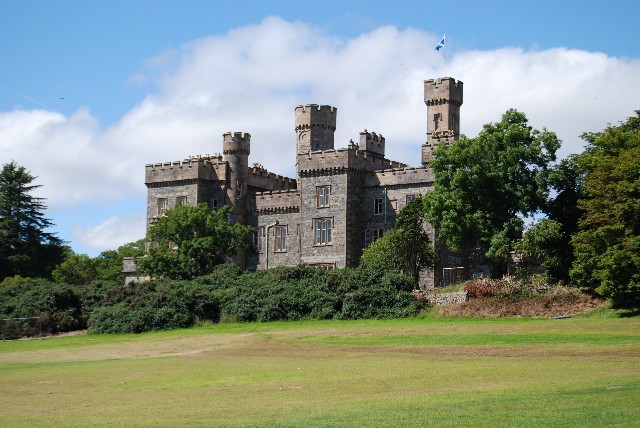
Fortified place · Medieval
Lews Castle
Outer Hebrides
A private retreat built on an opium-trade fortune ended up given whole to the town it once stood apart from: a rare reversal for a Highland laird's…
- Easy path

Fortified place · Iron Age
Dun Carloway
Outer Hebrides
On the south side of Dun Carloway the original wall still stands to 9.2 metres, and on the east side sections of the old wall reach close to nine m…
- Some walking
Questions people ask
- What is Dùn Èistean?
- Dùn Èistean is a multi-period archaeological site on an inter-tidal sea stack on the north-east coast of the Isle of Lewis, near the village of Knockaird in the district of Ness, in Scotland's Western Isles.
- Which clan is Dùn Èistean associated with?
- In local oral tradition it is regarded as the traditional stronghold of Clan Morrison, once a highly powerful family within the Lordship of the Isles.
- When was the site mainly occupied?
- Almost all of the surviving structures and finds date from the sixteenth to eighteenth centuries, though the Western Isles' Norse-period history (c. AD 800 to c. AD 1300) and comparisons with similar coastal sites suggest earlier, possibly prehistoric, evidence may still lie undiscovered beneath the later buildings.
- What structures survive on the site?
- The ruins of two large buildings and groups of interconnecting cellular structures survive on top of the stack, along with a large circular rubble mound at its highest point, an artificial pond, and a low turf wall enclosing the site.
- What has recent archaeology found at Dùn Èistean?
- In 2015, excavation recovered some of the earliest gun flints found anywhere in the British Isles. The site is now the focus of an ongoing research project into the history and archaeology of Ness, run by GUARD Archaeology, part of the University of Glasgow.
Sources
- Dùn Èistean — Wikipedia
- Dùn Èistean — Wikidata
- Dùn Èistean Archaeology Project
- GUARD Archaeology
Explore more: Fortified places · Iron Age · Outer Hebrides
The Ancient Codex, in your pocket
Get the Pocket Codex app
Carry the directory with you — Dùn Èistean and thousands of ancient places across Britain and Ireland, offline, wherever you roam.