The oldest cathedral in Scotland, now a Church of Scotland parish church in Kirkwall.
Two cousins agreed to meet on a small island, each bringing two ships. Magnus came on 16 April 1116 with his two. Hakon came with eight. Magnus was taken, and when he offered to go into exile or into prison instead, an assembly of chieftains ruled that one of the earls had to die. Hakon’s own standard bearer refused to do it. His cook, Lifolf, was made to, and killed Magnus with an axe blow to the head.
They had ruled Orkney together amicably enough for nine years before their followers fell out. Magnus was known for piety and gentleness — on a raid against Anglesey he had declined to fight at all and stayed aboard singing psalms — and after his burial at Birsay the rocky ground around the grave was said to have turned green, with healings reported there. William the Old, Bishop of Orkney, announced that it was heresy to go about with such tales, and was then struck blind in his own cathedral. His sight came back after he prayed at the grave.
The cathedral at Kirkwall was begun in 1137 and added to across the next three hundred years. William the Old was its first bishop, and the Bishop’s Palace nearby was built for him. Until the Reformation the Bishop of Orkney presided here; today it is a parish church of the Church of Scotland, and since 2024 its congregation has been part of a single Orkney-wide parish. It is listed at Category A, the highest grade in Scotland.
It also has a dungeon, and the dungeon was used. People accused of witchcraft in Orkney between 1594 and 1708 were generally imprisoned in the cathedral, and tried in it as well.
What follows is drawn from published sources, with each claim labelled by how firmly it is established.
History
Magnus had a reputation for piety and gentleness. On a raid led by the King of Norway against Anglesey he refused to fight at all and stayed aboard his ship singing psalms. King Eystein II of Norway later granted him a share of the earldom of Orkney held by his cousin Hakon, and the two ruled amicably as joint earls from 1105 to 1114.
Their followers fell out. The two sides met at a thing, an assembly, on Mainland Orkney ready to give battle, but peace was negotiated and the earls agreed to meet on the small island of Egilsay, each bringing two ships and no more. Magnus arrived on 16 April 1116, or perhaps 1117, with his two. Hakon came with eight. Magnus was taken and offered to go into exile or into prison, but an assembly of chieftains insisted that one of the earls must die. Hakon's standard bearer refused to carry out the execution, so Hakon ordered his cook Lifolf to do it, and Lifolf killed Magnus with an axe blow to the head.
Magnus was buried at the Christchurch in Birsay, where the rocky ground around his grave was said to have turned miraculously green and reports of healings multiplied. William the Old, Bishop of Orkney, warned that it was heresy to go about with such tales, and was then struck blind in his own cathedral at Birsay; his sight returned after he prayed at the grave of Magnus.
Construction of the cathedral began in 1137 and continued in additions across the next three hundred years. William the Old was the first Bishop of Orkney, and the nearby Bishop's Palace was built for him. Before the Scottish Reformation the cathedral was presided over by the Bishop of Orkney. The building has its own dungeon, and it was not ornamental. People accused of witchcraft in Orkney between 1594 and 1708 were usually held in the cathedral, and their trials were heard here too.
Today it serves as a parish church of the Church of Scotland, under presbyterian governance, and since 2024 its congregation has formed part of a single Orkney Islands ecclesiastical parish. It is listed at Category A, the highest grade of protection for a building in Scotland.
People
-
St Magnus
Joint earl of Orkney from 1105, killed on Egilsay by his cousin's cook after an assembly insisted one earl must die.
-
Earl Hakon
Magnus's cousin and co-earl, who came to the peace meeting with eight ships instead of two and ordered the killing.
-
Lifolf
Hakon's cook, made to carry out the execution after the standard bearer refused.
-
William the Old
First Bishop of Orkney, who dismissed the miracle stories as heresy and was struck blind before praying at the grave.
Cultural influences
-
The cathedral’s long medieval construction produced a substantial church in contrasting red and yellow sandstone, an enduring landmark in Kirkwall.
Connections
-
The cathedral and chambered cairn represent successive sacred landscapes around Orkney’s main settlement, from prehistoric ritual to medieval Christianity.
-
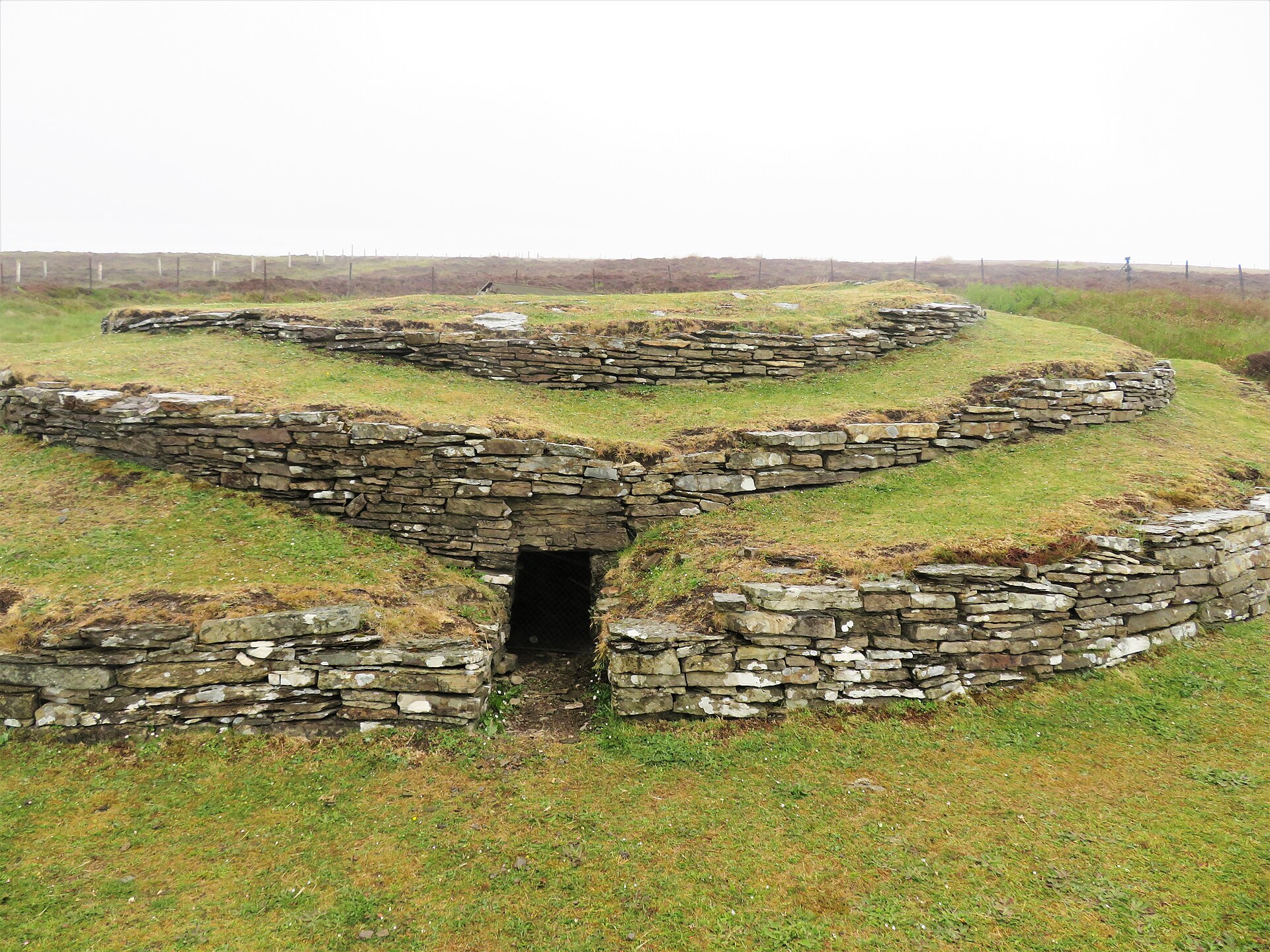
Photo: Gordon Hatton / Wikimedia Commons / CC BY-SA 2.0 Both monuments belong to Orkney Mainland’s long sequence of sacred and funerary sites, linking prehistoric cairns with Kirkwall’s medieval cathedral.
-

Photo: Otter at Dutch Wikipedia (Original text: Hopmans) / Wikimedia Commons / CC BY-SA 3.0 The cathedral and earth house span different periods of Orkney’s religious and domestic history, from prehistoric subterranean architecture to medieval worship.
What to look for
-
The dungeon
The cathedral held people accused of witchcraft in Orkney between 1594 and 1708, and their trials were heard here.
-
Three centuries of building
Construction began in 1137 and continued through additions over the following three hundred years.
-
The Bishop’s Palace nearby
The adjoining Bishop’s Palace was built for William the Old, the first Bishop of Orkney.
-
Category A protection
The cathedral is Category A listed, Scotland’s highest statutory protection grade for a historic building.
What is said
Folklore and tradition, recorded as what is said — not as established fact.
-
Magnus’s miracle tradition
The Orkneyinga saga says the ground at Magnus’s grave in Birsay turned green and healings followed; it also recounts William the Old’s blindness and recovery after prayer at the grave.
Plan your visit
- Location
- 58.9814°N · 2.9599°W
- Nearest settlement
- Kirkwall
- Time needed
- About 60 minutes
- Best time
- Daylight hours
- What survives
- The largely intact medieval cathedral retains its long-built fabric and functioning parish-church role, including the former dungeon.
- Facilities
- Visitor facilities depend on the current cathedral operation; check before travelling.
Opening & admission
Free entry.
- October–March: Monday–Saturday 09:00–13:00 and 14:00–17:00. April–September: Monday–Saturday 09:00–17:00 and Sunday 13:00–17:00.
- The cathedral may close for weddings or funerals; notices are displayed outside. Sunday worship is usually at 11:15.
Nearby places
Tomb or burial place · Prehistoric
Quanterness chambered cairn
Orkney Islands
A burial monument on Mainland into which a roundhouse was built about 700 BC, and which held the remains of 157 people.
- Some walking
Tomb or burial place · Prehistoric
Wideford Hill chambered cairn
Orkney Islands
Wideford Hill is a Stone Age burial mound on Mainland Orkney, with a chamber, side chambers and masonry that shows how the tomb was built.
- Near Kirkwall
- Easy path

Tomb or burial place · Prehistoric
Rennibister Earth House
Orkney Islands
An underground structure on Mainland, probably for storage, found in 1926 when a threshing machine broke through it.
- Some walking
Questions people ask
- Who was Magnus?
- An earl of Orkney with a reputation for piety and gentleness. On a raid led by the King of Norway against Anglesey he refused to fight at all and stayed aboard his ship singing psalms. King Eystein II later granted him a share of the earldom held by his cousin Hakon, and the two ruled amicably.
- How did he die?
- Their followers fell out, and the earls agreed to meet on the small island of Egilsay, each bringing two ships and no more. Magnus arrived on 16 April 1116, or perhaps 1117, with his two. Taken and offered exile or prison, he was condemned by an assembly of chieftains who insisted one earl must die; Hakon's standard bearer refused the execution, so Hakon ordered his cook Lifolf to do it.
- What followed his burial?
- Magnus was buried at the Christchurch in Birsay, where the rocky ground around his grave was said to have turned miraculously green and reports of healings multiplied. William the Old, Bishop of Orkney, warned that it was heresy to go about with such tales and was then struck blind in his own cathedral. Construction here began in 1137.
Sources
The Ancient Codex, in your pocket
Get the Pocket Codex app
Carry the directory with you — St Magnus Cathedral, Kirkwall and thousands of ancient places across Britain and Ireland, offline, wherever you roam.