
An enigmatic small coastal chapel whose proximity to the disputed Castle Bloody offers a rare glimpse of medieval worship beside a much older Shapinsay monument.
Linton Chapel stands in ruins on the east coast of Shapinsay, and the most interesting thing about it is what lies a short distance to the south. Castle Bloody — a prehistoric structure that archaeologists and the Ordnance Survey cannot agree about, read either as a chambered mound or as a souterrain — occupies the same stretch of shore.
That pairing is common in Orkney and almost never explained. Christian sites frequently sit close to much older ones, and whether that reflects continuity of belief, continuity of good building ground, or nothing at all is not usually recoverable from a small chapel with no documented history.
The chapel itself is thought to date from as early as the twelfth century, the period when churches across Orkney were first raised in stone, after the islands settled under the earldom and the bishopric. A building of this size on a coastal site was for local worship rather than for any grand foundation.
The record says very little more. There is no detailed account of its walls or fittings, and what a visitor finds is an outline on the shore and an older, stranger monument just along from it.
What follows is drawn from published sources, with each claim labelled by how firmly it is established.
History
Linton Chapel is a ruined chapel on Shapinsay’s east coast, thought to date as early as the twelfth century. Its dedication, parish and founder are not known from surviving records. The chapel belongs to the period when churches across Orkney were increasingly built in stone under the earldom and bishopric. Its small coastal scale suggests local worship rather than a major religious foundation.
The chapel and graveyard were scheduled in 1951. In 2005 the protected boundary was enlarged to include the full known extent of the archaeological remains. The documented monument is a small coastal chapel ruin with its burial ground. Detailed evidence for former fittings and wall elevations has not survived, so the visible outline is the principal feature for visitors.
Cultural influences
-
The small coastal chapel belongs to the period when churches across Orkney were first being raised in stone.
Connections
-
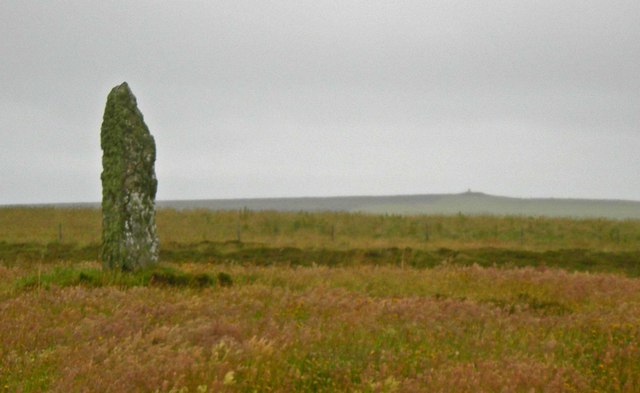
Photo: See above. / Wikimedia Commons / CC BY-SA 2.0 Mor Stein is one of the prehistoric monuments in the Shapinsay landscape around Linton Chapel, making the chapel part of a coast where visible ritual and settlement remains span very different periods.
-

Photo: C Michael Hogan / Wikimedia Commons / CC BY-SA 2.0 Castle Bloody lies south of Linton Chapel on the same Shapinsay coast. The prehistoric mound or souterrain and the medieval chapel are explicitly recorded together in site descriptions, but no evidence establishes a direct functional link between them.
-

Photo: Otter / Wikimedia Commons / CC BY-SA 3.0 Burroughston Broch, Castle Bloody and Linton Chapel form a small Shapinsay coastal group of prehistoric and medieval monuments. The broch’s Iron Age settlement setting shows how the chapel later occupied an already archaeologically rich shore.
Discovery & excavation
The chapel and its burial ground were first scheduled in 1951; the scheduled area was enlarged in 2005 to include the full extent of the archaeological remains.
What to look for
-
Chapel outline
The site survives as the outline of a small ruined chapel on Shapinsay’s east coast.
-
Prehistoric neighbour
Castle Bloody, a chambered mound or souterrain, lies a short distance to the south.
Plan your visit
- Location
- 59.0521°N · 2.8215°W
- Access
- Open access
- Terrain
- Easy going
- Time needed
- About 20 minutes
- Best time
- Daylight hours
- What survives
- A small coastal chapel ruin survives without a detailed record of its former fittings or wall elevations.
Opening & admission
No operator-published admission details are currently available; confirm access locally before travelling.
- Linton is a small scheduled chapel ruin and graveyard on Shapinsay’s east coast. No official opening hours or managed visitor facilities are published.
Nearby places
Sacred place · Prehistoric
Mor Stein
Orkney Islands
An isolated three-metre standing stone whose uncarved bulk records the considerable communal labour of quarrying, moving and raising a monument who…
- Near Shapinsay
- Easy path

Tomb or burial place · Prehistoric
Castle Bloody
Orkney Islands
An unresolved Shapinsay structure that may be a burial mound or an underground passage connected with settlement, challenging easy readings of how…
- Easy path

Fortified place · Iron Age
Burroughston Broch
Orkney Islands
One of Orkney’s best-preserved brochs, its intact guard chamber, wall gallery and internal well make the defensive engineering of a tower from abou…
- Some walking
Fortified place · Iron Age
Loch of Tankerness
Orkney Islands
A shallow loch whose shrinking water exposed a Bronze Age house, while its shores bring together Iron Age, prehistoric and modern water-supply arch…
- Near Kirkwall
- Easy path
Questions people ask
- How old is the chapel?
- It is thought to date from as early as the twelfth century.
- Where is it?
- On the east coast of Shapinsay in Orkney, at grid reference HY5218.
- What else is nearby?
- Castle Bloody, a megalithic monument, lies slightly to the south — so a prehistoric structure and a medieval chapel occupy the same stretch of coast.
Sources
The Ancient Codex, in your pocket
Get the Pocket Codex app
Carry the directory with you — Linton Chapel and thousands of ancient places across Britain and Ireland, offline, wherever you roam.