
Broken in two and hidden for centuries under a church floor, this cross-slab carries the only Pictish (of the Picts, the people of northern and eastern Scotland from about AD 300 to 900) carving known to repeat the same symbol three times over.
A slab of fine-grained sandstone, carved on both faces and along its edges, once lay unnoticed beneath the floorboards of an old parish church in the Black Isle village of Rosemarkie. Whoever laid it there, or whoever walked over it for generations afterwards, had no reason to suspect that the stone beneath their feet was an elaborately worked Pictish monument, broken into two pieces and put to use simply as paving.
When it finally came to light, sometime before 1821, the stone revealed one of the more accomplished surviving pieces of Pictish sculpture: a richly decorated cross filling one face, and on the other a set of the symbols the Picts carved onto stone across northern Scotland for centuries. Rosemarkie itself is thought to have been the site of a major Pictish monastery on the Black Isle in Easter Ross, which helps explain why a carving of this quality was made there in the first place.
The two broken sections were later rejoined, and the reassembled stone now stands in Rosemarkie’s Groam House Museum, a short walk from the ground in which it was found. It is classified as a Class II Pictish stone, meaning it pairs the older tradition of incised symbols with the cross of the new Christian faith on the same monument.
What follows is drawn from published sources, with each claim labelled by how firmly it is established.
History
Rosemarkie, on the Black Isle in Easter Ross, is thought to have grown into the site of a major Pictish monastery, and it was within this religious community, probably during the early medieval Pictish period, that a mason carved a substantial cross-slab from fine-grained local sandstone, combining a Christian cross with the symbols long used in Pictish art on the same monument.
At some later point the carved stone ceased to stand as a monument in its own right and instead ended up incorporated into the floor of the old parish church in the village of Rosemarkie, buried from view and unrecognised for an unknown length of time before anyone realised what lay beneath the paving. The stone was rediscovered in the floor of the old church sometime before 1821, by which point it had already broken into two separate pieces; despite the damage, enough of each fragment survived to show that they belonged to a single elaborately carved Pictish cross-slab once they were lifted clear of the floor.
The two broken sections were subsequently reconstructed into a single upright monument, rejoining the fragments back into the form of the original cross-slab, and the reassembled stone passed into the care of Rosemarkie's Groam House Museum, where it remains on permanent display today.
Cultural influences
-
Pictish Christian sculpture
The slab combines a Christian cross with Pictish symbols, linking Rosemarkie’s early church community to both traditions.
Connections
-
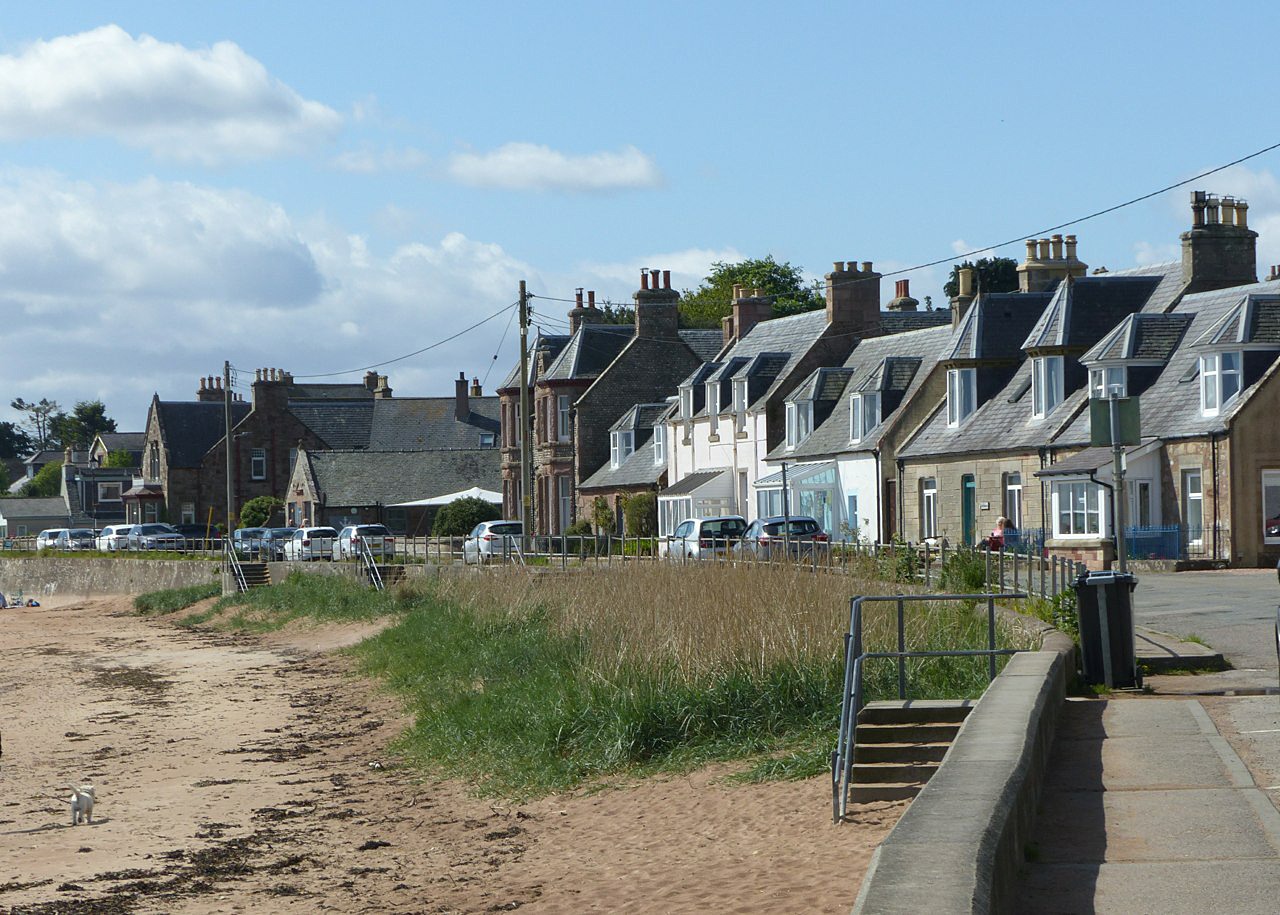
Photo: Alan Murray-Rust / Wikimedia Commons / CC BY-SA 2.0 Rosemarkie sculpture fragments
A related group of carved stone fragments recovered from the same site at Rosemarkie, alongside which the Rosemarkie Stone is usually discussed.
-
Groam House Museum, Rosemarkie
Holds the reconstructed Rosemarkie Stone and displays it to the public.
-
Pictish monastery at Rosemarkie
Rosemarkie is thought to have been the site of a major Pictish monastery, the community in which the stone was most likely carved.
Discovery & excavation
The stone was found sometime before 1821 in the floor of the old church in Rosemarkie, where it had been laid as paving. It was broken into two pieces at the time of its discovery; both fragments were later reconstructed into a single monument, which is now held and displayed at Rosemarkie's Groam House Museum.
What to look for
-
The cross face
One side of the slab carries an elaborately decorated cross, the dominant image on the stone.
-
Triple crescent symbols
The reverse face carries three separate crescent-and-V-rod symbols, making this the only known Pictish stone to repeat the same symbol three times.
-
Double-disc and Z-rod
Alongside the crescents, the reverse also bears a double-disc and Z-rod symbol, another common motif of Pictish symbol carving.
-
The smaller cross
A second, smaller cross appears at the bottom of the reverse face, beneath the main symbol carvings.
-
Interlace on the sides
The narrow side faces of the stone are decorated with interlace patterns, carried around the whole monument rather than confined to the front and back.
Plan your visit
- Location
- 57.5914°N · 4.1133°W
- Nearest settlement
- Rosemarkie
- Access
- Open access
- Terrain
- Easy going
- Time needed
- About 30 minutes
- Best time
- During Groam House Museum opening hours.
- What survives
- The two formerly broken sections have been reconstructed into a single upright cross-slab on museum display.
Opening & admission
Check the museum before travelling.
- Reconstructed stone is displayed in Groam House Museum.
Nearby places
Carved stone · Pictish & early medieval
Rosemarkie sculpture fragments
Highland
Fourteen carved fragments, including a slab showing Daniel in the lion's den, reveal a Pictish (of the Picts, the people of northern and eastern Sc…
- Near Rosemarkie
- Easy path

Building or ruin · Medieval
Fort George
Highland
Completed in 1769 at more than double its original budget, it is one of the most sophisticated artillery fortifications ever built in Europe: and i…
- Near Ardersier
Minor monument · Medieval
Market Cross, Church Street, Cromarty
Highland
Cromarty’s market cross, the stone cross marking a burgh’s right to hold a market, preserves a rare civic document in stone: its 1578 shaft and Geo…
- Near Cromarty
- Easy path
Minor monument · Medieval
Dovecot, Kilravock Castle
Highland
Kilravock’s pigeon house, built to keep birds for winter meat, makes the estate’s long-running economy tangible within a building altered from medi…
- Near Cawdor
Questions people ask
- What is the Rosemarkie Stone?
- A Class II Pictish stone carved with a cross on one face and Pictish symbols on the other, among the major surviving examples of Pictish stone carving.
- Where was the Rosemarkie Stone found?
- It was found before 1821 in the floor of the old church in the village of Rosemarkie, on the Black Isle in Easter Ross.
- Why is the stone unusual among Pictish carvings?
- Its reverse face carries three crescent-and-V-rod symbols, making it the only known Pictish stone to repeat the same symbol three times.
- Where can the Rosemarkie Stone be seen today?
- The reconstructed stone is on display at Groam House Museum in Rosemarkie.
- Was the stone always in one piece?
- No. It was broken into two parts when found, and these have since been reconstructed into the single monument now on display.
Sources
- Wikipedia: Rosemarkie Stone
- Wikidata: Rosemarkie Stone
- Fraser, Ritchie et al., Pictish Symbol Stones: An Illustrated Gazetteer (RCAHMS, 1999)
- MacNamara, The Pictish Stones of Easter Ross (Tain, 2003)
Explore more: Carved stones · Pictish & early medieval · Highland
The Ancient Codex, in your pocket
Get the Pocket Codex app
Carry the directory with you — Rosemarkie Stone and thousands of ancient places across Britain and Ireland, offline, wherever you roam.