The only medieval castle still standing within Glasgow's boundaries, and the very first property the National Trust for Scotland ever acquired.
One tower still climbs to its full height above the trees on this hill over the Levern Water; beside it lies only the buried footing of a second, blown apart by cannon fire and never rebuilt. That ragged pairing is the clearest record of what Crookston Castle has survived, and why its silhouette owes as much to a 15th-century bombardment as to the builders who first raised it.
The hill was a stronghold long before that stone tower existed. In the 12th century Sir Robert de Croc, whose name the site still carries, built a timber and earth castle here inside a ring ditch that can still be traced around the summit, and founded a chapel nearby in 1180 whose remains have since been uncovered. Around 1400 the Stewarts of Darnley, who had held the surrounding lands since the 1330s, replaced de Croc’s earthworks with the stone tower house that stands today, laid out on an unusual X-plan with a squat tower at each corner of a rectangular main block.
That plan, and the castle’s later ties to the earls of Lennox and to Mary, Queen of Scots’ second husband, Henry Stuart, Lord Darnley, made Crookston more than a local stronghold — for a time it was the principal seat of one of Scotland’s great noble families. It is now the second-oldest building in Glasgow after Glasgow Cathedral, a scheduled monument open to the public and cared for by Historic Environment Scotland.
What follows is drawn from published sources, with each claim labelled by how firmly it is established.
The name
The name Crookston derives from Sir Robert de Croc, the 12th-century lord who built the first timber and earth castle on this hill and gave his name to the village that grew up around it.
History
In the 12th century Sir Robert de Croc, the man who gave Crookston its name, built a timber and earth castle on this hill and encircled it with the ring ditch that can still be traced around the summit today. He founded a chapel nearby in 1180, whose remains have since been uncovered, and traces of an even earlier fortification have been found beneath his own work, showing the hill was valued as a stronghold well before any stone was laid.
The lands passed to Sir Alan Stewart in 1330 and then, in 1361, to Sir John Stewart of Darnley, whose family set about replacing de Croc's earth-and-timber castle entirely. Around 1400 the Darnley Stewarts raised the stone tower house that survives today, built to an unusual X-plan with a tower at each corner of a rectangular main block — a layout also found at Hermitage Castle in the Borders.
In 1489 the Stewart Earl of Lennox rebelled against James IV, and the king brought the great siege cannon Mons Meg from Edinburgh to bring him to heel. The bombardment virtually destroyed the castle's western end, and the two towers on that side were never rebuilt; a swift surrender followed, and later repairs in the 19th century obscured even the ruins that Mons Meg had left behind.
On 3 April 1544 the castle was besieged and captured by the Earl of Arran and Cardinal Beaton while the Earl of Lennox was away defending Glasgow Castle itself; Crookston was by then regarded as the Lennox earls' principal residence. Regent Arran followed up by installing five gunners in the castle that May, and the damage from this siege required extensive repair work in the years that followed.
The castle later formed part of the dower lands of Margaret Douglas, Countess of Lennox, whose son Henry Stuart, Lord Darnley — the second husband of Mary, Queen of Scots — was, by tradition, betrothed to her beneath a yew tree on the hill. The tree was felled in 1816, and a model of the castle carved from its wood is now kept at Pollok House. In 1572 Crookston passed to another Stewart, Charles, Earl of Lennox.
Ownership passed from the Stewarts to the Duke of Montrose in 1703, and it remained with the Dukes of Montrose until 1757, when the 2nd Duke sold Crookston to the Maxwells of Pollok. After years of neglect the Maxwells carried out a partial restoration in 1847 to mark Queen Victoria's visit to Glasgow, bringing the ruin back into some order after more than a century of abandonment.
In 1931 Sir John Maxwell Stirling-Maxwell, one of the National Trust for Scotland's founding members, presented Crookston to the Trust as its very first property. During the Second World War the surviving north-east tower was pressed into service as an aircraft watch post, before the castle settled into its present role as a scheduled monument open to the public.
People
-
Sir Robert de Croc
Built the first timber and earth castle on the hill in the 12th century and founded a chapel here in 1180; gave his name to Crookston.
-
Sir John Stewart of Darnley
Acquired the lands in 1361; his family replaced de Croc's earthworks with the stone castle raised around 1400.
-
Henry Stuart, Lord Darnley
Son of Margaret Douglas, Countess of Lennox, and second husband of Mary, Queen of Scots; tradition holds he was betrothed at Crookston.
-
Sir John Maxwell Stirling-Maxwell
Founding member of the National Trust for Scotland who presented Crookston to the Trust in 1931 as its first property.
Cultural influences
-
The Darnley Stewart tower-house
Around 1400 the Darnley Stewarts replaced the earlier earth-and-timber stronghold with an unusual X-plan stone tower house, a form shared with Hermitage Castle and central to Crookstons surviving character.
Connections
-
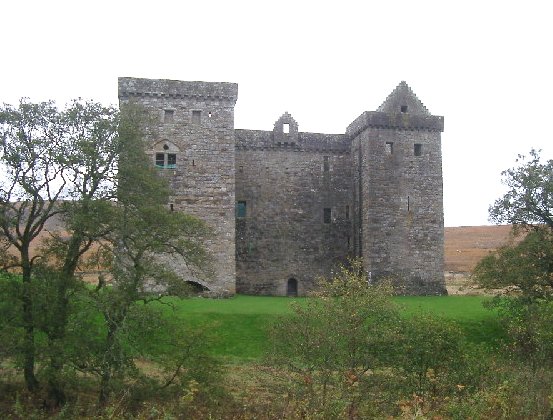
Photo: Kirsty Smith / Wikimedia Commons / CC BY-SA 2.0 Shares Crookston's unusual X-plan layout, with a tower set at each corner of the main block.
-
Pollok House
Holds the wood-carved model of Crookston Castle made from the timber of the felled betrothal yew tree.
-
.jpg?width=320)
Photo: Bewahrerderwerte / Wikimedia Commons / CC BY-SA 4.0 The only building in Glasgow older than Crookston Castle, which is the city's second-oldest surviving building.
Discovery & excavation
Investigation at Crookston has uncovered the remains of the chapel that Robert de Croc founded in 1180, along with evidence of an even earlier fortification beneath the 12th-century earthworks, showing the hill was defended before any castle recorded by name stood on it.
In culture
-
The Abbot by Sir Walter Scott
In his 1820 novel The Abbot, Scott has Mary, Queen of Scots watch the Battle of Langside from beneath Crookston's yew tree — a scene the actual topography of the site makes impossible.
-
Poems by Burns, Motherwell and Tannahill
The castle is also mentioned in verse by Robert Burns, William Motherwell and Robert Tannahill, part of a wider Scots literary tradition of writing about ruined strongholds.
What to look for
-
The surviving north-east tower
The only tower to survive to its full height, this corner tower is around 6 m square and rises through four storeys, reachable today by modern iron ladders leading up to a view from the roof.
-
The vaulted hall
At first-floor level the barrel-vaulted hall rises to 8.3 m, with a turnpike stair in the south-east corner once giving access to a further storey above and to rooms in the eastern towers.
-
The entrance and basement
The north-facing entrance was defended by a portcullis and two doors; beyond it a barrel-vaulted basement holds slit windows and a well, while a straight mural stair climbs to the right.
-
The 12th-century ring ditch
Around the base of the hill runs the ring ditch dug by Sir Robert de Croc in the 12th century, still traceable on the ground and one of the earliest surviving features of the site.
-
The prison chamber
Within the basement of the north-east tower is a prison cell accessible only from above, a reminder of the castle's role as a working stronghold rather than simply a residence.
What is said
Folklore and tradition, recorded as what is said — not as established fact.
-
Betrothal beneath the yew
Local tradition holds that Henry Stuart, Lord Darnley, was betrothed to Mary, Queen of Scots, beneath a yew tree at Crookston, though this cannot be confirmed with certainty.
Plan your visit
- Location
- 55.8350°N · 4.3558°W
- Nearest settlement
- Gloucester
- Access
- Open access
- Time needed
- About 45 minutes
- Best time
- Visit in daylight and dry conditions, when the castle ruins and surrounding landscape can be viewed safely.
- What survives
- The castle survives as the substantially intact north-east tower and adjoining remains of the once four-towered stone block, within the earlier earthworks on the hilltop.
- Facilities
- No dedicated visitor facilities are documented at the ruins; plan to use facilities in nearby settlements.
Opening & admission
Free entry.
- Open daily 9.30am–5.30pm from 1 April to 30 September; from 1 October to 31 March, open Monday to Wednesday and Saturday to Sunday, 10am–4pm.
- Last entry is 30 minutes before closing. Check Historic Environment Scotland’s current closure notice before travelling.
Nearby places

Sacred place · Medieval
Paisley Abbey
Renfrewshire
Robert II was born here by caesarean section in 1316, after his mother fell from her horse nearby. A stone marker stands where she came off.
.jpg?width=800)
Building or ruin · Medieval
Glasgow Cathedral
Glasgow City
One of only two medieval Scottish cathedrals: alongside St Magnus in Orkney: to survive the Reformation (the sixteenth-century suppression of monas…
- Near Gloucester

Ancient tree · Medieval
Wallace Oak (Elderslie)
Renfrewshire
By the mid-nineteenth century a Scotsman's snuff box was expected to contain a fragment of this oak. The relic trade is what killed it.
- Near Renfrewshire
The setting
Near Crookston Castle, about 6 metres away.
Photo: Lairich Rig / Wikimedia Commons / CC BY-SA 2.0
Near Crookston Castle, about 6 metres away.
Photo: Richard Sutcliffe / Wikimedia Commons / CC BY-SA 2.0
Near Crookston Castle, about 13 metres away.
Photo: Richard Sutcliffe / Wikimedia Commons / CC BY-SA 2.0
Near Crookston Castle, about 13 metres away.
Photo: Richard Sutcliffe / Wikimedia Commons / CC BY-SA 2.0
Questions people ask
- When was Crookston Castle built?
- The surviving stone castle was built around 1400 by the Stewarts of Darnley, replacing an earlier timber and earth castle raised on the same hill in the 12th century by Sir Robert de Croc.
- Is Crookston Castle the oldest building in Glasgow?
- No — it is the second-oldest building in Glasgow, after Glasgow Cathedral, but it is the only surviving medieval castle within the city.
- Why is the castle missing its western towers?
- In 1489 James IV bombarded the castle with the cannon Mons Meg after the Earl of Lennox rebelled, destroying the western towers; they were never rebuilt.
- What is Crookston Castle's connection to the National Trust for Scotland?
- It was the Trust's first property, presented in 1931 by Sir John Maxwell Stirling-Maxwell, one of the Trust's founding members.
- Can visitors go inside the castle?
- Yes — Crookston Castle is a scheduled monument maintained by Historic Environment Scotland and is open to the public.
Sources
- Wikipedia: Crookston Castle
- Historic Environment Scotland — Visitor Guide
- Coventry, Martin — The Castles of Scotland (3rd Edition), Goblinshead, 2001
- Mason, Gordon — The Castles of Glasgow and the Clyde, Goblinshead, 2000
Explore more: Fortified places · Medieval · Glasgow City
The Ancient Codex, in your pocket
Get the Pocket Codex app
Carry the directory with you — Crookston Castle and thousands of ancient places across Britain and Ireland, offline, wherever you roam.