
Tantallon is Scotland’s last medieval curtain-wall castle, a dramatic coastal fortress whose single massive landward wall defended a naturally cliff-bound headland.
Tantallon’s huge red-sandstone curtain wall cuts across a promontory above the Firth of Forth, facing Bass Rock. Sea cliffs defend three sides; the whole military problem of the site is concentrated into one heavily fortified landward barrier.
Built for the Red Douglas earls and repeatedly besieged by kings, Covenanters and Cromwell’s army, it was left a ruin after 1651. Its unusually complete defensive logic makes the ruined towers, ditch and gatehouse exceptionally legible.
The defences comprise only that single large wall securing a coastal promontory, a form unique in Scotland. The south-east, north-east and north-west approaches are naturally defended by steep sea cliffs and were only ever protected by relatively small walls. To the south-west the massive curtain wall blocks off the end of the promontory, which forms the inner courtyard. Built of local red sandstone, the wall has a tower at each end and a heavily fortified gatehouse in the centre, all of which provided residential accommodation. A north range containing a hall completed the main part of the castle, enclosing a courtyard about 70 by 44 metres. In total the buildings offered around 1,100 square metres of accommodation.
In form Tantallon follows the twelfth-century castles of Bothwell and Kildrummy as a castle of enceinte. It was the last of that type built in Scotland, the smaller tower house having become increasingly popular — Threave Castle, raised at about the same time by Earl William’s cousin Archibald the Grim, is a much more modest tower. There are also similarities with courtyard castles such as Doune, of the late fourteenth century, which is likewise entered through a passage beneath a strong keep tower.
The curtain wall is over 15 metres high, 3.6 metres thick and around 90 metres long, with several small chambers within it and stairs under arched ceilings reaching the parapet walk. That walk, beneath the sixteenth-century crenels, connects the three towers.
The north-west tower, the Douglas Tower, was circular and 12 metres across, though the west side has collapsed. Seven storeys high, it formed the lord’s donjon, holding his private accommodation and connecting to the hall in the north range. Its lowest storey was a pit prison, and the timber-floored chambers above were square, with vaulted garderobes.
The East Tower is D-planned with the curved face outwards, 9 metres across. Originally of five storeys, its bottom three were reduced to two after the siege of 1528 by the insertion of stone vaults, and large gun ports were added in the basement at the same time. Its third floor was designed to open onto a parapet on the south-east wall, but that wall was never built.
The central gatehouse tower is square, 13 metres across and up to 24 metres high, and held four storeys of chambers, some with canopied fireplaces, though the internal walls and floors are gone. The main entrance ran through a passage below, protected by a drawbridge, three pairs of doors, a portcullis and machicolations — holes in the ceiling through which defenders could drop missiles. Two bartizans face in towards the courtyard, where a sixteenth-century spiral stair climbs to the head of the curtain wall. The entrance was originally a pointed arched gateway flanked by round towers. A barbican added in the early fourteenth century was destroyed in 1528, though fragments remain. After that siege the gatehouse facade was rebuilt with more gun ports at ground level and the gateway corridor narrowed; the work covered the remains of the earlier round towers and gave the tower rounded corners for additional strength.
The north range, about 10 by 40 metres, connects to the Douglas Tower. Its western section is fourteenth-century and holds the remains of the great hall, used by the lord, above the laigh or low hall used by the labourers and later divided into cellars; the marks of the hall’s pitched roof can be seen on the inside wall of the Douglas Tower. The sixteenth-century eastern section contained a bakehouse and further private chambers and has partly collapsed into the sea. Only a small stretch of the other walls survives to the east, containing a postern gate that gave access to the sea through a cleft in the cliffs below. The well is 32 metres deep and was re-excavated in the nineteenth century.
Alongside the curtain wall runs a deep rock-cut ditch, with a larger second ditch about 100 metres away defining the outer court. Two mounds inside the outer ditch may, Charles McKean suggests, conceal sixteenth-century caponiers — defensive positions allowing covering fire along a trench. McKean notes that Sir James Hamilton of Finnart, the King’s Master of Works and the engineer who built Scotland’s only known caponiers at Craignethan and Blackness, was present with the King at the 1528 siege and worked here afterwards. A stone-fronted mound formerly ran outside the ditch; only a 30-metre section of that outer wall survives, at the south end, ending in a two-storey round tower with several gun ports, built before 1528 and perhaps inspired by the new artillery defences at nearby Dunbar Castle. A seventeenth-century lectern doocot is the only building in the outer court. Beyond the outer ditch lie a seventeenth-century ravelin, a triangular earthen artillery defence, and the remains of a third, smaller ditch.
A map of the area drawn before 1300 shows a castellated site named Dentaloune, possibly a corruption of the Brythonic din talgwn, high-fronted fortress. The barony of North Berwick, Tantallon included, then belonged to the Earls of Fife.
In 1346 William Douglas, nephew of Robert the Bruce’s companion Sir James Douglas, returned from France to claim his inheritance as chief of the name. By murdering his godfather, Sir William Douglas of Liddesdale, he became undisputed head of the House of Douglas, and was created Earl of Douglas in 1358. How he came to hold Tantallon is unclear, but in correspondence of 1374 he calls it our castle of Temptaloun. He may have been made castellan as a tenant of Isabella, Countess of Fife, and appears to have built the present castle shortly before or shortly after his elevation, to reflect his new standing. It was meant as a status symbol, though its curtain-wall form was already becoming outmoded.
Tantallon was the home of Douglas’s sister-in-law and mistress Margaret Stewart, third Countess of Angus, mother of his illegitimate son George Douglas. In 1377 the Earl of Angus made his close friend Alan de Lawedre of The Bass constable, an office he held until at least 1389. When the second Earl of Douglas died in 1388 the Earl of Fife claimed the lands and confirmed the countess’s right to live there; several attempts were made to dislodge her, but Parliament formalised an agreement in April 1389 and George Douglas was recognised as Earl of Angus in right of his mother.
The barony stayed with the Earldom of Fife, but the castle itself passed outright to George Douglas — the beginning of the division in the house, with Archibald the Grim heading the main line, the Black Douglases, and George the progenitor of the Red. In 1397 George married Princess Mary Stewart, daughter of Robert III, allying the Red Douglases with the Stewarts. Isabella, Countess of Lennox, widow of the executed Duke of Albany, was warded here from 1425 to 1433, and in 1429 another royal enemy, Alexander, Lord of the Isles, was held here until his reconciliation with James I two years later. The third Earl of Angus made Tantallon his main residence and was in rebellion from 1443 until his death; his raid on the Black Douglas lands of Abercorn brought retaliation and his forfeiture in 1446. In 1452 James II granted the castle to the fourth earl, who led the royal force that defeated the Black Douglases at Arkinholm in May 1455.
Archibald Bell-the-Cat, fifth earl, turned against the crown in 1482 and around 1490 struck a treasonable agreement with Henry VII against James IV. On 11 October 1491 James besieged the castle with guns sent from Edinburgh and Linlithgow and crossbows and culverins from Leith, but Angus submitted and little damage was done. By 1493 he was back in favour as Chancellor.
In 1514 Archibald Douglas, sixth Earl of Angus, married James IV’s widow Margaret Tudor, Regent for her infant son James V. The couple conspired unsuccessfully to take the young king to England, sparking civil war; the regency passed to John Stewart, Duke of Albany, who seized Tantallon in 1515 and returned it when Angus made peace. Margaret Tudor stopped here on her way to England that year and left valuable costume and jewels behind, including several chaffrons and a diamond given her by Louis XII of France, which were collected by Thomas Dacre’s agent.
In 1525 Angus, backed by Henry VIII, staged a virtual coup, taking custody of the king and becoming Chancellor. In 1528 the sixteen-year-old James V escaped, joined his mother at Stirling and pronounced Angus attainted. Angus retreated here and then to England; the castle was seized but he returned and refortified it. On 23 October 1528 the king laid siege, the defence in the hands of Angus’s servant Simon Penango while Angus himself remained at Billie in the Merse. Alexander Jardine of Applegarth, Master of Artillery, consulted Robert Borthwick and John Drummond about the guns required, and James borrowed cannon from Dunbar Castle, held by Albany’s French garrison. According to Pitscottie, Captain Maurice of Dunbar supplied Thrawinmouth, Mow and her marrow, two great botcards, two moyanes, two double falcons and four quarter falcons, with powder, gunners and bullets; James left three hostages in pledge. The castle was bombarded for twenty days, but the deep outer ditch kept the guns too far off to do substantive damage. The king lifted the siege and returned to Edinburgh, whereupon Angus counterattacked, captured the royal artillery and killed the principal gunner David Falconer.
Angus wrote to the Earl of Northumberland that James had brought Scottish and French engineers, ingenious men, to the siege without success. In May 1529 he fled to England, and Penango, receiving no further supplies or reinforcements, made terms and surrendered. Tantallon was held as a royal fortress until James V’s death in 1542, when Angus returned and recovered it.
The king had meanwhile set about repairs. Sir Thomas Erskine of Brechin, his secretary, was made keeper and organised the strengthening work, and was here in July 1533; the castle then went to the king’s eldest illegitimate son James, and Oliver Sinclair was installed as captain. Accounts for 1537 to 1539 record George Sempill as master mason working under John Scrimgeour, the King’s Master of Works. The gatehouse front was rebuilt and the East Tower strengthened, wide-mouthed gun holes were punched through the landward walls, and a crenellated parapet was added to the curtain wall; several chambers and passages within the great landward wall were filled with masonry, as can still be seen.
On his return in 1542 Angus was still in contact with Henry VIII, and allowed Sir Ralph Sadler, the English ambassador, to reside here during the attempts to negotiate a marriage between the infant Mary, Queen of Scots, and Edward, Prince of Wales. It has been claimed that the Earl of Hertford’s army bypassed Tantallon during the invasion of 1544 because of the earl’s English sympathies, but Hertford was keen to put an English garrison in it and negotiated unsuccessfully with one of the keepers, Alexander Jardine. The nearby castle of Oliver Sinclair was among the places burnt by the returning English army in May 1544, and Tantallon was unmolested again in 1547. Angus was imprisoned at Blackness Castle in 1544, after which he changed sides to support the Scottish cause; the gunners here were rewarded in August 1548 for firing on English ships during an engagement in the Firth of Forth.
Angus died at Tantallon in January 1557 and the castle was seized by the army of the Queen Regent, Mary of Guise. Simon Preston, laird of Craigmillar, was made keeper and repairs followed the next year, six labourers called barrowmen spending ten days in April 1558 cleaning out the well. George Drummond of Blair held it with a garrison of seven horsemen and 22 soldiers. James Douglas, fourth Earl of Morton, took control in 1565 on behalf of his nephew the young eighth Earl of Angus, but the following year Mary, Queen of Scots, gave the captaincy to Robert Lauder of the Bass and his son — an appointment that followed the surrender of Sir William Douglas of Lochleven, one of those charged with the murder of Rizzio. Mary visited in November 1566.
Andrew Hume was captain in 1577. The eighth earl was exiled to England in 1581 and left some of the best furnishings with Lord Hunsdon at Berwick-upon-Tweed, including a bed of green velvet and damask, a bed of crimson velvet embroidered with images and beasts of gold, and a bed of cloth of silver and gold; he had the brewhouse repaired in September 1583. In April 1584 the keepers of Fast Castle, Innerwick and Tantallon were commanded to surrender their castles to the crown. After the eighth earl died in 1588 the Earls of Angus generally lived elsewhere. An inventory of furnishings and armaments was made in February 1592, and in July James VI took possession, installing Alexander Home of North Berwick as captain. In September 1596 the captain, Stephen Bruntfield, was killed by James Carmichael, son of the Captain of the Royal Guard; Bruntfield’s brother Adam later killed Carmichael in single combat. William Douglas, tenth Earl of Angus, took up residence on 5 November 1608.
Military action returned with the Bishops’ Wars. The Douglases had remained Catholic after the Reformation, incurring the wrath of the Presbyterian Covenanters who opposed Charles I’s attempts to interfere with the Scottish Church, and in 1639 the Covenanters captured the castle while William, newly created Marquess of Douglas, was in Edinburgh.
Cromwell’s forces invaded Scotland in 1650 and took the south of the country after Dunbar in September. In February 1651 Cromwell found his communications under attack from a small Royalist group based here — 91 men under Alexander Seton. His answer was to send between 2,000 and 3,000 troops under General Monck with much of the artillery he had in Scotland. Seton was ennobled by Charles II as Viscount of Kingston on 14 February, during the siege. After twelve days of bombardment a breach was made in the Douglas Tower and the defenders were compelled to surrender, though only after quarter had been granted in recognition of their bravery. The castle was left in ruins and never repaired or inhabited again. The Commonwealth land forces in that siege were supported by the Commonwealth Navy.
The same year brought one of the few recorded uses of the dungeon, when the Captain of the Bass Rock took an English ship carrying provisions to the English army in the west — a cargo of 6,000 pairs of boots, 5,000 saddles and 10 tons of London beer — and the captured crew were imprisoned here.
James Douglas, second Marquess of Douglas, was forced by gambling debts accrued by himself and his father to consolidate his estates, and in 1699 sold the ruins to Sir Hew Dalrymple, President of the Court of Session, who already owned the barony of North Berwick, the Bass, Fidra and other property nearby. Dalrymple allowed the castle to decay further and to be quarried to some extent for stone. Sir Walter Scott described it at length in his 1808 poem Marmion. The Dalrymples carried out some restoration in the late nineteenth century, and in 1924 Sir Hew Hamilton-Dalrymple handed the castle to the Office of Works.
In 1944 it played a part in the preparations for the Normandy invasion. A few weeks before D-Day, captured German Würzburg, Freya and Seetakt radars — the types defending the French coast — were moved here and used to train RAF bomber crews, among them 617 Squadron, in a deception intended to mislead the Germans about where the Allies would land. Beginning the night before the landings, thin strips of aluminium foil were dropped in vast numbers in carefully choreographed patterns over many hours, to create on German radar the illusion of huge approaching fleets. The technique was perfected in the waters off Tantallon and carried out on the night of 5 to 6 June off the coast of France.
The ruins appear in Jonathan Glazer’s 2013 thriller Under the Skin, with Scarlett Johansson and Michael Moreland shown on the roof and descending the narrow inside staircase; the location manager Eugene Strange said the castle had to be coastal so that the actors would be buffeted on the ramparts. It has also served as the setting for the challenges Warrior’s Wall and Stones of Destiny in the fourteenth episodes of series 11 and 12 of Raven and in episodes 2 and 3 of the Gaelic miniseries Fitheach. In modern times the castle and its surroundings have attracted several ghost stories.
What follows is drawn from published sources, with each claim labelled by how firmly it is established.
History
William Douglas, first Earl of Douglas, built Tantallon in the mid-fourteenth century on a coastal headland five kilometres east of North Berwick. It became the seat of the Red Douglases through his illegitimate son George, Earl of Angus. The castle is Scotland’s last medieval curtain-wall castle: cliffs protect three sides, while a single massive wall closes the landward approach.
The curtain wall is about 90 metres long, 3.6 metres thick and more than 15 metres high, with the Douglas Tower, East Tower and central gatehouse. A rock-cut ditch and outer court strengthened the approach. James IV besieged the castle in 1491, while James V attacked in 1528; later rebuilding added gun ports, strengthened walls and altered the gatehouse for artillery warfare.
Covenanters captured Tantallon in 1639. In 1651 Cromwell sent an army and artillery against a garrison of only 91 Royalists; after twelve days of bombardment, a breach in the Douglas Tower forced surrender. The castle was never reoccupied. It later served in 1944 radar-deception training for the Normandy landings and is now a scheduled monument in Historic Environment Scotland’s care.
People
-
William Douglas, 1st Earl of Douglas
Built Tantallon on its North Sea headland in the mid-fourteenth century, establishing the fortress that became the seat of the Red Douglas earls.
-
George Douglas, Earl of Angus
Illegitimate son of William Douglas who inherited Tantallon as Earl of Angus, making it the principal seat of the Red Douglas line.
-
Oliver Cromwell
Sent an army and artillery against Tantallon’s 91 Royalist defenders in 1651; the twelve-day bombardment breached Douglas Tower and ended occupation.
Cultural influences
-
Tantallon’s sea cliffs left only the landward side to defend, concentrating its immense curtain wall, gatehouse and towers across the headland approach.
Connections
-
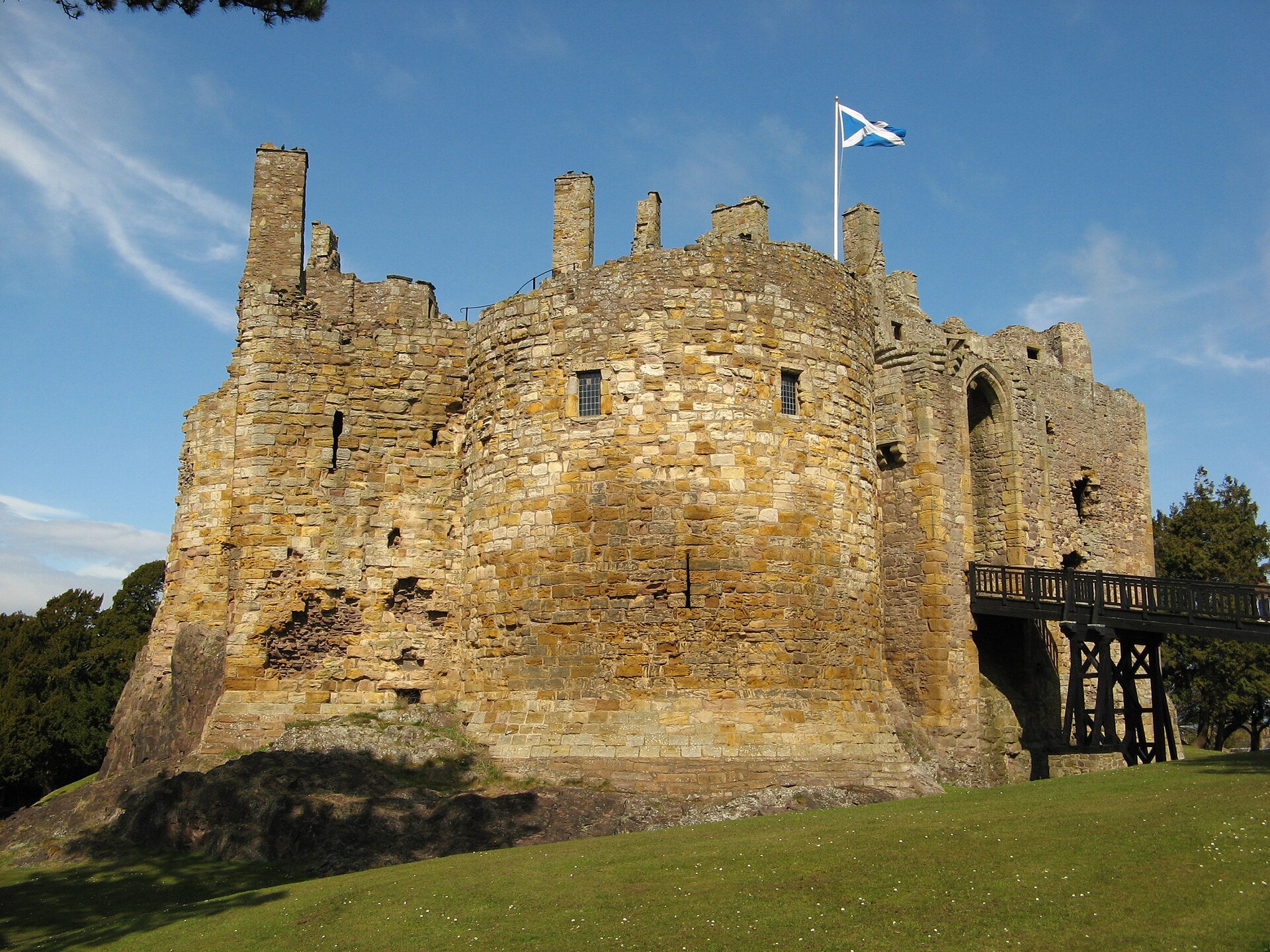
Photo: Jonathan Oldenbuck / Wikimedia Commons / CC BY-SA 3.0 A comparable East Lothian stronghold, allowing comparison between Dirleton’s inland castle and Tantallon’s dramatic coastal fortress.
-
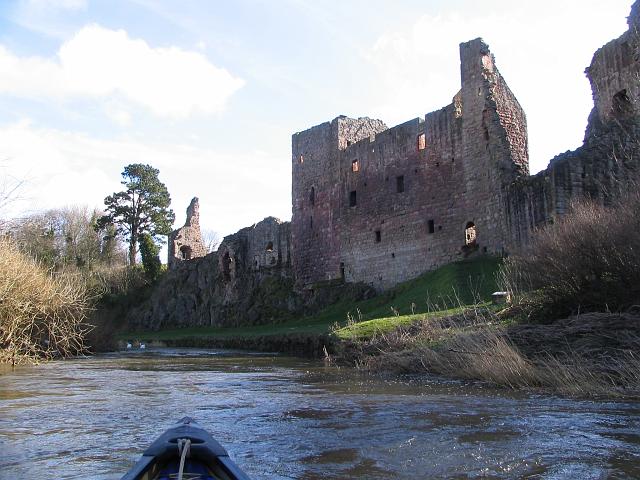
Photo: Alastair Seagroatt / Wikimedia Commons / CC BY-SA 2.0 Another medieval castle in the region, placing Tantallon within the wider network of East Lothian baronial power.
-
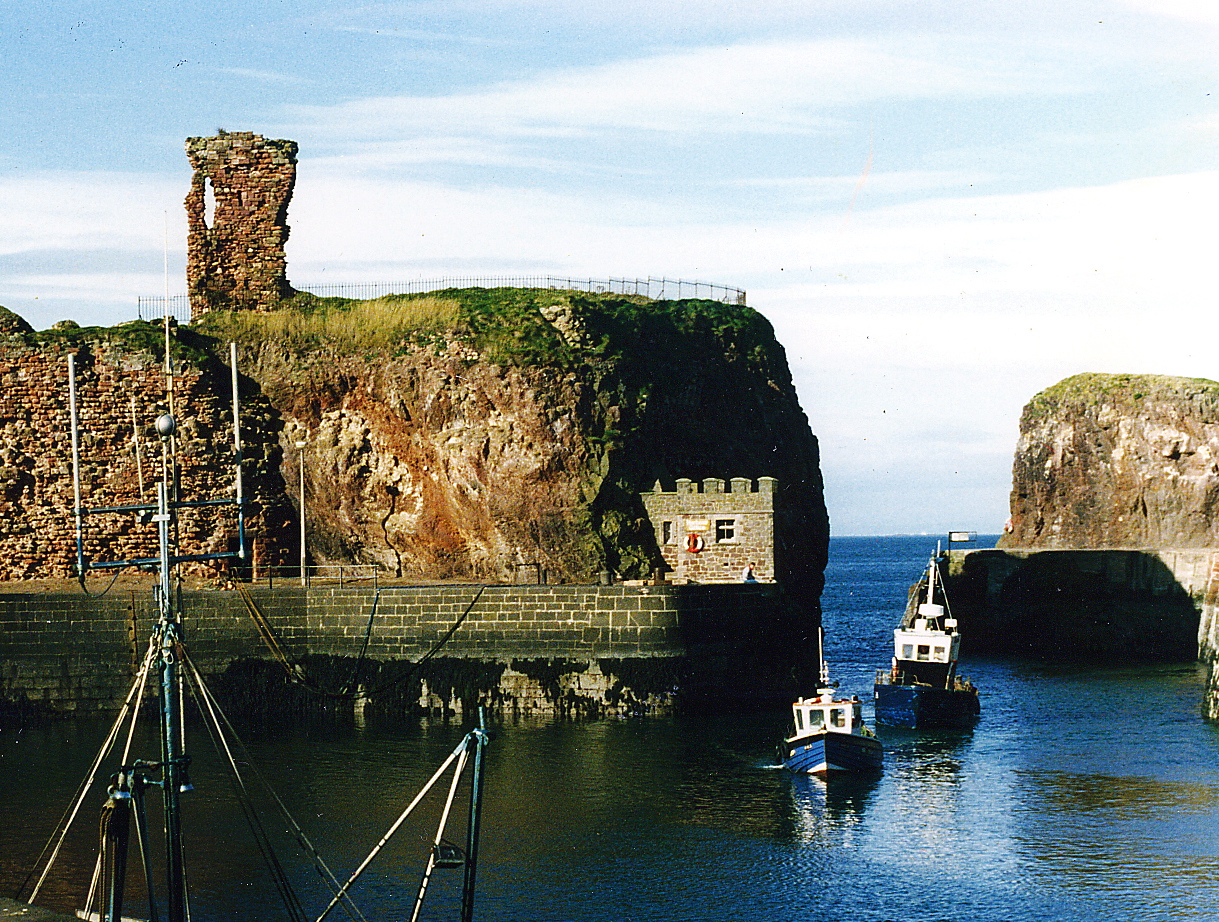
Photo: Phillip Capper from Wellington, New Zealand / Wikimedia Commons / CC BY 2.0 A major coastal stronghold whose history helps explain the strategic importance of Tantallon and the surrounding North Sea approaches.
Discovery & excavation
The ruin retains the massive landward curtain, gatehouse, Douglas and East towers, rock-cut ditch and artillery alterations from its repeated sieges.
What to look for
-
The landward curtain
The huge landward curtain stretches about 90 metres across the headland, concentrating the castle’s defence on the only approach not protected by cliffs.
-
The Douglas Tower
The Douglas Tower, East Tower and central gatehouse form the principal defences, later adapted with gun ports and stronger walls for artillery warfare.
-
The rock-cut ditch
A deep rock-cut ditch and outer court separated attackers from the curtain wall, making the inland approach as formidable as the sea-cliff setting.
-
The view to Bass Rock
Bass Rock dominates views across the Firth of Forth, explaining why Tantallon’s headland was both a visual landmark and a strategically exposed fortress.
Plan your visit
- Location
- 56.0564°N · 2.6506°W
- Nearest settlement
- North Berwick
- Access
- Paid entry — managed visitor site
- Terrain
- Rough ground — reasonable boots advised
- Time needed
- About 45 minutes
- Best time
- Visit during published opening hours and in dry daylight, when the castle ruins, cliffs and coastal views can be explored comfortably.
- What survives
- The unoccupied ruin retains its three-sided cliff setting and exceptional landward defences, including the breached Douglas Tower and curtain wall.
- Facilities
- Visitor facilities depend on the current HES operation; check the official site before travelling.
Opening & admission
Paid entry; check current HES opening times and conservation restrictions before travelling.
- The clifftop castle has uneven surfaces, steep edges and restricted access to some internal areas.
Nearby places
Fortified place · Medieval
Dirleton Castle
East Lothian
A thirteenth-century cluster keep of three joined round towers: among the earliest Scottish castles built with towers projecting beyond the walls,…
- Near Dunbar
- Some walking
Fortified place · Medieval
Hailes Castle
East Lothian
Hailes Castle is a riverside Hepburn stronghold whose fourteenth-century towers, chapel and service rooms record border warfare and late medieval l…
- Near Dunbar
Fortified place · Medieval
Dunbar Castle
East Lothian
A red-stone stronghold so formidable it was besieged, rebuilt and fought over for a thousand years, then torn down so thoroughly no one could ever…
- Near Dunbar
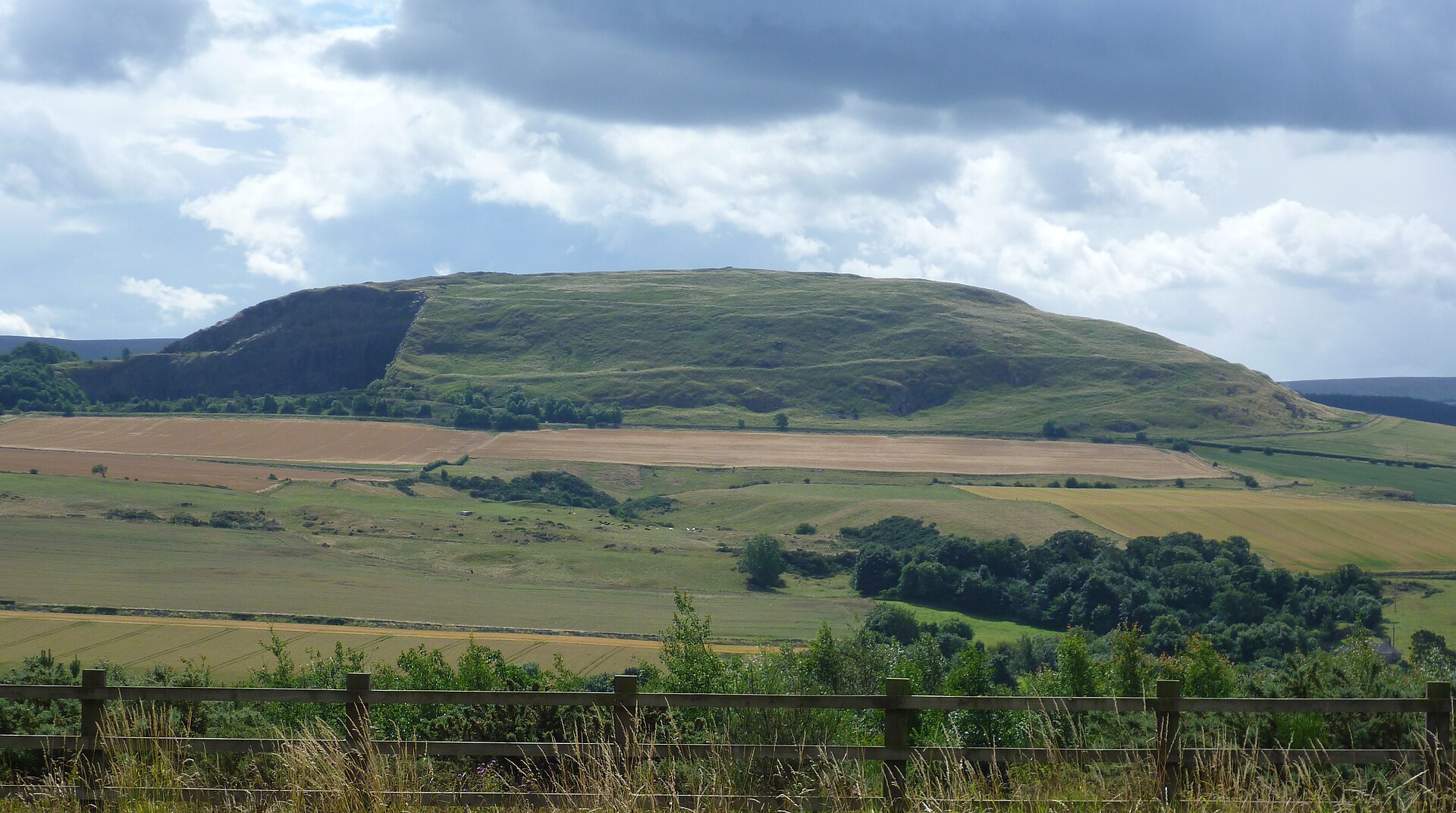
Settlement · Prehistoric
Traprain Law
East Lothian
The hill was already a place of burial by around 1500 BC and shows evidence of occupation and ramparts after 1000 BC; the ramparts were rebuilt and…
- Near East Linton
- 25 min walk from car park
- Some walking
Questions people ask
- Why is Tantallon Castle unusual?
- It is Scotland’s last medieval curtain-wall castle, with one great wall defending a cliff-bound promontory.
- Who built Tantallon?
- William Douglas, first Earl of Douglas, built it in the mid-fourteenth century.
- When was it finally ruined?
- Cromwell’s siege in 1651 left it badly damaged, and it was never repaired or inhabited afterwards.
Sources
The Ancient Codex, in your pocket
Get the Pocket Codex app
Carry the directory with you — Tantallon Castle and thousands of ancient places across Britain and Ireland, offline, wherever you roam.