
A low platform was built up out of the ground beside Eskdalemuir before the twelve stones of the Loupin Stanes were set in an oval on top of it, at grid reference NY25709663 in Dumfries and Galloway. At the west-south-west edge of the ring rise two large pillars, taller than their companions, of the kind that mark out the so-called 'entrance circles' of south-west Scotland.
A low platform was built up out of the ground beside Eskdalemuir before the twelve stones of the Loupin Stanes were set in an oval on top of it, at grid reference NY25709663 in Dumfries and Galloway. At the west-south-west edge of the ring rise two large pillars, taller than their companions, of the kind that mark out the so-called ‘entrance circles’ of south-west Scotland.
Those two pillars give the circle its name. Local tradition holds that people once leaped from the top of one stone to the other, and the Scots phrase for that act — the loupin, or leaping — became the name the monument still carries.
The Loupin Stanes did not stand alone. Two further circles once lay nearby, now so reduced as to be almost imperceptible on the ground, and a line of stones runs south from the site toward the Girdle Stanes, hinting that the two surviving circles were once joined.
What follows is drawn from published sources, with each claim labelled by how firmly it is established.
The name
The name 'Loupin Stanes' means 'leaping stones', taken from the tradition of leaping between the tops of the two large pillars at the west-south-west of the circle.
History
The circle was raised as an oval setting of twelve stones placed on a deliberately built, artificial platform — a construction that lifted and levelled the ring above the surrounding ground. Two large pillars were set at the west-south-west of the ring. Stones of this kind, larger than the rest and marking one side of the circle, are typical of the 'entrance circles' found across south-west Scotland, placing the Loupin Stanes within a recognised regional tradition of monument building.
Two other stone circles were built in the immediate vicinity. Both have since been reduced to the point of being almost imperceptible, leaving the Loupin Stanes as the most complete of the group. A line of stones was set running south from the circle toward the nearby Girdle Stanes. It has been suggested that this line is the surviving remains of an avenue that once linked the two circles into a single ceremonial arrangement.
Cultural influences
-
A line of stones running south towards the Girdle Stanes suggests that the Loupin Stanes once formed part of a linked ceremonial landscape of stone circles.
Connections
-
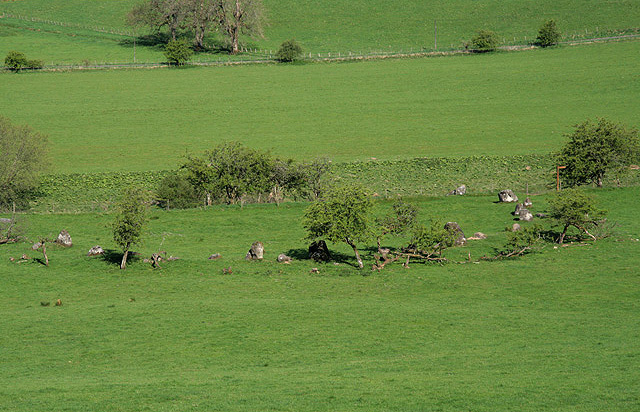
Photo: Walter Baxter / Wikimedia Commons / CC BY-SA 2.0 A nearby stone circle to the south, possibly once linked to the Loupin Stanes by an avenue marked by a surviving line of stones.
What to look for
-
The two large pillars
At the west-south-west of the circle stand two pillars markedly larger than the other stones, the feature that names the site and that marks it as an 'entrance circle'.
-
The artificial platform
The twelve stones sit on a low, deliberately built platform rather than on the natural ground surface.
-
The oval setting of twelve stones
The ring is oval rather than truly circular and is made up of twelve stones in all.
-
The line of stones to the south
A row of stones runs south from the circle toward the Girdle Stanes, possibly the remains of a linking avenue.
What is said
Folklore and tradition, recorded as what is said — not as established fact.
-
The leaping stones
Local tradition holds that people once leaped from the top of one of the two large pillars to the other, and it is said that this practice gave the circle its name.
Plan your visit
- Location
- 55.2583°N · 3.1705°W
- Nearest settlement
- Newton Stewart
- Access
- Open access
- Terrain
- Easy going
- Time needed
- About 45 minutes
Nearby places
Sacred place · Prehistoric
Girdle Stanes
Dumfries and Galloway
Twenty-six standing stones curve in a crescent above the bank of the White Esk near Eskdalemuir, in Dumfries and Galloway. The gap in the ring is n…
- Easy path
Sacred place · Prehistoric
Whitcastles stone circle
Dumfries and Galloway
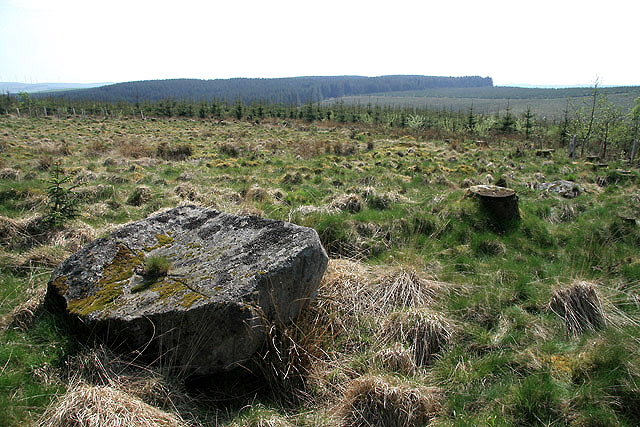
Nine stones lie fallen in an oval on high ground north-east of Lockerbie, none of them still standing. The setting, known as Whitcastles or Little…
- Near Newton Stewart
- Easy path
Fortified place · Roman
Burnswark Hill
Dumfries and Galloway
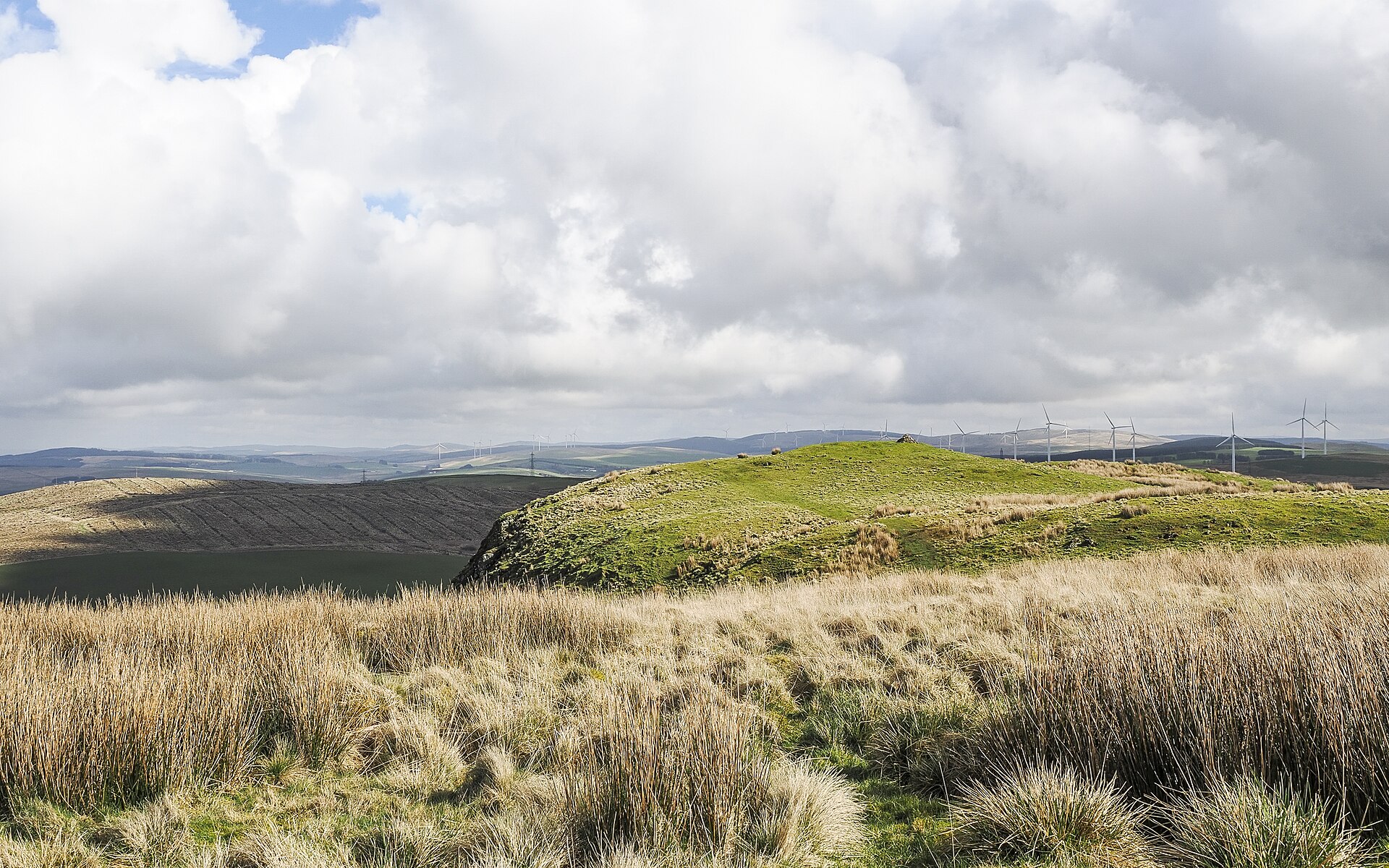
A swathe of hundreds of lead sling bullets lies scattered along the south-eastern flank of Burnswark Hill, marking the line where Roman slingers on…
- Some walking
Fortified place · Roman
Birrens Roman Fort (Blatobulgium)
Dumfries and Galloway
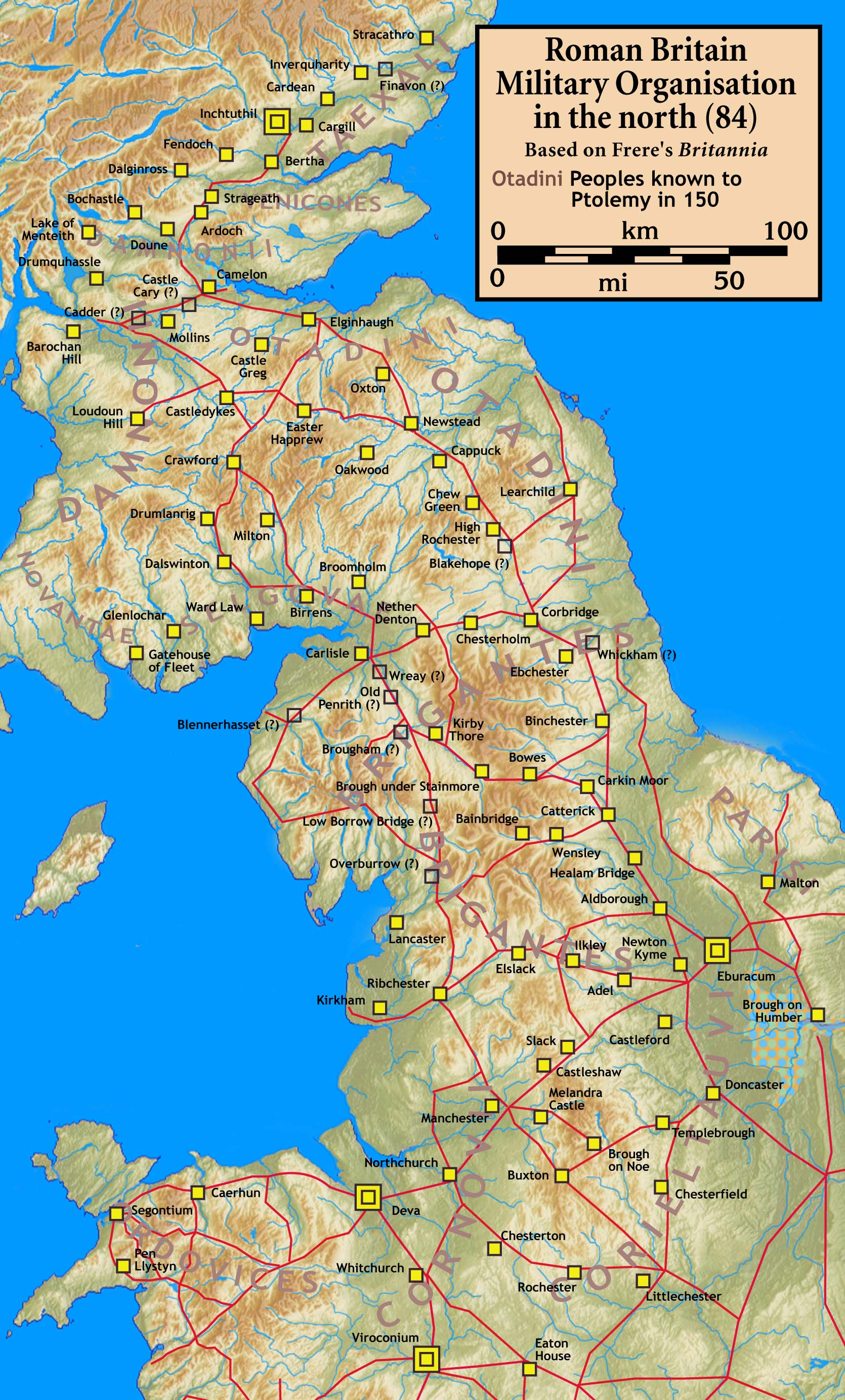
More inscribed and sculptured Roman stones have been recovered from Birrens than from any other site in Scotland, and it is this dense scatter of a…
- Some walking
Questions people ask
- Where are the Loupin Stanes?
- The Loupin Stanes are a stone circle near Eskdalemuir in Dumfries and Galloway, Scotland, at grid reference NY25709663.
- How did the circle get its name?
- The name means 'leaping stones' and comes from a tradition of leaping between the tops of the two large pillars at the west-south-west of the ring.
- How many stones are there?
- The circle is an oval setting of twelve stones placed on an artificial platform, with two of them noticeably larger pillars.
- What is an 'entrance circle'?
- It is a type of stone circle found in south-west Scotland distinguished by two large pillars set on one side; the Loupin Stanes are an example, with their pillars at the west-south-west.
- What other monuments are nearby?
- Two other circles once stood nearby but are now almost imperceptible, and a line of stones runs south to the Girdle Stanes, possibly the remains of an avenue linking the two circles.
Sources
The Ancient Codex, in your pocket
Get the Pocket Codex app
Carry the directory with you — Loupin Stanes and thousands of ancient places across Britain and Ireland, offline, wherever you roam.