A single narrow path is the only way in — sea guards the other three sides — and in 1647 that natural trap became the site of one of Scotland's bloodiest massacres.
At southern Kintyre, a narrow neck joins Dunaverty’s rock to the mainland. Fragments of masonry mark the former stronghold, where a drawbridge once crossed the approach and Clan Donald and its rivals contested the sea route for four centuries.
What happened at Dunaverty reads like a compressed history of medieval and early-modern Scotland: a Norwegian king’s fleet, a fugitive Robert the Bruce, forfeited earldoms, and finally a massacre so violent that the rock itself was renamed for it. Little of the stonework survives above ground, but the site is protected as a scheduled monument, and its story is carried almost entirely by documentary record rather than surviving fabric.
What follows is drawn from published sources, with each claim labelled by how firmly it is established.
History
In 1248 Henry III of England permitted Walter Byset to buy stores from Ireland for Dunaverty Castle, which Byset had seized and was fortifying, reportedly in revenge for the hospitality Alexander II of Scotland had shown to English pirates. That same year, Allan, son of the Earl of Atholl, took the castle back and made Byset his prisoner, ending the episode almost as quickly as it began.
By 1263 Dunaverty was garrisoned by Alexander III of Scotland during the Norwegian campaign of King Hákon Hákonarson. The castle was eventually surrendered to the Norwegian king, who granted it to Dubhghall mac Ruaidhrí, a loyal supporter in the Hebrides. When Norwegian sovereignty in the region evaporated after 1263, Alexander III appears to have retaken the stronghold for the Scottish crown.
Late in 1306 the embattled Robert I fled to Dunaverty and to his friend Aonghus Óg Mac Domhnaill, Lord of the Isles. According to the medieval poem The Bruce, Aonghus Óg sheltered the king there for three days before taking him on to Rathlin Island. Some contemporary sources instead suggest the castle was already under Robert's control, acquired from a certain Maol Coluim that March; by September, when the English arrived, the king was gone.
In 1493 the fourth and last Lord of the Isles forfeited his title to James IV of Scotland, and by 1494 the king had garrisoned and provisioned Dunaverty. The MacDonalds, led by the newly knighted Sir John MacDonald, are said to have retaken the castle before James had even left for Stirling, hanging the body of the king's castle governor over the walls in sight of his departing entourage. Sir John was later captured by MacIain of Ardnamurchan and hanged on the Burgh Muir near Edinburgh.
The crown repaired the castle between 1539 and 1542, and in January 1544 a commission ordered its captain, constable and keeper to hand it over with its artillery and ammunition to the Earl of Argyll, who that April received a twelve-year tack of North and South Kintyre including the fortress. In October 1588 the Earl of Sussex sailed from Dublin and burnt Saddell, Dunaverty and Machrimore in retaliation for Clan MacDonald activity in Ireland, before burning farms on Arran, Bute and Cumbrae.
In 1626 the Lordship of Kintyre was reconstituted for the Earl of Argyll, with Dunaverty Castle named as its principal seat. Argyll granted the lordship to his son James, who in 1635 issued a charter of it at Dunaverty to Viscount Dunluce; the Scottish Privy Council set the transfer aside after a complaint from Argyll's elder son, the Marquis of Lorn, who received his own charter to the lordship, castle included, on 12 December 1636.
During the Civil War, in 1647, Dunaverty was besieged by Scottish supporters of Oliver Cromwell under General David Leslie. The MacDonald garrison surrendered, and around three hundred of them were massacred afterwards — an event remembered as the Battle, or Massacre, of Dunaverty. The castle has stood as a ruin ever since, and the rock is still known locally as Blood Rock.
People
-
Robert I
King of Scotland who took refuge at Dunaverty in 1306 while fleeing English forces.
-
Aonghus Óg Mac Domhnaill
Lord of the Isles who, according to The Bruce, sheltered Robert I at Dunaverty before taking him to Rathlin Island.
-
James IV
King of Scotland who garrisoned and provisioned Dunaverty Castle by 1494 after the forfeiture of the Lordship of the Isles.
-
David Leslie
General who led the Covenanting siege of Dunaverty in 1647 that ended in the massacre of the garrison.
-
Alexander III
Garrisoned Dunaverty during King Hákon Hákonarson’s Norwegian campaign in 1263, before the castle returned to the Scottish crown.
Cultural influences
-
Headland defence
Sea on three sides and a narrow landward neck made the rocky headland the decisive influence on the castle’s defensive form and repeated military importance.
Connections
-
Rathlin Island
Aonghus Óg Mac Domhnaill is said to have taken Robert I from Dunaverty to Rathlin Island after sheltering him there in 1306.
-
Saddell
Burnt alongside Dunaverty and Machrimore by the Earl of Sussex's raiding fleet in October 1588.
-
Lordship of the Isles
Dunaverty passed to the crown after the fourth and last Lord of the Isles forfeited his title to James IV in 1493.
-
Earldom of Argyll
Dunaverty was named the principal seat of the Lordship of Kintyre, held by successive Earls of Argyll from 1544 and again from 1626.
What to look for
-
The headland approach
Sea encloses the site on three sides; the only landward approach is a narrow neck of ground to the north, once crossed by a drawbridge.
-
Blood Rock
The local name for the ruined stronghold, given after the massacre of its garrison in 1647.
What is said
Folklore and tradition, recorded as what is said — not as established fact.
-
The hanged governor
It is said that after retaking the castle in 1494, the MacDonalds hung the body of the king's castle governor over the walls in full view of James IV's departing entourage.
Plan your visit
- Location
- 55.3075°N · 5.6447°W
- Nearest settlement
- Southend
- Access
- Open access
- Terrain
- Rough ground — reasonable boots advised
- Time needed
- About 30 minutes
- Best time
- Daylight in calm, dry weather, when the exposed headland path is easier to negotiate.
- What survives
- Very little masonry remains; the headland setting and narrow approach are the principal surviving features.
- Facilities
- No dedicated visitor facilities are recorded at the castle site.
Opening & admission
Free to view as a scheduled monument; check current access conditions before visiting.
- Little of the castle remains; reached via a narrow path along a rocky headland with sea on three sides
- Uneven, exposed coastal terrain
Nearby places

Sacred place · Medieval
St Columba's Chapel, Southend
Argyll and Bute
A ruined medieval chapel on the Kintyre coast whose carved grave slabs are the strongest surviving evidence of the community that once worshipped h…
- Near Southend
- Some walking
Sacred place · Medieval
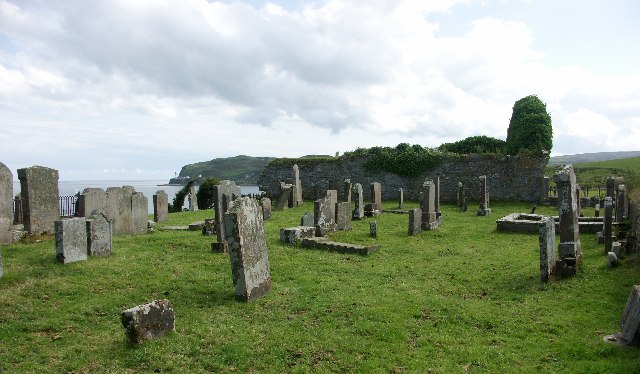
Kilchousland Chapel
Argyll and Bute
One of only a handful of Scottish chapels dedicated to St Constantine, a shadowy royal-saint whose cult is otherwise scarce in the historical record.
- Near Campbeltown
- Some walking
Fortified place · Medieval
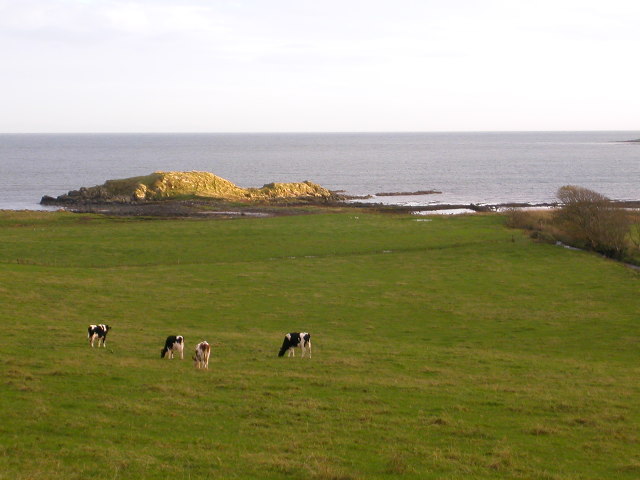
Smerby Castle
Argyll and Bute
Two separate bonds, in 1594 and 1597, show the family here signing not as MacDonald but as M'Connall: a rare direct trace of how Gaelic Kintyre act…
- Near Campbeltown
- Rough ground
Fortified place · Medieval
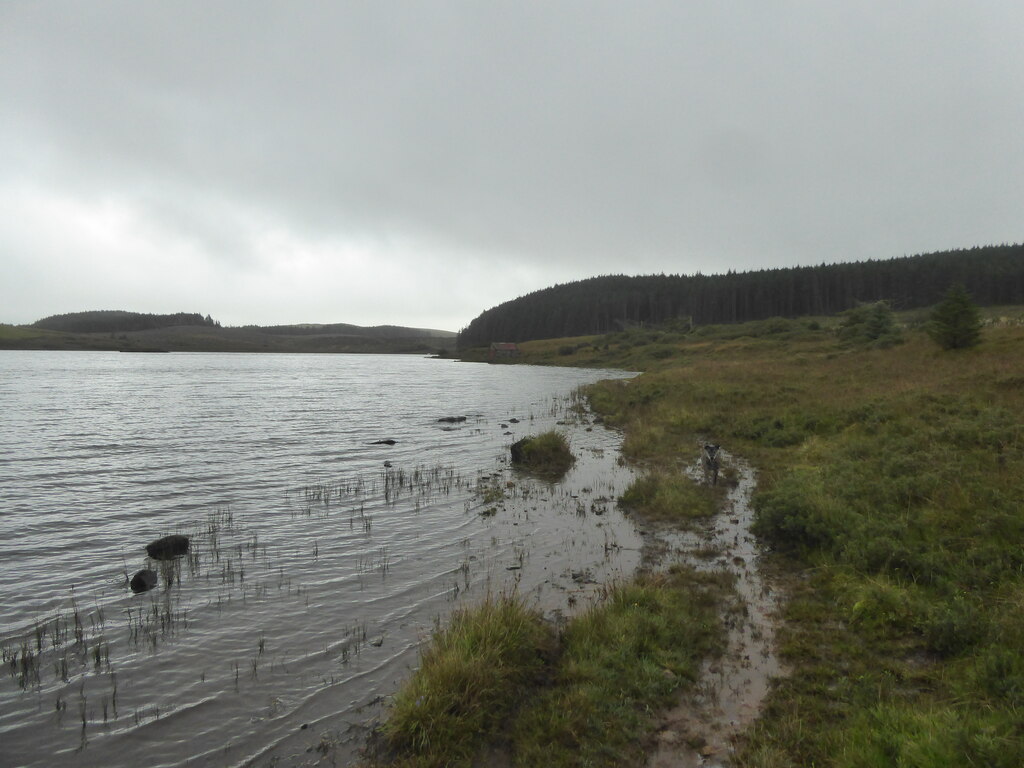
Tangy Loch Castle
Argyll and Bute
A causeway now vanished beneath the water once linked this island stronghold to the shore, leaving a ruin that in the seventeenth century belonged…
- Near Campbeltown
- Rough ground
Questions people ask
- What is Dunaverty Castle?
- A ruined stronghold on a sea-girt headland at Southend, Kintyre, once held by Clan Donald and now protected as a scheduled monument.
- Why is Dunaverty Castle known as Blood Rock?
- Around 300 MacDonald defenders were massacred there in 1647 after surrendering to a Covenanting force led by General David Leslie.
- Did Robert the Bruce visit Dunaverty Castle?
- Tradition holds he sheltered there for three days in 1306 with Aonghus Óg Mac Domhnaill before moving on to Rathlin Island.
- How much of Dunaverty Castle survives today?
- Very little; the site is largely ruined, with the headland's natural defences more legible than any standing masonry.
- Who controlled Dunaverty Castle historically?
- Control passed between the Scottish crown, Norway, and Clan Donald across the 13th to 15th centuries, before settling with the Earls of Argyll.
Sources
- Wikipedia: Dunaverty Castle
- Barrow, Kingship and Unity: Scotland 1000–1306
Explore more: Fortified places · Medieval · Argyll and Bute
The Ancient Codex, in your pocket
Get the Pocket Codex app
Carry the directory with you — Dunaverty Castle and thousands of ancient places across Britain and Ireland, offline, wherever you roam.