
Tomb or burial place · Prehistoric · Orkney Islands
Knowes of Trotty
An unusually rich Bronze Age cemetery where imported gold and amber were buried with cremated people, evidence that Orkney elites reached far beyond the islands.
Four gold discs came out of the biggest mound here in 1858, with amber beads and pendants and the cremated remains of whoever they were buried with. Neither gold nor amber occurs in Orkney. Both had to be carried a very long way north, and somebody at the Knowes of Trotty had the standing to command them.
The cemetery is twelve surviving barrows on the Mainland, raised between about 2030 and 1770 BC. That makes it one of the earliest groups of burial mounds in Orkney and one of the largest Bronze Age cemeteries in the United Kingdom — an unusual claim for a place this far from anywhere that is normally treated as a centre.
What the grave goods imply is the interesting part. A community at the northern edge of the islands was reaching into exchange networks that ran the length of Britain and beyond, and was burying the proceeds rather than passing them on.
What follows is drawn from published sources, with each claim labelled by how firmly it is established.
History
Twelve burial mounds survive on the Mainland of Orkney, dating to between 2030 and 1770 BC. They form one of the earliest groups of barrows in Orkney and one of the largest Bronze Age cemeteries anywhere in the United Kingdom, which for an island group of this size is a considerable concentration. The largest mound was opened in 1858. Alongside cremated human remains it produced four gold discs together with a number of amber beads and pendants — grave goods of a quality and a rarity that place whoever was buried here well outside the ordinary run of Bronze Age burials in the north.
Gold and amber are both imported materials in Orkney. Their presence in a single mound on Mainland says that the people using this cemetery were connected to exchange networks reaching a long way south, and had the standing to draw on them.
Cultural influences
-
Gold discs, amber beads and pendants in the cemetery show long-distance exchange reaching Orkney between 2030 and 1770 BC.
Connections
-
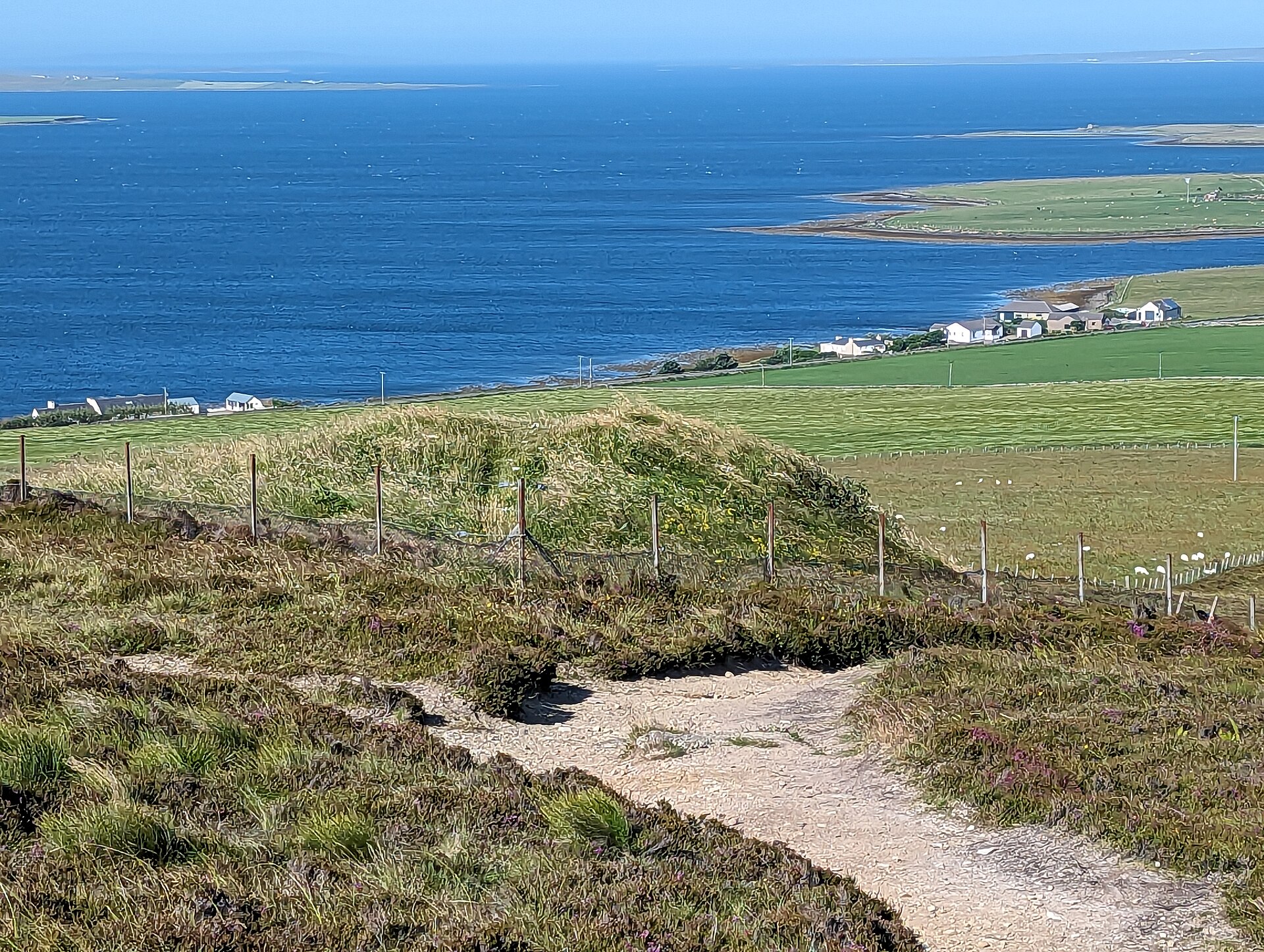
Photo: PaulT (Gunther Tschuch) / Wikimedia Commons / CC BY-SA 4.0 Cuween Hill’s Neolithic communal tomb provides the earlier burial tradition against which the Knowes of Trotty’s Bronze Age barrow cemetery can be understood: collective chambered burial gave way here to individual or small-group mound burials.
-
Photo: Otter at Dutch Wikipedia (Original text: Hopmans) / Wikimedia Commons / CC BY-SA 3.0 Maeshowe is a monumental Neolithic chambered tomb, whereas the Knowes of Trotty are a later Bronze Age cemetery. Together they make the changing forms of ritual burial on Orkney Mainland visible across more than a millennium.
-

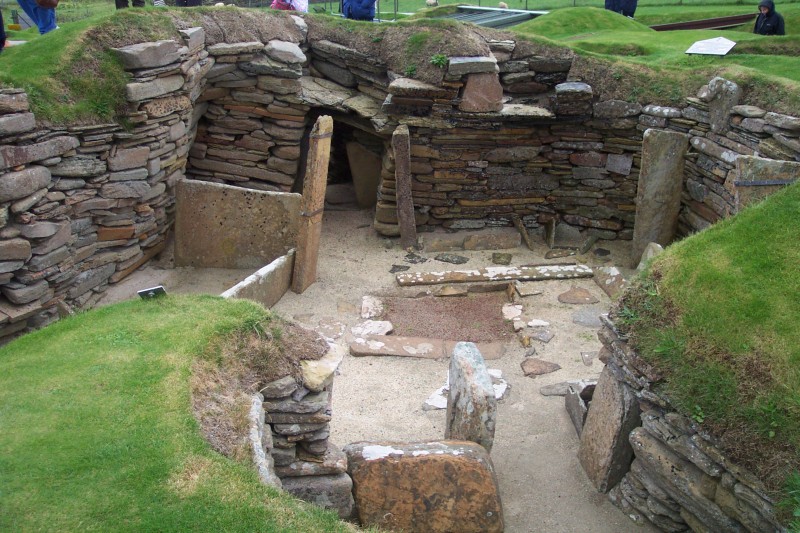
Photo: Otter / Wikimedia Commons / CC BY-SA 3.0 Barnhouse is a Neolithic settlement in the Heart of Neolithic Orkney landscape; the Knowes of Trotty provide a later Bronze Age burial counterpart in the same Mainland archaeological region, rather than another domestic site.
Discovery & excavation
The largest burial mound was opened in 1858, yielding cremated human remains, four gold discs and amber beads and pendants.
What to look for
-
Barrow cemetery
Twelve Bronze Age burial mounds form one of Orkney’s largest barrow groups and one of Britain’s largest cemetery concentrations.
-
Largest mound
The mound opened in 1858 contained cremated remains with four gold discs and amber ornaments, grave goods imported to Orkney.
Plan your visit
- Location
- 59.0402°N · 3.1492°W
- Access
- Visible from a public way
- Terrain
- Easy going
- Time needed
- About 30 minutes
- Best time
- Daylight hours
- What survives
- Twelve Bronze Age barrows survive on the Orkney Mainland, forming a large cemetery group.
Opening & admission
No reliable current admission details are recorded; verify before travelling.
- The mounds are visible today only as slight bumps in a large field.
Nearby places
Tomb or burial place · Prehistoric
Cuween Hill Chambered Cairn
Orkney Islands
A crawl into this first-farming-age tomb leads to four side cells and the extraordinary remains of people and twenty-four dogs, evidence of a commu…
- Near Finstown
- 270 metres from car park
- Easy path
Tomb or burial place · Prehistoric
Maeshowe Chambered Cairn
Orkney Islands
The burial mound was built around 2800 BC by farming communities of central Orkney and contains a stone chamber associated with the Grooved Ware po…
- Near Stenness
- 1.6 km from car park
- Easy path

Settlement · Prehistoric
Barnhouse Settlement
Orkney Islands
A settlement of the first farming age on the shore of the Loch of Harray, close to the Standing Stones of Stenness.
- Easy path
Sacred place · Prehistoric
Heart of Neolithic Orkney
Orkney Islands
The Orkney World Heritage group is made up of monuments from the closing Stone Age, roughly 4000–2500 BC, whose remains illuminate the islands’ cha…
- Some walking
The setting
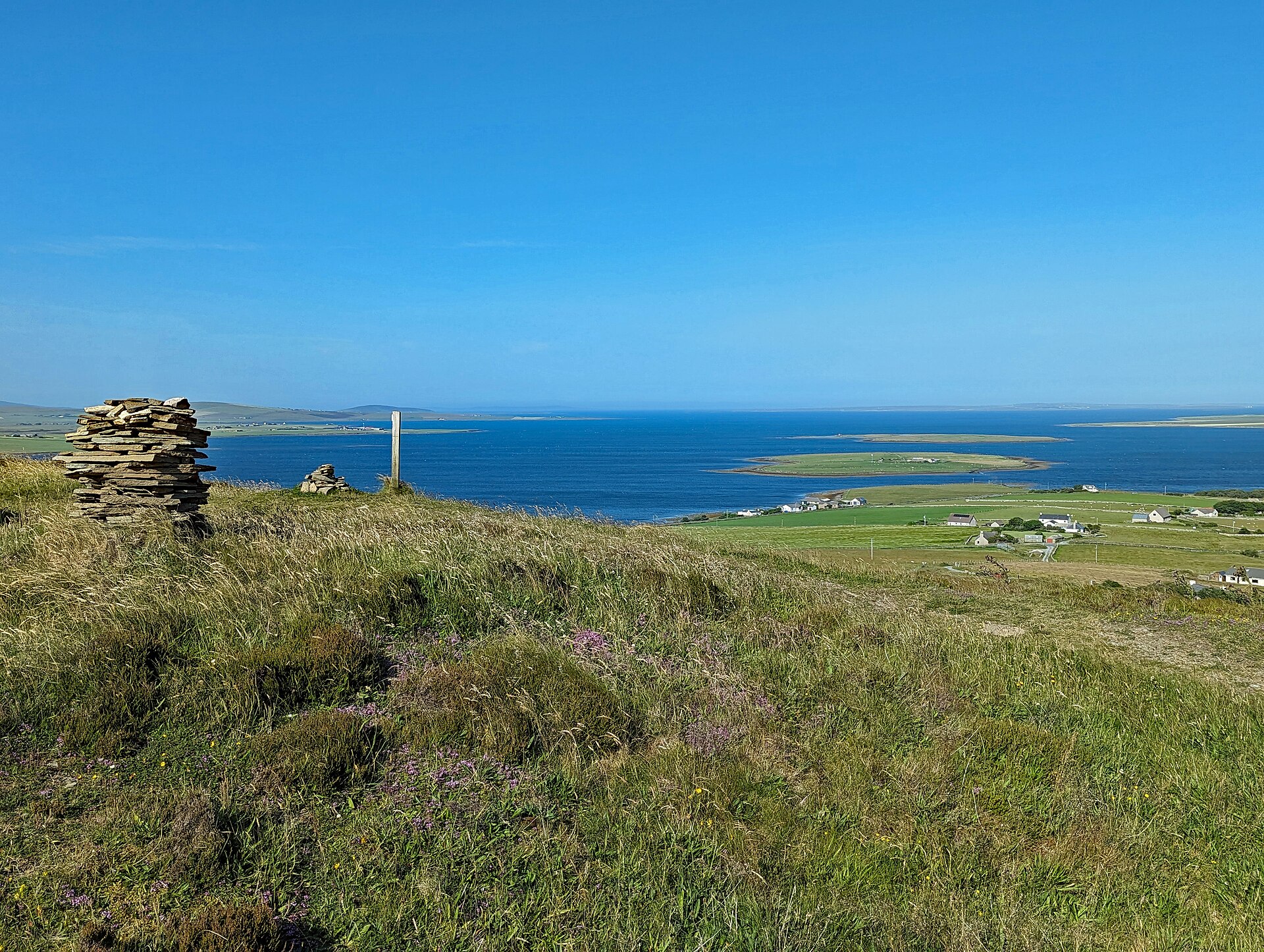
Heather moorland and fields around the Knowes of Trotty cemetery, whose burial mounds are low in the landscape.
Photo: Bill Boaden / Wikimedia Commons / CC BY-SA 2.0
Heather moorland and low mounds at the Knowes of Trotty cemetery.
Photo: Gordon Hatton / Wikimedia Commons / CC BY-SA 2.0
Netherhouse farm and fields below the heathland of the Knowes of Trotty cemetery.
Photo: Bill Boaden / Wikimedia Commons / CC BY-SA 2.0
Questions people ask
- What was found in the largest mound?
- When it was opened in 1858 it held a stone burial cist flanked by tall standing stones, containing cremated human bone, four gold discs and amber beads and pendants.
- What are the gold discs?
- Discs of paper-thin gold foil decorated with concentric circles of zig-zags and lines — grave goods of a quality very rarely found this far north.
- How many mounds are there?
- Twelve, laid out in two rows at the foot of the western slopes of the Ward of Redland, ranging from 9 to 18 metres across and 0.6 to 3 metres high.
- How old are they?
- Between 2030 and 1770 BC. This is one of the earliest groups of burial mounds in Orkney and one of the largest Bronze Age cemeteries in the United Kingdom.
- What can be seen today?
- Very little. Time and soil erosion have reduced the mounds to slight bumps in a large field, though in the Bronze Age they would have stood much higher and been visible from a distance.
Sources
- Wikipedia: Knowes of Trotty
- Wikidata: Q56666589
- Canmore 2035 — Knowes of Trotty, Huntiscarth (barrows, Bronze Age) (accessed 2026-08-03)
Explore more: Tomb or burial places · Prehistoric · Orkney Islands
The Ancient Codex, in your pocket
Get the Pocket Codex app
Carry the directory with you — Knowes of Trotty and thousands of ancient places across Britain and Ireland, offline, wherever you roam.