Two potsherds incised with the figures of deer, lifted from Dùn Morbhaidh and now kept in the National Museum of Antiquities of Scotland, are among the most telling relics of this Coll hillfort (a defended enclosure on high ground, ringed with banks and ditches). They came from the excavations of Erskine Beveridge, the early 20th-century antiquary who rated the site one of the four most interesting fortifications on the island, alongside Dùn an Achaidh, Dùn Anlaimh and Dùn Dubh.
Two potsherds incised with the figures of deer, lifted from Dùn Morbhaidh and now kept in the National Museum of Antiquities of Scotland, are among the most telling relics of this Coll hillfort. They came from the excavations of Erskine Beveridge, the early 20th-century antiquary who rated the site one of the four most interesting fortifications on the island, alongside Dùn an Achaidh, Dùn Anlaimh and Dùn Dubh.
Also recorded as Dun Borbaidh, the fort crowns a craggy hill near the shore about 2 miles (3.2 km) northeast of Gallanach, at grid reference NM 2345 6331. Its defences are much reduced: a wall on the western summit survives only in short lengths, standing at most 0.7 metres in three courses, with two further walls traceable across the terraced eastern slopes.
What follows is drawn from published sources, with each claim labelled by how firmly it is established.
The name
Erskine Beveridge argued that the correct form of the name was Dun Borbaidh, and that the version appearing on maps, Dùn Morbhaidh, was probably incorrect. He held that the fort took its name from the nearby Eilean Borbaidh and Traigh Bhorbaidh, that the local pronunciation was "Borow" or "Borive", and that "Borive" resembled several other Hebridean placenames apparently derived from the Norse word borg.
History
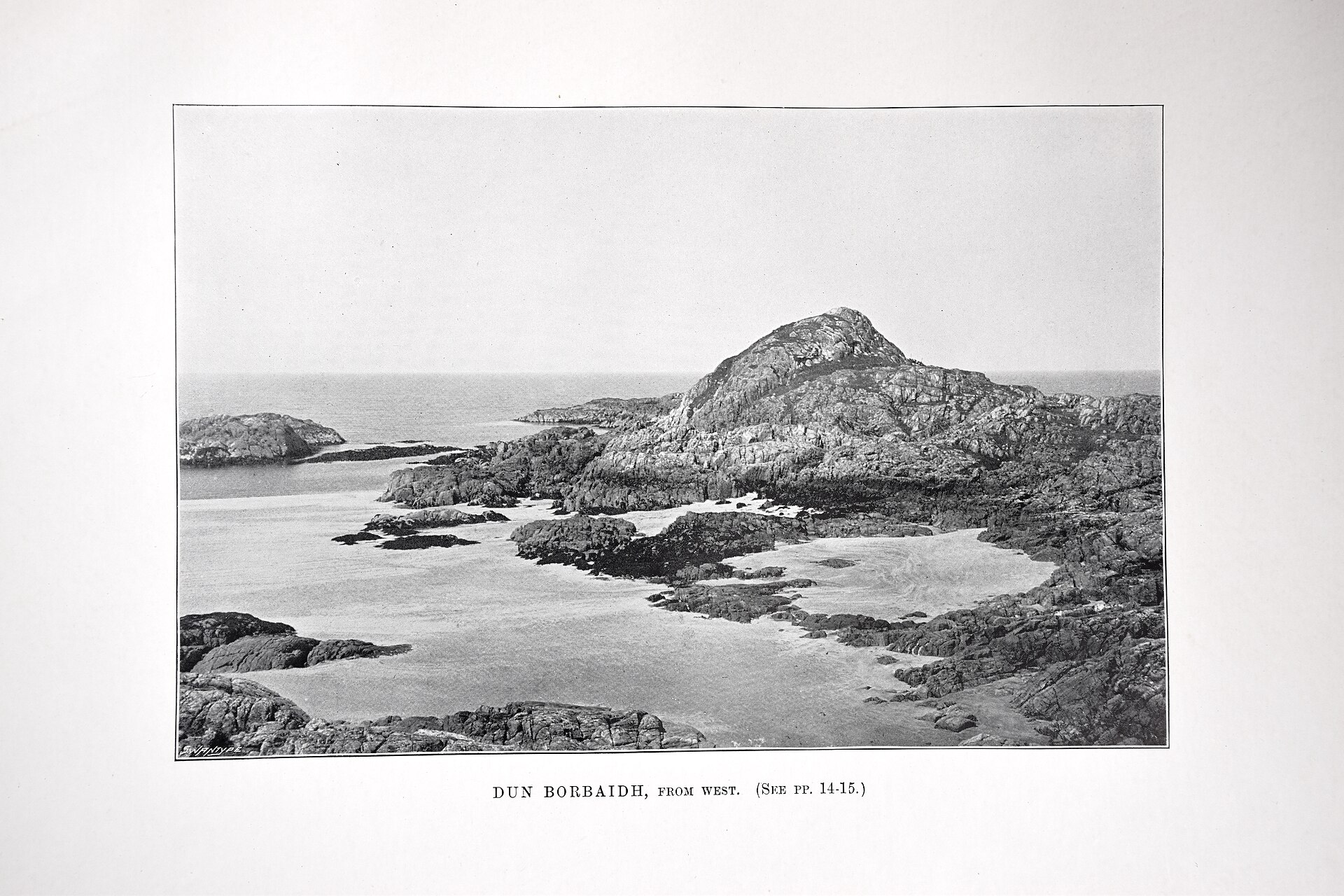
In 1972 the Ordnance Survey visited the site and recorded it as "probably a dun with outworks"; no trace of any midden was found on that visit. Earlier excavation had nevertheless recovered midden material, hammerstones and decorated potsherds, giving the interpretation an archaeological basis beyond the later survey. In 1995 M. W. Holley recovered a further potsherd at grid reference NM 2345 6331.
People
-
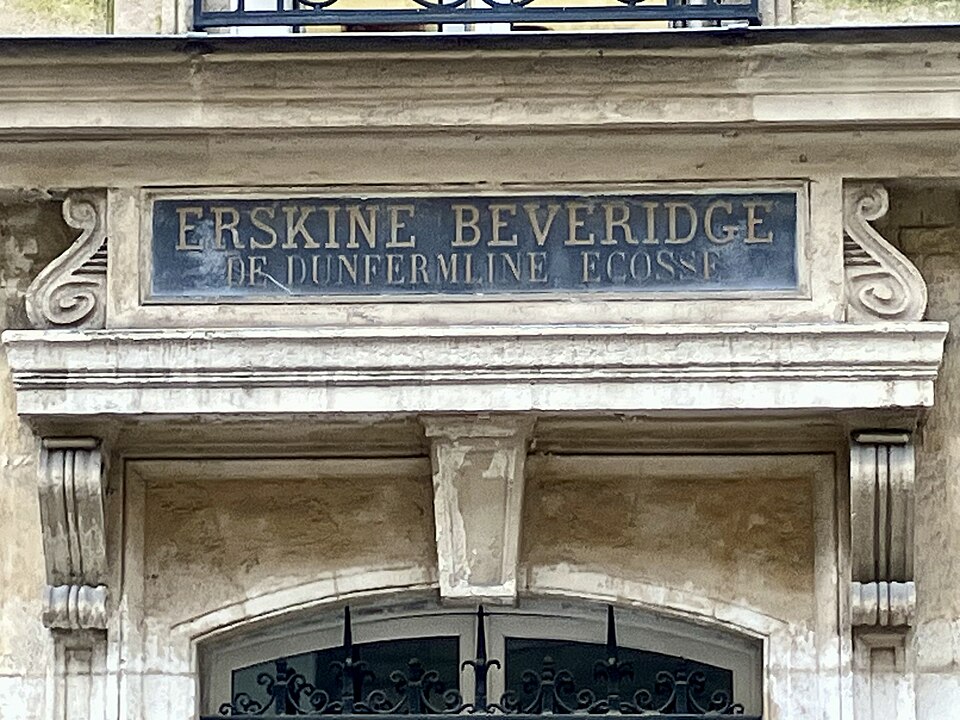
Portrait: Pieton75 / Wikimedia Commons / CC0 Erskine Beveridge
Early 20th-century antiquary who excavated the fort, recovered its finds, and argued for the name Dun Borbaidh; he rated it among the four most interesting fortifications on Coll.
-
Richard Hingley
Archaeologist who observed that potsherds decorated with figures of deer, including examples from Dùn Morbhaidh, point to the importance of hunting in some Iron Age communities of the Western Isles.
-
M. W. Holley
Recovered potsherd from the site in 1995.
Cultural influences
-
Norse place-naming
Beveridge traced the name element "Borive" to the Norse word borg, linking it to other Hebridean placenames and reflecting Norse influence on the naming of the surrounding coast.
-
Hunting in Iron Age island life
Following Hingley, the deer figures on the pottery are read as a sign of the standing of hunting among some Iron Age communities of the Western Isles, a theme shared with a small group of other Hebridean sites.
Connections
-
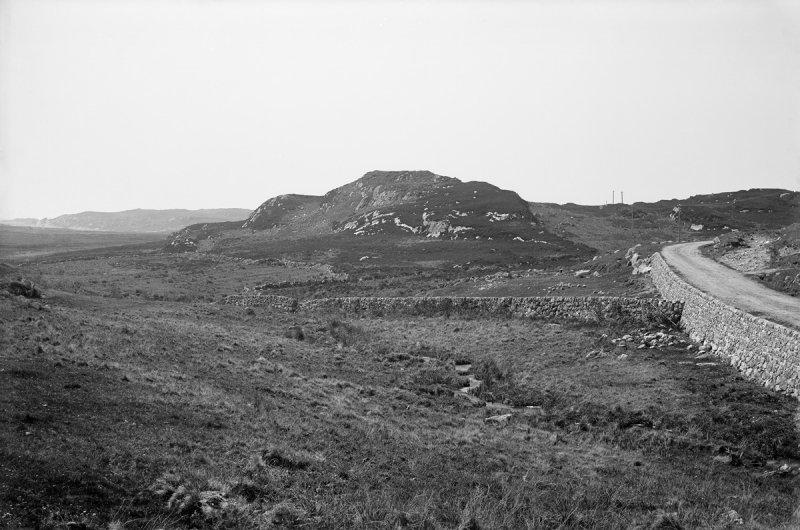
Photo: Erskine Beveridge (1851–1920) / Wikimedia Commons / Public domain Beveridge grouped Dùn an Achaidh with Dùn Morbhaidh among Coll’s four most interesting fortifications; Dùn an Achaidh survives as the island’s best-preserved dun, providing a useful comparison with the more fragmentary hillfort.
-
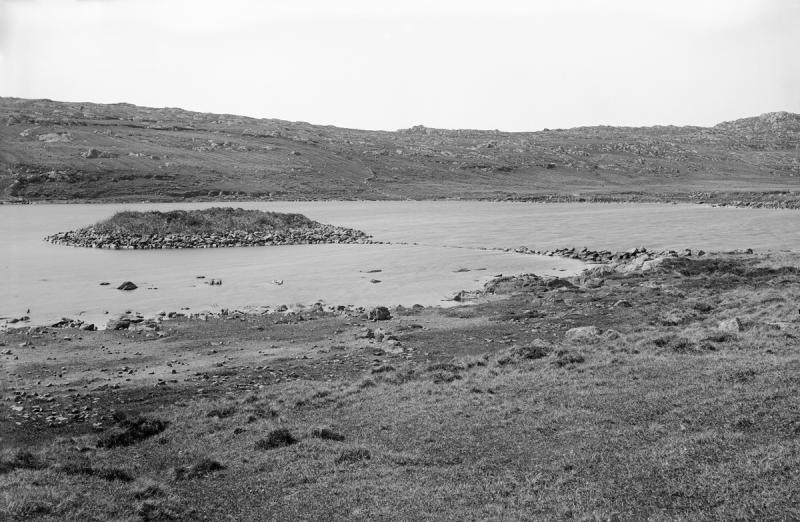
Photo: Erskine Beveridge (1851–1920) / Wikimedia Commons / Public domain Dùn Anlaimh
Beveridge counted Dùn Anlaimh among the four notable Coll fortifications with Dùn Morbhaidh. A separate local tradition ties Anlaimh to the Norseman Iain Garbh and to Dùn Dubh, showing the island’s forts also accrued later story traditions.
-
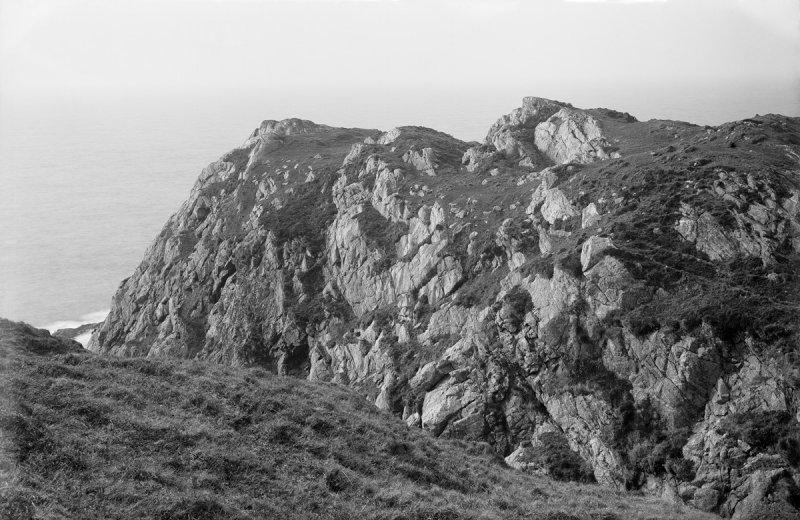
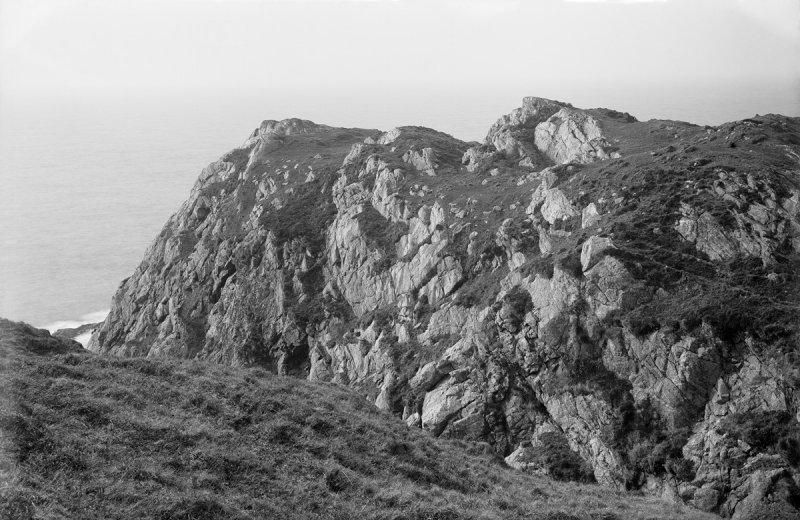
Photo: Erskine Beveridge (1851–1920) / Wikimedia Commons / Public domain Dùn Dubh was one of the four Coll fortifications singled out by Beveridge with Dùn Morbhaidh. It also appears in a local tradition with Dùn Anlaimh and Dùn Beic, a distinct story cycle rather than evidence for a direct tie to Morbhaidh.
-
Bragar, Lewis; Kilpheder, South Uist; Galson, Lewis
Hebridean sites where, like Dùn Morbhaidh, potsherds decorated with figures of deer have been found.
Discovery & excavation
Beveridge's excavation recovered midden material, small rounded pebbles and an abundance of hammerstones, many of them broken, along with potsherds decorated with incised patterns and finger-impressed cordons. He considered that some of the finds had been subjected to fire, comparing them to the foundations at Dùn an Achaidh. Two potsherds bearing incised figures of deer were among the finds.
Finds now held at: National Museum of Antiquities of Scotland.
In culture
-
The deer potsherds in the national collection
The two potsherds incised with figures of deer, recovered by Beveridge, are held in the National Museum of Antiquities of Scotland, where they sit within a wider record of deer-decorated Hebridean pottery.
What to look for
-
Summit wall traces
On the west side and summit, an area of about 30 by 15 metres is guarded by a wall of which only traces survive; two short lengths of its outer face stand at a maximum height of 0.7 metres in three courses.
-
Three lines of wall
The defences comprise an inner wall on the summit, a medial wall largely set around a terrace on the eastern half of the hill, and an outer wall around the foot of the hill facing level ground.
-
Terraced eastern slopes
The eastern half of the hill is made up of a series of slopes, terraces and rocky outcrops, with the medial wall following the terrace and appearing in a narrow gap on its northern part.
-
The entrance
Traces of the outer wall survive on one side of the entrance, together with an outer stretch of facing stones.
What is said
Folklore and tradition, recorded as what is said — not as established fact.
-
The cave and the massacre
Beveridge recorded that no tradition attached to the fort itself, but that one concerned a cave beneath it, said to run from an entrance on the rocky shore far inland; the cave was reputed to have been the scene of a massacre of many local people. (tradition recorded by Beveridge)
Plan your visit
- Location
- 56.6795°N · 6.5169°W
- Nearest settlement
- Gallanach
- Access
- Open access
- Terrain
- Rough ground — reasonable boots advised
- Time needed
- About 90 minutes
- What survives
- Low traces of walls and outworks survive on the craggy hilltop.
Opening & admission
Free to visit; no visitor facilities are recorded, so check current access conditions before travelling.
- Hillfort on a craggy hilltop near the shore, with uneven terrain and walls surviving only as low traces
- No parking or visitor facilities are recorded
- Located on the island of Coll, 2 miles northeast of Gallanach
Nearby places
Fortified place · Iron Age
Dùn Dubh
Argyll and Bute
The name Dùn Dubh renders from Scottish Gaelic as "the black dun", and the early 20th-century antiquary Erskine Beveridge counted it among the four…
- Near Arinagour
- Rough ground

Fortified place · Medieval
Dùn an Achaidh
Argyll and Bute
Scorch marks still visible on its foundations appear to confirm a local legend of islanders burning out a tyrannical Norse chief's son from Coll's…
- Near Acha
- Rough ground
Settlement · Medieval
Breachacha crannog
Argyll and Bute
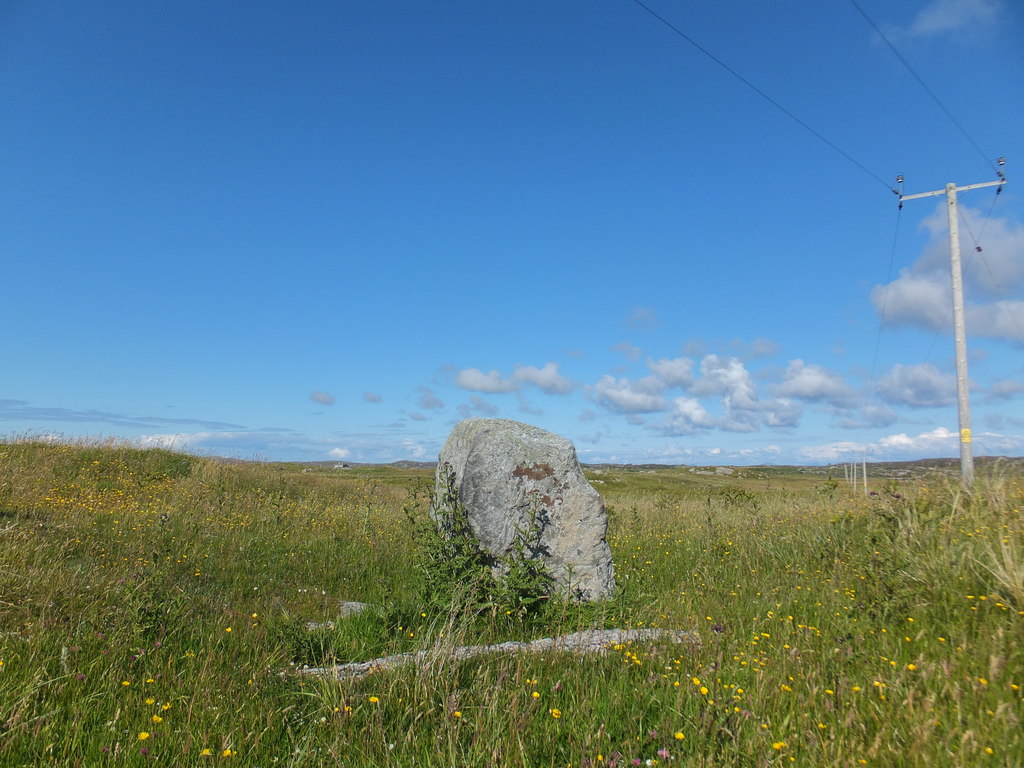
A drained loch bed south of Breachacha Castle on Coll still holds an artificial island whose stonework and mysterious dug pits have never been full…
- Near Arinagour
- Rough ground
Fortified place · Medieval
Cairnburgh Castle
Argyll and Bute
A single fortress split across two separate islets in the Treshnish Isles, held in turn by the heirs of Somerled and the Macleans of Duart for over…
- Near Tobermory
- Rough ground
Questions people ask
- Where is Dùn Morbhaidh?
- It stands on a craggy hill close to the shore on the island of Coll in the Inner Hebrides, about 2 miles (3.2 km) northeast of Gallanach, at grid reference NM 2345 6331.
- Why is the site sometimes called Dun Borbaidh?
- The antiquary Erskine Beveridge argued that Dun Borbaidh was the correct name and that the map form Dùn Morbhaidh was probably mistaken. He linked it to the nearby Eilean Borbaidh and Traigh Bhorbaidh and a local pronunciation of "Borow" or "Borive", derived from the Norse word borg.
- What was found at the fort?
- Beveridge recovered midden material, rounded pebbles, many hammerstones, and potsherds decorated with incised patterns and finger-impressed cordons. Two potsherds bear incised figures of deer and are held in the National Museum of Antiquities of Scotland. Later potsherd was found by M. W. Holley in 1995.
- What can be seen at the site today?
- Only fragments of the defences survive: traces of a summit wall standing up to 0.7 metres in three courses, a medial wall set around an eastern terrace, and an outer wall around the foot of the hill, with facing stones visible near the entrance.
- Is there a tradition attached to Dùn Morbhaidh?
- Beveridge noted no tradition about the fort itself, but recorded one about a cave beneath it, said to run from the rocky shore far inland and to have been the scene of a massacre of many local people.
Sources
- Wikipedia: Dùn Morbhaidh (accessed 2026-07-18)
- Wikidata: Dùn Morbhaidh (Q5320413) (accessed 2026-07-18)
Explore more: Fortified places · Iron Age · Argyll and Bute
The Ancient Codex, in your pocket
Get the Pocket Codex app
Carry the directory with you — Dùn Morbhaidh and thousands of ancient places across Britain and Ireland, offline, wherever you roam.