Scorch marks still visible on its foundations appear to confirm a local legend of islanders burning out a tyrannical Norse chief's son from Coll's best-preserved dun.
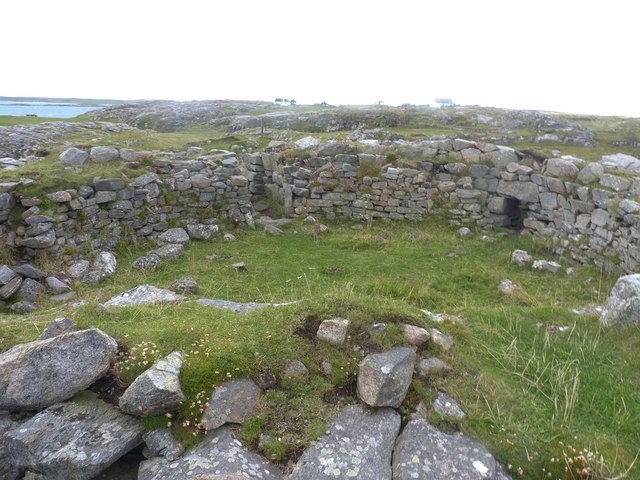
On a rocky ridge rising some 22 metres above the ground near the village of Acha on Coll stands a dun (a small drystone fort), its walls tracing the crest of the outcrop and its single entrance set at the north-east end, still guarded by an outer wall of large boulders. Of all the duns scattered across this Hebridean island, this one is generally reckoned the best preserved.
Its name comes from the Gaelic an t-Achadh, “the field”, but an older name recorded from local memory tells a different story: Dun Bhorlum mhic Anlaimh righ Lochlinn, read by the early 20th-century antiquary Erskine Beveridge as “the fort of Borlum, son of Olaf, King of Norway”. Local tradition holds that the dun was once the stronghold of a Norse chief’s tyrannical son, and that the islanders eventually rose against him, storming the fort by night and burning him out. Beveridge, working on the site before he ever heard the story, had already noted scorch marks on the foundations - a coincidence he took as support for the legend.
Beveridge ranked Dùn an Achaidh among the four most interesting fortifications on Coll, alongside Dùn Anlaimh, Dùn Dubh and Dùn Morbhaidh, and excavation at the site produced decorated pottery, a slate whorl and a stone pounder, since transferred to the National Museum of Scotland. Whether or not Norsemen ever actually held the ridge, the dun’s long life stretched into more troubled centuries: Beveridge argued that outlawed ‘broken men’ named in a 1587 Scottish parliamentary act may well have sheltered within its walls.
What follows is drawn from published sources, with each claim labelled by how firmly it is established.
The name
The name Dùn an Achaidh comes from the Scottish Gaelic an t-Achadh, meaning "the field". Beveridge recorded an older local name, Dun Bhorlum mhic Anlaimh righ Lochlinn, which he translated either as "the fort of ridge of the son of Olaf, King of Norway" or "the fort of Borlum, son of Olaf, King of Norway", noting that borlum was an old Gaelic word for "ridge". The Reverend Dugald MacEchern instead read borlum as "board-land", meaning the home farm of a residence, though he noted that locals themselves treated Borlum simply as a personal name.
History
During the Viking Age, several duns on Coll and neighbouring Tiree are thought to have been occupied by Norse settlers, a possibility the early 20th-century antiquary Erskine Beveridge argued was supported by both the names attached to the forts and the traditions still told about them locally. Dùn an Achaidh, whose older Gaelic name ties it directly to a son of a Norse king, was one of the sites he singled out as evidence of this Norse presence on the island.
In 1587 the Scottish parliament drew up the General Band, a measure intended to curb decades of feuding among Highland clans by making landowners answerable in law for the conduct of the men living on their ground. Hector Maclean of Coll, laird of the island, was named among the chiefs required to give surety for so-called 'broken men' - outlaws without a chief - and Beveridge argued that such men would have found refuge and defensive security in Coll's old duns, including Dùn an Achaidh, well within historic times.
In the early 20th century Beveridge surveyed Dùn an Achaidh in detail, recording it as one of the four most interesting fortifications on Coll alongside Dùn Anlaimh, Dùn Dubh and Dùn Morbhaidh. He noted that the dun's older Gaelic name, Dun Bhorlum mhic Anlaimh righ Lochlinn, could be read as "the fort of Borlum, son of Olaf, King of Norway", and observed scorch marks on the foundations that seemed to bear out a local story of the dun being burned.
Around the same period, the Reverend Dugald MacEchern independently recorded a closely related tradition, giving the fort's full name as Dun Acha Bhorrolam and describing the ridge itself as a natural stronghold once held by a Norseman, son of Olaf, king of Lochlann. MacEchern translated Borlum as "board-land", the home farm of a residence, though he noted that local people treated Borlum simply as a personal name rather than a description of the land.
Local tradition on Coll also held that Samuel Johnson visited Dùn an Achaidh during his celebrated tour of the Hebrides with James Boswell, but Beveridge found no mention of any dun visit in either man's own published account of the journey, leaving the claim unconfirmed and, in Beveridge's own assessment, unlikely.
People
-
Erskine Beveridge
Early 20th-century antiquary who surveyed Coll's duns, ranked Dùn an Achaidh among the island's four most interesting fortifications, and recorded the local traditions and older name attached to the site.
-
Rev. Dugald MacEchern
Recorded an independent local tradition concerning Dùn an Achaidh and its full Gaelic name, offering his own translation of the name element Borlum.
-
Hector Maclean of Coll
Laird of Coll named in the 1587 General Band, the Scottish parliamentary measure requiring Highland landowners to answer for the conduct of men living on their land.
Cultural influences
-
A remembered Norse layer
The older local name and the tradition of Borlum, son of Olaf, place Dùn an Achaidh within Coll’s remembered Norse past. Erskine Beveridge considered Norse occupation of several duns on Coll and Tiree likely during the Viking Age, while treating the story itself as tradition.
Connections
-
Dùn Anlaimh
A crannog dun roughly 2.1 kilometres north of Dùn an Achaidh, likewise traditionally linked to a Norse figure named Anlamh, or Olaf.
-
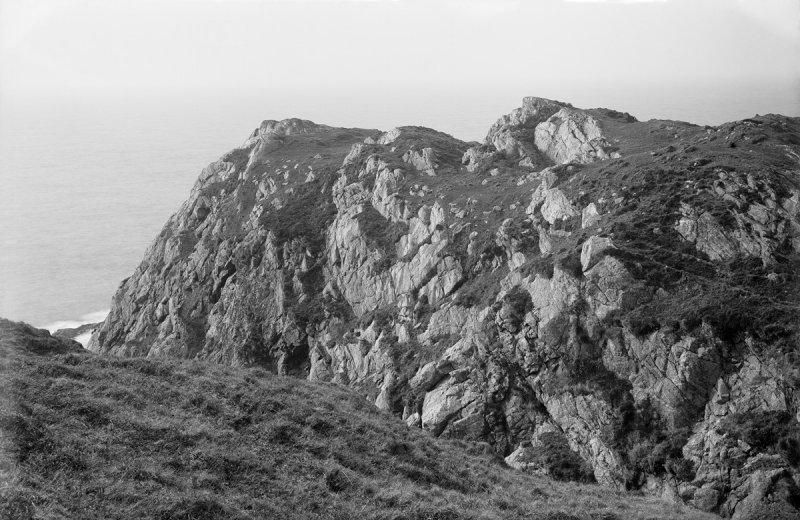
Photo: Erskine Beveridge (1851–1920) / Wikimedia Commons / Public domain One of the four fortifications on Coll that Erskine Beveridge judged, alongside Dùn an Achaidh, to be among the island's most interesting.
-
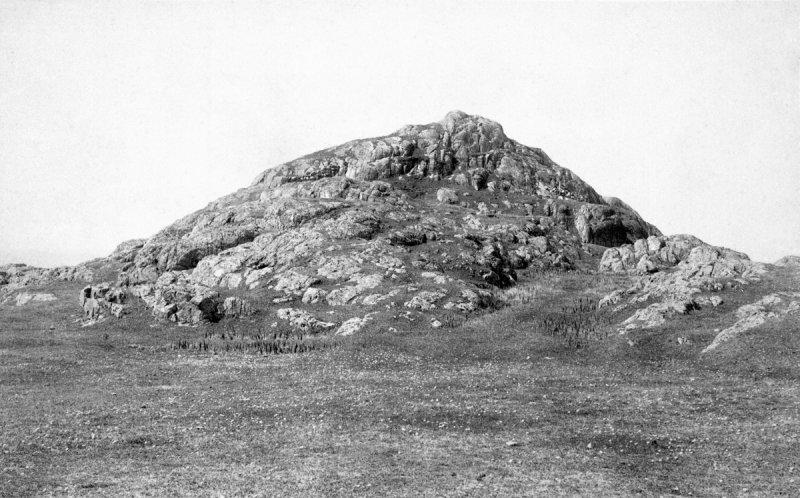
Photo: Erskine Beveridge (1851–1920) / Wikimedia Commons / Public domain Grouped with Dùn an Achaidh by Beveridge as one of Coll's four most interesting fortifications.
Discovery & excavation
Archaeological finds from the site include decorated pottery, a slate whorl and a stone pounder. These were removed from the dun and are now held in the National Museum of Antiquities of Scotland, today part of the National Museum of Scotland in Edinburgh.
Finds now held at: National Museum of Scotland, Edinburgh.
What to look for
-
Scorched foundation stones
Beveridge recorded visible evidence of fire on the dun's foundations, discovered before he knew the local burning legend and taken by him as support for the tradition.
-
Boulder-built outer defence
The approach to the north-east entrance is protected by an additional wall of large boulders positioned about 5 metres below the summit area.
-
The ridge setting
The dun sits atop a rocky ridge 22 metres above the surrounding ground, drained by the Allt a' Mhuilinn ("the stream of the mill"), a natural vantage that strengthened the site's defences.
What is said
Folklore and tradition, recorded as what is said — not as established fact.
-
The Burning of the Dun
Local tradition holds that the dun was the stronghold of a tyrannical Norseman, said to be the son of a king named Anlaimh (Olaf), until the islanders rose up, attacked by night, and set fire to the fort to drive out its Norse occupiers.
-
Samuel Johnson's Visit
Local tradition on Coll held that Samuel Johnson visited the dun during his tour of the Hebrides, though it is said that neither Johnson nor his companion James Boswell mentioned any such visit in their own accounts.
Plan your visit
- Location
- 56.5981°N · 6.5907°W
- Nearest settlement
- Acha
- Access
- Open access
- Terrain
- Rough ground — reasonable boots advised
- Time needed
- About 45 minutes
- What survives
- Ruined dun survives as foundation stones and defensive walls on a rocky ridge; scorch marks are reported on the foundations.
Opening & admission
No admission is charged; check current access guidance before visiting.
- Sits atop a rocky ridge about 22 metres high, reached via rough, uneven ground
- No formal visitor facilities or managed access route are recorded
Nearby places
Settlement · Medieval
Breachacha crannog
Argyll and Bute
A drained loch bed south of Breachacha Castle on Coll still holds an artificial island whose stonework and mysterious dug pits have never been full…
- Near Arinagour
- Rough ground
Fortified place · Iron Age
Dùn Dubh
Argyll and Bute
The name Dùn Dubh renders from Scottish Gaelic as "the black dun", and the early 20th-century antiquary Erskine Beveridge counted it among the four…
- Near Arinagour
- Rough ground
Fortified place · Iron Age
Dùn Morbhaidh
Argyll and Bute
Two potsherds incised with the figures of deer, lifted from Dùn Morbhaidh and now kept in the National Museum of Antiquities of Scotland, are among…
- Near Gallanach
- Rough ground
Fortified place · Iron Age
Dun Mor Vaul
Argyll and Bute
A drystone tower with an internal diameter of 9.2 metres and walls roughly 4.5 metres thick stands on a rocky knoll on the northern coast of Tiree,…
- Near Balemartine
- Some walking
The setting
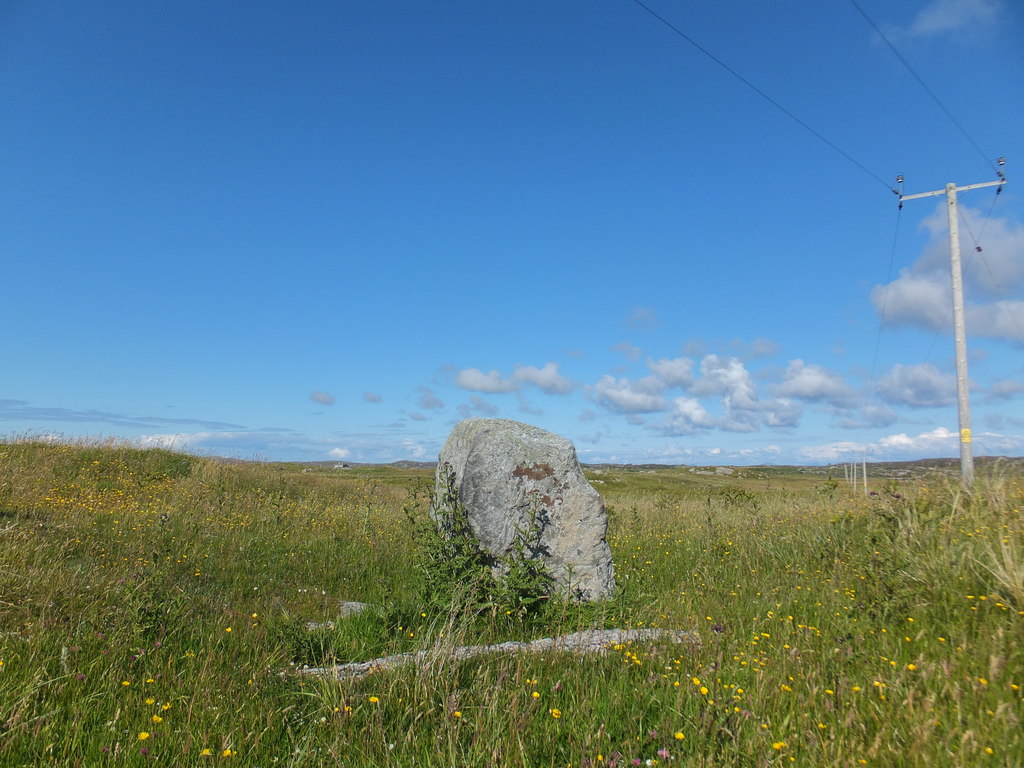
Landscape east of Uig near Dùn an Achaidh; the fort is not visible.
Photo: Peter Mackenzie / Wikimedia Commons / CC BY-SA 2.0
Road approaching Acha in the landscape around Dùn an Achaidh; the fort is not visible.
Photo: Euan Nelson / Wikimedia Commons / CC BY-SA 2.0
Moorland near Uig in the wider setting around Dùn an Achaidh; the fort is not visible.
Photo: Richard Webb / Wikimedia Commons / CC BY-SA 2.0
Questions people ask
- What does the name Dùn an Achaidh mean?
- It derives from the Scottish Gaelic an t-Achadh, meaning "the field". An older local name instead links the dun to a son of a Norse king.
- Why is Dùn an Achaidh significant?
- It is considered the best-preserved dun on Coll and was ranked by antiquary Erskine Beveridge among the island's four most interesting fortifications.
- What has been found at the site?
- Excavation produced decorated pottery, a slate whorl and a stone pounder, all now held in the National Museum of Scotland.
- Is there a legend attached to the dun?
- Tradition holds it was the stronghold of a Norse chief's son, burned out by islanders in revolt; scorch marks on the foundations are said to support the story.
- Where is Dùn an Achaidh located?
- It stands on a rocky ridge about 350 metres south-west of Acha Mill on the island of Coll, in the Inner Hebrides.
Sources
- Wikipedia: Dùn an Achaidh
- Wikidata: Dùn an Achaidh
- Erskine Beveridge, Coll and Tiree: Their Prehistoric Forts and Ecclesiastical Antiquities
Explore more: Fortified places · Medieval · Argyll and Bute
The Ancient Codex, in your pocket
Get the Pocket Codex app
Carry the directory with you — Dùn an Achaidh and thousands of ancient places across Britain and Ireland, offline, wherever you roam.