A four-storey tower house on a tidal islet reachable only at low tide, restored twice from ruin and now among the best-preserved medieval castles in western Scotland.
Twice a day the sea retreats from a narrow strip of rock in Loch Laich, and for a few hours the exposed ground connects a small tidal islet to the shore near Port Appin — the only time anyone can reach the four-storey tower house standing on it without a boat. Castle Stalker’s isolation was never an accident: the walk out across the tide-washed rock, timed against the loch, has kept the building apart from the mainland for seven centuries, and still does today.
The name comes from the Gaelic Stalcaire, meaning ‘hunter’ or ‘falconer’, and the castle has changed hands about as often as its name suggests wildness. A small fort raised around 1320 by Clan MacDougall, then Lords of Lorn, gave way to the Stewarts within a couple of generations; it was the Stewarts who are thought to have rebuilt the castle in the form still standing, a tower house now counted among the best-preserved medieval examples anywhere in western Scotland.
Lost to Clan Campbell in the seventeenth century, abandoned as a roofless ruin by around 1840, and eventually bought back into private hands in the twentieth century, the castle owes its present condition to two separate rounds of restoration work, the second of which — completed across roughly a decade from 1965 — brought it back into something close to its original form. It remains privately owned, open to visitors on selected summer days, and has become familiar well beyond Argyll as a filming location, most famously as the ‘Castle Aaaaarrrrrrggghhh’ of Monty Python and the Holy Grail.
What follows is drawn from published sources, with each claim labelled by how firmly it is established.
The name
The name 'Stalker' derives from the Gaelic Stalcaire, meaning 'hunter' or 'falconer' — the same root preserved in the castle's Gaelic name, Caisteal an Stalcaire.
History
Around 1320 Clan MacDougall, then the Lords of Lorn, raised a small fort on the tidal islet in Loch Laich, an inlet off Loch Linnhe. The islet's isolation, reachable from the shore only with difficulty and only at low tide, made it a naturally defensible seat for the lordship, setting the pattern of a stronghold whose access and protection alike depended entirely on the tide.
Around 1388 the Stewarts displaced the MacDougalls as Lords of Lorn, inheriting the islet and its earlier fortification. It is believed that around the 1440s they rebuilt the site in the form that survives today: a four-storey tower house or keep, now reckoned among the best-preserved medieval tower houses anywhere in western Scotland and later recognised with Category A listed status.
The Stewarts' relative King James VI of Scotland is recorded as having visited the castle. Local tradition holds that around 1620 a drunken bet cost the Stewarts their stronghold, and it passed into the hands of Clan Campbell, historic rivals of the Stewarts in the region. Ownership subsequently changed between the two clans more than once, reflecting the shifting fortunes that shaped this part of Argyll through the seventeenth century.
By around 1840 the Campbells had finally abandoned the castle, and it lost its roof soon afterwards, leaving the tower house to stand open to the elements for decades. The loss of the roof marked the point at which Castle Stalker passed from an occupied residence into a ruin, a state in which it remained for the rest of the nineteenth century.
In 1908 Charles Stewart of Achara bought the ruined castle, by then roofless and decaying since its abandonment around 1840, and carried out basic conservation work to arrest further decay. The purchase returned a Stewart, if not the original branch that had lost the castle in the seventeenth-century wager, to ownership of the stronghold their ancestors had built nearly five centuries before.
In 1965 Lieutenant Colonel D. R. Stewart Allward acquired Castle Stalker and, over roughly the following decade, carried out a full restoration, returning the roofless ruin to a complete and habitable tower house. The castle remains in private ownership today, standing within the Lynn of Lorn National Scenic Area, and is opened to the public at selected times each summer.
People
-
King James VI of Scotland
A relative of the Stewart owners, he is recorded as having visited the castle before it passed to Clan Campbell around 1620.
-
Charles Stewart of Achara
Bought the ruined castle in 1908 and carried out basic conservation work to halt its decay.
-
Lt. Col. D. R. Stewart Allward
Acquired the castle in 1965 and completed a full restoration of the tower house over about ten years.
Connections
-
Clan MacDougall
Built the original small fort on the islet around 1320, when they held the Lordship of Lorn.
-
Clan Campbell
Took ownership of the castle around 1620 after a drunken bet with the Stewarts, and held it, with interruptions, until abandoning it around 1840.
-
The Stewarts of Appin
Took over the Lordship of Lorn around 1388 and are believed to have rebuilt the castle in its present form around the 1440s.
In culture
-
Monty Python and the Holy Grail
The castle appears as the fictional 'Castle Aaaaarrrrrrggghhh' in the 1975 comedy film.
-
Highlander: Endgame
Used as a filming location for this instalment of the Highlander film franchise.
-
Sense8
Featured in the Netflix series as the estate of the 'Old Man of Hoy'.
-
Black Mirror
Appears as a filming location in the episode 'Loch Henry'.
-
The Boggart
Said to be the inspiration for the fictional Castle Keep in the children's novel The Boggart.
What to look for
-
Four-storey tower house
The castle rises as a compact four-storey keep, one of the best-preserved medieval tower houses surviving in western Scotland.
-
Tidal islet setting
The castle stands on a small islet in Loch Laich, reachable from the shore only with difficulty and only at low tide.
-
Category A listing
Recognised as a Category A listed building, reflecting its architectural and historic importance.
What is said
Folklore and tradition, recorded as what is said — not as established fact.
-
The drunken bet
Local tradition holds that around 1620 the castle passed from the Stewarts to Clan Campbell as the result of a drunken bet made during a visit by King James VI.
Plan your visit
- Location
- 56.5715°N · 5.3862°W
- Nearest settlement
- Port Appin
- Access
- Private — no general public access
- Terrain
- Rough ground — reasonable boots advised
- Time needed
- About 30 minutes
- What survives
- The restored tower house stands on a tidal islet; the ruin is not an open-access interior visit.
Opening & admission
Privately owned and only open to the public at limited times in summer — check the castle's own website before visiting.
- Set on a tidal islet reachable only with difficulty across the shore at low tide
- Visible from the A828 road between Oban and Glen Coe
Nearby places
Fortified place · Iron Age
Tirefour Castle
Argyll and Bute
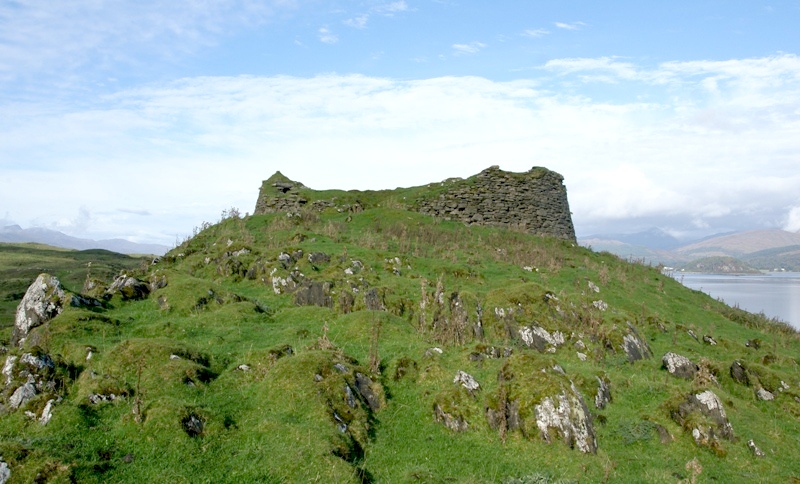
A drystone broch: a round, hollow-walled tower distinctive to Scotland's Iron Age, the centuries before Rome arrived: survives to a maximum height…
- Rough ground
Building or ruin · Medieval
St Moluag's Cathedral, Lismore
Argyll and Bute
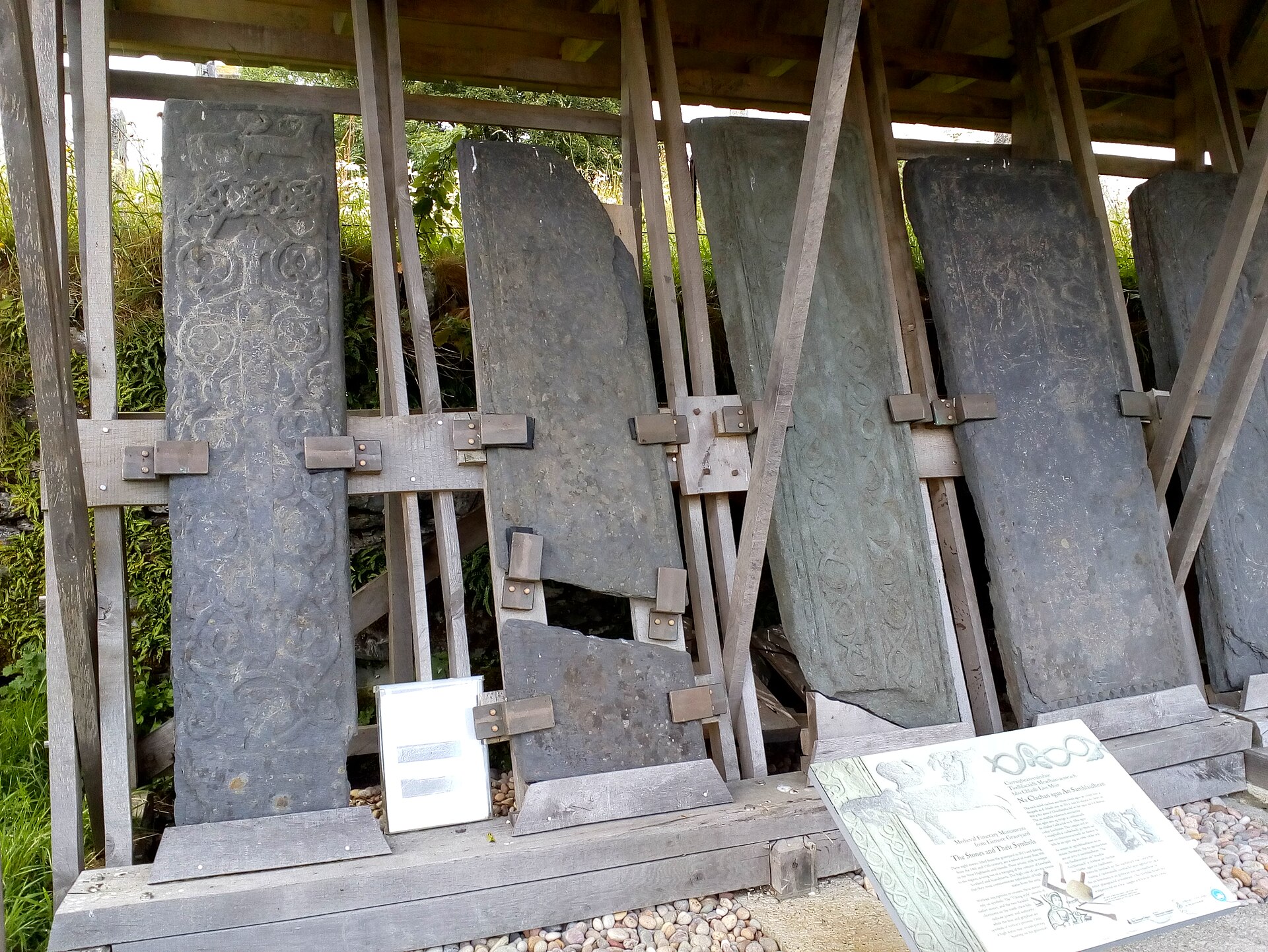
The parish church swallowed a medieval cathedral whole in 1749, still wearing its doorways, piscina: the basin near an altar for rinsing communion…
- Easy path
Fortified place · Medieval
Castle Coeffin
Argyll and Bute
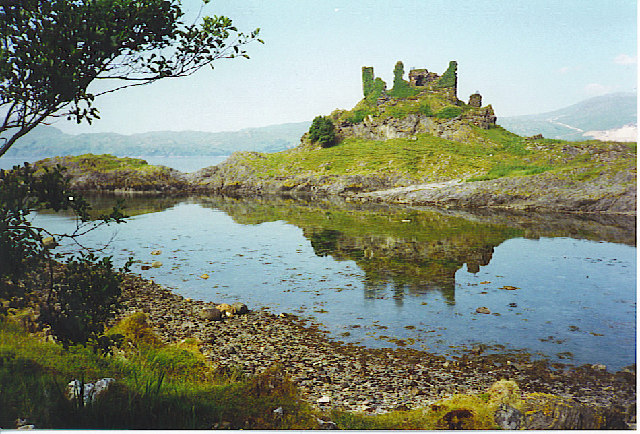
A 13th-century hall-castle on a Lismore promontory, raised on the site of an earlier Viking stronghold and named for a Danish prince said to haunt…
- Rough ground

Fortified place · Medieval
Lochnell Castle
Argyll and Bute
A staircase inside is said to be carved from a sacred yew felled on nearby Bernera Island: timber that reportedly survived at least two fires which…
- Easy path
Questions people ask
- Why is Castle Stalker difficult to visit?
- It stands on a tidal islet in Loch Laich, reachable from the shore only with difficulty and only when the tide is out.
- What does the name 'Stalker' mean?
- It comes from the Gaelic Stalcaire, meaning 'hunter' or 'falconer', reflected in the castle's Gaelic name, Caisteal an Stalcaire.
- Who built Castle Stalker?
- Clan MacDougall raised a small fort on the site around 1320; the Stewarts, who took the Lordship of Lorn in 1388, are believed to have rebuilt it around the 1440s.
- How did Castle Stalker end up owned by Clan Campbell?
- Tradition holds that around 1620 the Stewarts lost the castle to Clan Campbell in a drunken bet, after which ownership changed between the two clans more than once.
- Has anyone lived on the islet permanently?
- No — National Records of Scotland classified the island as having no usual residents at either the 2001 or 2011 census.
Sources
- Wikipedia: Castle Stalker
- National Records of Scotland — 2011 Census
Explore more: Fortified places · Medieval · Argyll and Bute
The Ancient Codex, in your pocket
Get the Pocket Codex app
Carry the directory with you — Castle Stalker and thousands of ancient places across Britain and Ireland, offline, wherever you roam.