
Roughly a hundred yards southeast of Benie Hoose, close to the cliff edge at Yoxie Geo on Whalsay's northeastern coast, a partly ruined Neolithic (the first farming period in Britain, roughly 4000–2500 BC) building carries a name that no longer quite fits it. Early assessments took the site for a grouping of standing stones and it was named accordingly; closer examination later showed it to be the remains of a house, its walls built in part from megaliths, many of which still stand upright in place. Locally the site is also known as Yoxie Biggins.
Roughly a hundred yards southeast of Benie Hoose, close to the cliff edge at Yoxie Geo on Whalsay’s northeastern coast, a partly ruined Neolithic building carries a name that no longer quite fits it. Early assessments took the site for a grouping of standing stones and it was named accordingly; closer examination later showed it to be the remains of a house, its walls built in part from megaliths, many of which still stand upright in place. Locally the site is also known as Yoxie Biggins.
The building, part of the Pettigarths Field settlement that also includes a megalithic tomb and Benie Hoose itself, dates to around 4,000 years ago. It once measured about 18 by 11 metres, with an L-shaped main block to the west and a smaller forecourt to the east, though little survives of its northern end. No trace of any door fixture has been found, but a stone-paved passage lined with boulders still runs through the house, continuing into a circular room that it divides into two recessed sections.
What the building was used for has been debated since its excavation by C.S.T. Calder, who read Yoxie and its Benie Hoose neighbour as a temple and an attendant priestly dwelling, comparable to prehistoric shrines on Malta and to a similar structure at Stanydale on the Shetland Mainland. That reading has not held up: early and middle Neolithic society is not thought to have supported anything as socially complex as a priestly caste, and both buildings are now regarded as houses rather than religious structures.
What follows is drawn from published sources, with each claim labelled by how firmly it is established.
The name
The name Standing Stones of Yoxie comes from the megaliths built into the structure's walls, many of which are still standing; before excavation clarified the building's layout, these upright stones were taken for an isolated standing-stone grouping. The site is also known locally as Yoxie Biggins.
History
Around 4,000 years ago, during the Neolithic period, a house was built on the northeastern coast of Whalsay as part of a wider settlement at Pettigarths Field, which grew to include a megalithic tomb and a second house known as Benie Hoose nearby. What came to be called the Standing Stones of Yoxie took its name from the megaliths worked into its walls, many of which remained standing when the site was later examined; only later did investigators recognise that what looked like a stone grouping was in fact the partitioned remains of a substantial dwelling, originally around 18 by 11 metres, with an L-shaped block to the west and a smaller forecourt to the east.
In the centuries that followed, the site continued to see use: material recovered from Yoxie spans both the early and late Bronze Age, indicating that the building or its immediate surroundings remained occupied, or were returned to, long after its Neolithic construction. Activity at the site continued into the Iron Age, when further material was deposited alongside the earlier Neolithic and Bronze Age finds, pointing to a long and intermittent history of use rather than a single short-lived settlement phase.
The site was excavated by C.S.T. Calder, who interpreted Yoxie as the remains of a temple and Benie Hoose as a dwelling that may have housed the priests serving it. He noted that the layout of the two buildings echoed records of temples and priestly houses in Malta, and drew the same conclusion about a comparable structure at Stanydale on the Shetland Mainland; had the reading held, Yoxie and Stanydale would have counted among the earliest known temples anywhere in the British Isles.
That interpretation has since been set aside. Early and middle Neolithic society does not appear to have supported the kind of complex social structure, a distinct priestly caste, that a temple building would imply, and both Yoxie and Benie Hoose are now regarded as prehistoric houses rather than religious buildings.
People
-
C.S.T. Calder
Excavated the Standing Stones of Yoxie and Benie Hoose, and first interpreted Yoxie as the remains of a Neolithic temple.
Connections
-
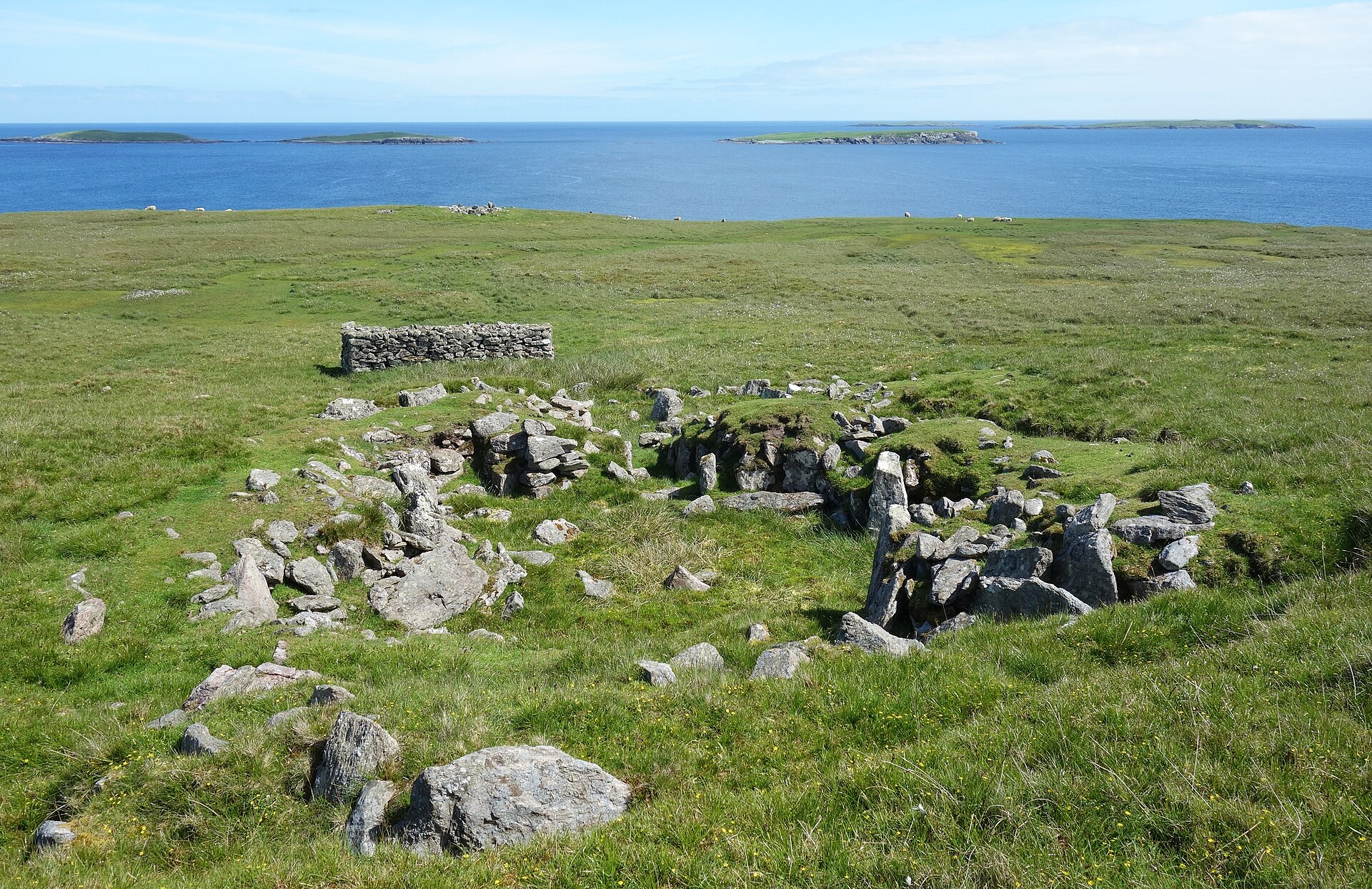
Photo: Des Blenkinsopp / Wikimedia Commons / CC BY-SA 2.0 Neighbouring Neolithic house about 100 yards to the northwest, excavated alongside Yoxie and originally read as a possible dwelling for priests.
-
Pettigarths Field settlement
The wider Neolithic settlement of which Yoxie forms part, also including a megalithic tomb.
-
Stanydale
A comparable structure on the Shetland Mainland that excavator C.S.T. Calder also interpreted as a Neolithic temple.
-
Ħal Tarxien, Malta
Prehistoric temple complex to which the layout of Yoxie and Benie Hoose has been compared.
Discovery & excavation
Excavation directed by C.S.T. Calder recovered pottery from both Yoxie and Benie Hoose, including at Yoxie a large vessel closely resembling a plain Bipartite Urn, likely used to store barley. More than 120 stone tools of crude manufacture were also unearthed at Yoxie, alongside material spanning the Neolithic construction phase, the early and late Bronze Age, and a later Iron Age occupation.
Finds now held at: Standing Stones of Yoxie; Benie Hoose.
What to look for
-
The L-shaped main block
The western part of the building forms a substantial L-shaped block, the best-preserved section of the structure.
-
The forecourt
A smaller forecourt lies to the east of the main block; no trace of any door fixture survives in either area.
-
The paved passage and circular room
A stone-paved passage lined with boulders runs through the house and continues into a circular room, which it divides into two recessed sections.
-
The standing megaliths
Many of the megaliths built into the walls remain upright, the feature that gave the site its name even after the original 'standing stones' reading of the site was overturned.
What is said
Folklore and tradition, recorded as what is said — not as established fact.
-
Druid priests at Benie Hoose
Local tradition holds that the stones were used for ceremonies by Druid priests said to have lived at Benie Hoose, and in some tellings that druids live there still. The belief sits awkwardly with the archaeology: the ruins are around 4,000 years old, and there is no written reference to druids anywhere before about 200 BC, with no reliable source even from later periods.
Plan your visit
- Location
- 60.3665°N · 0.9371°W
- Access
- Open access
- Terrain
- Easy going
- Time needed
- About 30 minutes
Nearby places
Ancient place · Prehistoric
Benie Hoose
Shetland Islands
Benie Hoose lies in Nesting parish, towards the north-east of Whalsay, laid out in the unusual form of a figure of eight rather than the single rou…
- Easy path

Tomb or burial place · Prehistoric
Pettigarths Field Cairns
Shetland Islands
On a low rise in the parish of Nesting in north-east Whalsay, two burial monuments stand roughly 140 metres north-west of the settlement mound at B…
- Easy path
Carved stone · Pictish & early medieval
Lunnasting stone
Shetland Islands
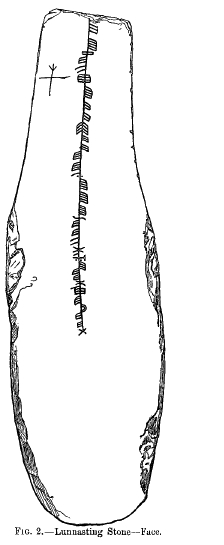
The Lunnasting stone is a slab of slate, 44 inches (1.1 m) long, about 13 inches (0.33 m) wide and just an inch (2.5 cm) thick, carrying an ogham i…
- Easy path

Fortified place · Iron Age
Broch of Cullingsburgh
Shetland Islands
Very little survives above ground of the broch (a tall circular tower of unmortared stone, found only in Scotland) that once stood on a shoulder of…
- Some walking
Questions people ask
- What is the Standing Stones of Yoxie?
- It is a Neolithic building on the northeastern coast of Whalsay in Shetland, about 4,000 years old, originally mistaken for a grouping of standing stones but now understood to be the partitioned remains of a prehistoric house.
- Why is it called the Standing Stones of Yoxie if it is a house?
- The name comes from the megaliths built into its walls, many of which are still standing; early assessments took these for a stone grouping before excavation revealed the outline of a partitioned building. The site is also known locally as Yoxie Biggins.
- Was Yoxie really a Neolithic temple?
- Excavator C.S.T. Calder thought so, comparing its layout and that of neighbouring Benie Hoose to temple and priestly-house remains in Malta, and interpreting a similar structure at Stanydale the same way. The idea has since been abandoned, since early and middle Neolithic society does not appear to have had the complex social structure a priestly caste would imply; both buildings are now regarded as houses.
- What has been found at the site?
- Finds span the Neolithic construction phase through to the early and late Bronze Age and a later Iron Age occupation, including pottery from both Yoxie and Benie Hoose, among it a large vessel resembling a plain Bipartite Urn possibly used for storing barley, and more than 120 crude stone tools.
- Is there any truth to the Druid legend associated with the site?
- No reliable evidence supports it. Local tradition holds that Druid priests based at Benie Hoose used the stones for ceremonies, but the ruins are around 4,000 years old and there is no written reference to druids anywhere before about 200 BC.
Sources
The Ancient Codex, in your pocket
Get the Pocket Codex app
Carry the directory with you — Standing Stones of Yoxie and thousands of ancient places across Britain and Ireland, offline, wherever you roam.