
Torrylin Cairn preserves a Neolithic (the late Stone Age, about 4000–2500 BC in Britain) Clyde cairn whose chamber, burials and later damage reveal both prehistoric (before written records reached Britain) ritual and fragile survival.
Beside Kilmory Water south of Lagg, Torrylin Cairn survives as a disturbed Neolithic chambered tomb on Arran. Stone robbing and later dumping of field stones have obscured its original outline, but the long, narrow burial chamber still records the monument’s internal design. Its compartments offer a close, physical reminder that a cairn was not simply a heap of stone but an arranged setting for the dead.
Nineteenth-century excavation found an elongated chamber divided into four compartments, with the intact innermost space containing the remains of six adults, a child and an infant, along with a flint tool and pottery fragment. Torrylin is a Clyde cairn, a regional tomb type found across south-west Scotland, and its relationship to better-preserved Carn Ban nearby connects a compromised Arran monument to a wider Neolithic architectural tradition.
What follows is drawn from published sources, with each claim labelled by how firmly it is established.
History
Torrylin Cairn was constructed in the Neolithic as a chambered tomb of the Clyde cairn type, a form found across south-west Scotland. Although the original shape and size are now uncertain, the source indicates that it probably had a crescent-shaped forecourt framed by a façade of slender upright stones. This suggests a monument designed not only to enclose burials but also to structure approach, gathering and visual encounter at its entrance.
Antiquarian excavation in the nineteenth century uncovered an elongated burial chamber divided into four compartments. Only the innermost compartment remained intact, where excavators found the remains of six adults, a child and an infant, together with a flint tool and a pottery fragment. The evidence gives the cairn a particularly human scale, recording repeated deposition of people of different ages within a deliberately partitioned funerary space.
The tomb’s later history has substantially altered what can be read on the ground. Stone robbing damaged the cairn, and field stones were subsequently dumped over it, leaving its original dimensions and profile uncertain. This loss is itself historically significant: Torrylin demonstrates how prehistoric monuments can persist through partial survival, with the chamber and excavation record becoming vital evidence where the larger architectural form has been compromised.
Cultural influences
-
Torrylin belongs to the Clyde cairn tradition of chambered tombs found across south-west Scotland, using an elongated burial chamber and a probable forecourt for approach and commemoration.
Connections
-

Photo: habiloid / Wikimedia Commons / CC BY-SA 2.0 Historic Environment Scotland presents this Iron Age dun with Torrylin as part of the archaeological sequence of south Arran, linking a later fortified settlement to the cairn’s Neolithic burial landscape.
-
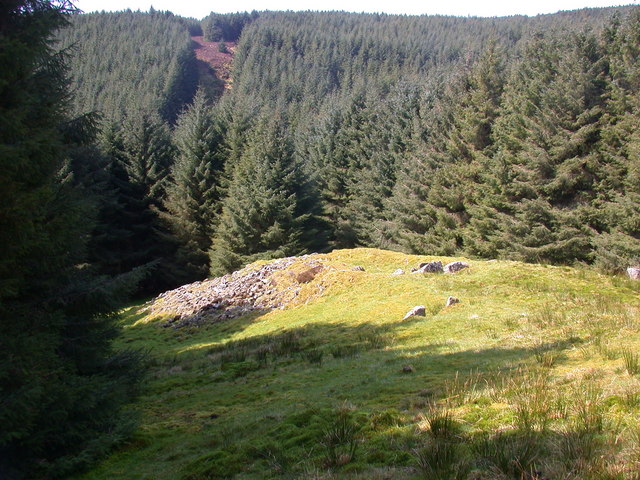
Photo: David G Campbell / Wikimedia Commons / CC BY-SA 2.0 Both are managed Historic Environment Scotland prehistoric monuments in south Arran: Torrylin is a chambered cairn and Carn Ban a later Neolithic or early Bronze Age burial cairn.
-

Photo: Nigel Homer / Wikimedia Commons / CC BY-SA 2.0 Torrylin and Kilpatrick Dun are both Historic Environment Scotland sites on Arran; their chambered cairn and dun show the island’s archaeological sequence from Neolithic burial to later fortified settlement.
Discovery & excavation
Nineteenth-century excavation exposed the long chamber and its four compartments, including burials in the intact innermost space.
What to look for
-
The surviving chamber
Look for the surviving chamber rather than expecting a complete cairn profile. It measures about 6.7 metres long and 1.2 metres wide, an unusually direct indication of the narrow internal passage and compartments once protected by the cairn.
-
The four compartments
Notice the four-part arrangement of the elongated burial chamber. The source records that only the innermost compartment was intact during nineteenth-century excavation, which makes the surviving division central to understanding how the tomb organized burial space.
-
The robbed surface
Read the disturbed surface with care. Stone robbing and later dumping of field stones have changed the cairn’s appearance, so irregularities and missing fabric are evidence of the monument’s later treatment as well as of its Neolithic construction.
-
The lost forecourt
Imagine the probable crescent-shaped forecourt and slender upright façade at the entrance. These inferred elements help explain why a chambered cairn could be an architectural setting for approaching and commemorating the dead, rather than a sealed container alone.
-
Carn Ban to the north-east
Place the cairn beside Kilmory Water and relate it to Carn Ban about five kilometres northeast. The two sites share the Clyde cairn tradition, though Carn Ban is better preserved, making their comparison useful for distinguishing original design from later loss.
Plan your visit
- Location
- 55.4408°N · 5.2339°W
- Access
- Open access
- Terrain
- Moderate walking
- Parking
- Parking is available at the cairn.
- Time needed
- About 30 minutes
- Best time
- Daylight, in dry conditions.
- What survives
- A disturbed cairn beside Kilmory Water, with its surviving chamber more legible than its original outer shape.
- Facilities
- No dedicated visitor facilities are documented at the cairn; plan to use facilities in nearby settlements.
Opening & admission
Free to visit and open year-round.
- The cairn lies beside Kilmory Water south of Lagg.
- Stone robbing and dumped field stones have obscured the original cairn shape.
Nearby places

Fortified place · Iron Age
Torr a'Chaisteal
North Ayrshire
Torr a’Chaisteal preserves the low, turf-covered defences of an Iron Age (from about 800 BC until the Romans came) dun and its link to Arran’s wide…
- Near Blackwaterfoot
- Some walking
Tomb or burial place · Prehistoric
Carn Ban, Arran
North Ayrshire
Carn Ban is one of south-west Scotland’s best-known Neolithic (the first farming period in Britain, roughly 4000–2500 BC) Clyde cairns, preserving…
- Near Kilmory
- Easy path

Fortified place · Iron Age
Kilpatrick Dun
North Ayrshire
Kilpatrick Dun is a substantial later Iron Age (the centuries before Rome arrived, from about 800 BC) fortified residence on Arran, with an eight-m…
- Near Blackwaterfoot
- Some walking

Sacred place · Prehistoric
Machrie Moor Stone Circles
North Ayrshire
Machrie Moor gathers stone circles, burials and earlier timber settings into an exceptional prehistoric (before any written account of Britain exis…
- Near Machrie
- Some walking
The setting
Near Torrylin Cairn, about 16 metres away.
Photo: Caroline Martin / Wikimedia Commons / CC BY-SA 2.0
Near Torrylin Cairn, about 25 metres away.
Photo: Rob Farrow / Wikimedia Commons / CC BY-SA 2.0
Near Torrylin Cairn, about 35 metres away.
Photo: Raibeart MacAoidh / Wikimedia Commons / CC BY-SA 2.0
Questions people ask
- What type of monument is Torrylin Cairn?
- Torrylin is a Neolithic chambered tomb of the Clyde cairn type, a form found across south-west Scotland.
- What was found inside Torrylin Cairn?
- Nineteenth-century excavation found an intact innermost chamber compartment containing the remains of six adults, a child and an infant, plus a flint tool and a pottery fragment.
- Why is the cairn’s original form uncertain?
- The cairn has been disturbed by stone robbing and later dumping of field stones, so its original shape and size cannot be determined with certainty.
Sources
The Ancient Codex, in your pocket
Get the Pocket Codex app
Carry the directory with you — Torrylin Cairn and thousands of ancient places across Britain and Ireland, offline, wherever you roam.