Clackmannan’s early market cross stands beside a town court building and the Clackmannan Stone, a rare civic group tied to the town’s origins.
A stone cross stands in a small grassed enclosure at the west end of Clackmannan’s Main Street, beside the remains of the town court building (a historic town court and prison) and the Clackmannan Stone. Together the three structures form an unusually concentrated civic and historical group.
The cross dates from the seventeenth century and was donated by Sir Henry Bruce, whose family were superiors of the burgh. The lower shaft shows wear traditionally linked with prisoners’ chains, although that explanation remains uncertain.
Later changes are visible in the stone steps and ball finial, while the neighbouring stone carries traditions about King Robert Bruce and the origin of Clackmannan’s name. The group preserves civic, legal and local memory in one streetscape.
What follows is drawn from published sources, with each claim labelled by how firmly it is established.
History
The market cross was erected in the seventeenth century and donated to Clackmannan by Sir Henry Bruce, whose family held superiority over the burgh. Its raised position placed a symbol of authority and public trade at the centre of the town’s civic landscape. Some sources suggest that wear on the lower shaft was made by chains used to secure prisoners before the tolbooth existed. The explanation is possible but uncertain, so the worn stone is evidence of use while the precise cause remains a matter of interpretation.
The ball finial came from the grounds of Clackmannan Tower in the late nineteenth century and replaced an earlier finial removed about forty years before. The current stone steps were built in 2007, replacing concrete steps made in 1949. These recorded alterations explain how the cross acquired the form seen at the civic group today. The cross stands beside the partial tolbooth, whose surviving tower dates from about 1680 while the original building was authorised in 1592. The neighbouring Clackmannan Stone was moved to its present position in 1833, creating the group visible today.
Local tradition says that King Robert Bruce left a glove on the stone after staying at nearby Clackmannan, but the story cannot explain the place-name because Clackmannan is recorded from the twelfth century. The group therefore holds legend and documentary history side by side.
People
-
Sir Henry Bruce
He donated the market cross to Clackmannan; the Bruce family were superiors of the burgh.
Cultural influences
-
The cross expressed the burgh’s civic authority and its right to public trade, positioned beside the tolbooth at the centre of Clackmannan’s civic group.
Connections
-
Clackmannan Tolbooth
The cross stands beside the partial tolbooth, a civic and legal building whose surviving tower dates from about 1680.
-
Clackmannan Stone
The cross forms part of the civic group with the stone associated with the town’s name and local traditions.
What to look for
-
Cross, tolbooth and stone
The market cross stands beside the partial tolbooth and Clackmannan Stone, forming a civic group at the centre of the burgh. The arrangement brings together public trade, local legal authority and the stone associated with the town’s name and traditions.
Plan your visit
- Location
- 56.1073°N · 3.7524°W
- Nearest settlement
- Alloa
- Access
- Visible from a public way
- Terrain
- Easy going
- Time needed
- About 60 minutes
- Best time
- Visit in daylight as part of a walk around Clackmannan’s historic centre.
- What survives
- The mercat cross survives as a solitary historic pillar bearing the Bruce family arms, positioned beside the Tolbooth and Clackmannan Stone.
- Facilities
- The cross has no dedicated facilities; use shops, toilets and other services in Clackmannan’s town centre.
Opening & admission
Free to view from the public way; no admission arrangements are published for the cross.
- The cross stands beside the Tolbooth and Clackmannan Stone in the town centre.
Nearby places

Fortified place · Medieval
Alloa Tower
Clackmannanshire
Alloa Tower is one of Scotland’s earliest and largest tower houses, retaining its timber roof and battlements from a long Erskine family residence.
- Near Alloa
- Easy path
Minor monument · Medieval
Market Cross, High Street, Airth
Falkirk
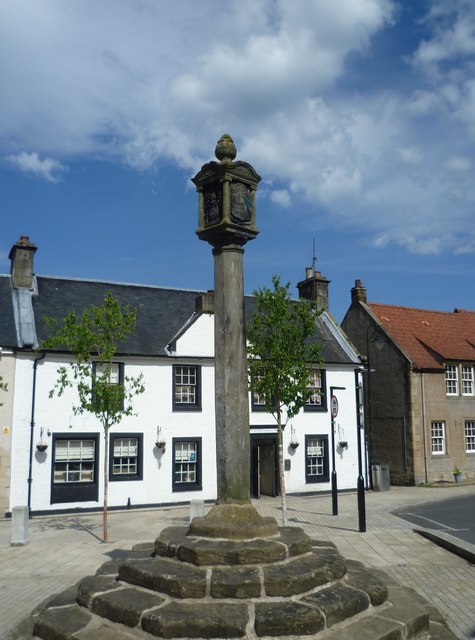
Airth Mercat Cross is a 1697 market marker in the High Street, protected through Category A listing after its former scheduled-monument designation…
- Easy path

Fortified place · Medieval
Castle Campbell
Clackmannanshire
Castle Campbell was the lowland seat of Clan Campbell’s earls and dukes of Argyll, where a fifteenth-century tower grew into a royal and political…
- Near Alloa
The setting
Main Street in Clackmannan, with the mercat cross nearby.
Photo: Kim Traynor / Wikimedia Commons / CC BY-SA 3.0
Clackmannan Development Trust building beside the mercat cross.
Photo: Richard Sutcliffe / Wikimedia Commons / CC BY-SA 2.0
Main Street in Clackmannan, in the civic setting of the mercat cross.
Photo: Leslie Barrie / Wikimedia Commons / CC BY-SA 2.0
The clock tower of Clackmannan Tolbooth, beside the mercat cross.
Photo: Richard Sutcliffe / Wikimedia Commons / CC BY-SA 2.0
Questions people ask
- When was the cross made?
- It dates from the seventeenth century.
- Who donated it?
- Sir Henry Bruce donated it to the town.
- What stands beside it?
- The cross stands beside the partial tolbooth and Clackmannan Stone.
- What is the Bruce story?
- Local tradition says Robert Bruce left a glove on the stone, but the story does not explain the documented twelfth-century place-name.
Sources
- Historic Environment Scotland — Clackmannan Tolbooth, Mercat Cross and Clackmannan Stone
- Gifford and Walker, Buildings of Scotland: Central and Stirling
Explore more: Minor monuments · Medieval · Clackmannanshire
The Ancient Codex, in your pocket
Get the Pocket Codex app
Carry the directory with you — Clackmannan Mercat Cross and thousands of ancient places across Britain and Ireland, offline, wherever you roam.