
Alloa Tower is one of Scotland’s earliest and largest tower houses, retaining its timber roof and battlements from a long Erskine family residence.
Immense rubble-built walls rise four storeys above Alloa, enclosing one of Scotland’s earliest and largest tower houses. Alloa Tower retains its original timber roof and battlements, rare survivals that give physical weight to its medieval history. The building served as the residence of the Erskine family, later earls of Mar, and the tower is now managed as a public heritage property.
Archaeology dates the original fortified house to the early fourteenth century, despite earlier traditional dates. It began with a cellar, at times used as a pit prison, then acquired a great hall and extra storey by the mid-fourteenth century. Fifteenth-century enlargement produced four or five levels while retaining first-floor entry. The tower later became an annexe to Alloa House, constructed by John Erskine in 1710; that mansion burned in 1800 and was eventually demolished. Scheduled-monument status followed in 1960.
What follows is drawn from published sources, with each claim labelled by how firmly it is established.
History
Alloa Tower was built as part of fortifications defending the north shore of the Firth of Forth. Archaeological investigations in the early 1990s dated its original fortified house to the early fourteenth century, with a cellar sometimes used as a pit prison. By the mid-fourteenth century it had gained a great hall and reached three storeys, with entry at first-floor level. A fifteenth-century enlargement created four or five levels. Ground-floor access was likely added late in the sixteenth century. John Erskine, sixth Earl of Mar, incorporated the tower into Alloa House in 1710. That house burned in 1800, was rebuilt in the 1830s and later demolished. The tower became a scheduled monument in 1960.
The listing is category A, made on 9 June 1960, and dates the tower to the fifteenth century with alterations in the sixteenth, seventeenth and late eighteenth. It records four storeys and an attic in coursed rubble, measuring 62 feet 6 inches by 39 feet 6, and rising 68 feet to the parapet walk.
The parapet is stepped and crenellated, with corbelled rounds at the angles and another at the centre of the north wall — a detail that breaks the usual pattern of corner turrets alone. The doorpiece is arched in the Ionic order of Philibert de l’Orme, nineteenth-century work that may reproduce an earlier doorway, and its bases are possibly seventeenth century. It existed in its present form by at least 1861, when it appears in a print of Alloa and Environs.
The mansion that superseded the tower has itself gone. Alloa House, built by George Angus between 1834 and 1838 and extended by John Melvin in 1868, has been demolished. Its stables survive as a quadrangle with a tower at the centre of the north front over a pend, mid nineteenth century and severely plain — so what remains of the estate is the medieval tower at one end and the Victorian service buildings at the other, with the house that stood between them erased.
The listing also records that the tower has been de-scheduled, meaning it is protected as a listed building rather than as a scheduled monument. Among the sources cited are the Old and New Statistical Accounts, the latter noting that the attached mansion burned in August 1800.
People
-
John Erskine, 6th Earl of Mar
He built Alloa House around the medieval tower in 1710, turning the former fortified residence into an annexe of a larger estate house.
Connections
-
Firth of Forth
The tower was raised as part of the fortifications defending the north shore of the firth.
-
Alloa House
The mansion John Erskine, sixth Earl of Mar, built around the tower in 1710. It burned in 1800, was rebuilt in the 1830s and later demolished, leaving the tower standing alone.
-

Photo: kim traynor / Wikimedia Commons / CC BY-SA 2.0 The nearest recorded monument in this directory, a little over two kilometres east in the old county town.
-
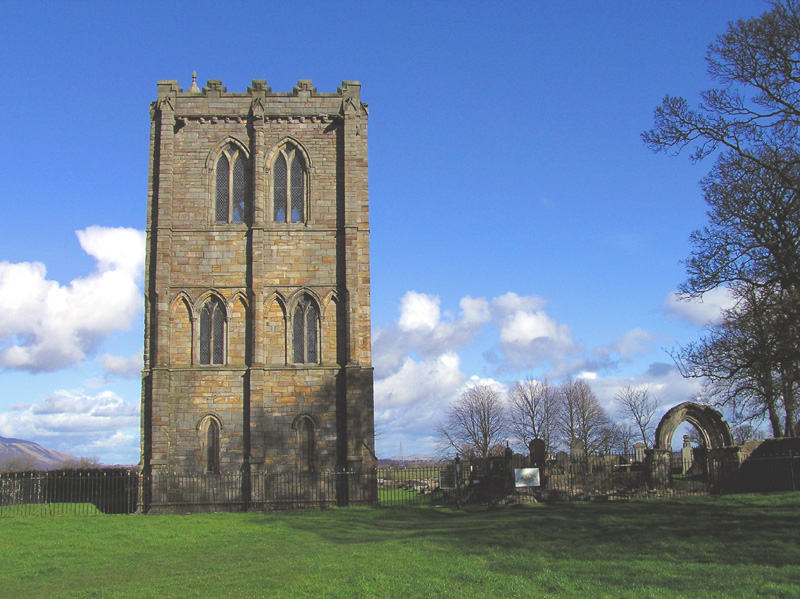
Photo: Unknown / Wikimedia Commons / CC BY-SA 3.0 The medieval abbey some eight kilometres west along the same stretch of the Forth carse.
Discovery & excavation
Archaeological assessment dates the original fortified house to the early fourteenth century, revising older traditional dates for the tower.
What to look for
-
Original timber roof and battlements
The tower retains its original timber roof and battlements, rare survivals within one of Scotland’s largest medieval tower houses.
Plan your visit
- Location
- 56.1124°N · 3.7883°W
- Nearest settlement
- Alloa
- Access
- Paid entry — managed visitor site
- Terrain
- Easy going
- Parking
- Free member parking is available at the tower; parking at the entrance is possible by prior arrangement, including accessible parking.
- Time needed
- About 60 minutes
- Best time
- Visit during the National Trust for Scotland’s published opening hours and allow time for the tower and grounds.
- What survives
- Alloa Tower is a four-storey tower house with restored interiors and a visitor display; the Trust provides an accessibility guide and interpretation for the building.
- Facilities
- The tower has a small shop, free member parking, a bike rack, accessible parking by arrangement, an accessible toilet, children’s activities and large-print interpretation on request.
Opening & admission
Now a public attraction run by the National Trust for Scotland, with events held through the year — check the Trust's website for current opening times and admission.
- From 3 April to 31 October 2026, the tower and shop are open Friday–Monday, noon–4pm, with last entry at 3pm.
- The tower is closed from 1 November 2026 to 28 February 2027; check the Trust before travelling for seasonal changes.
Nearby places

Minor monument · Medieval
Clackmannan Mercat Cross
Clackmannanshire
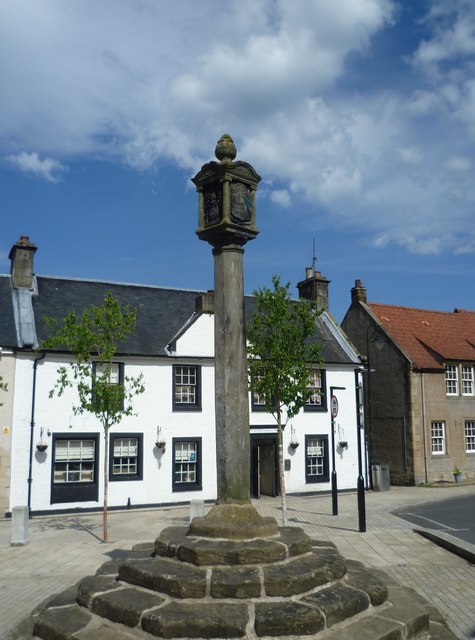
Clackmannan’s early market cross stands beside a town court building and the Clackmannan Stone, a rare civic group tied to the town’s origins.
- Near Alloa
- Easy path
Minor monument · Medieval
Market Cross, High Street, Airth
Falkirk
Airth Mercat Cross is a 1697 market marker in the High Street, protected through Category A listing after its former scheduled-monument designation…
- Easy path

Fortified place · Iron Age
Dumyat
Clackmannanshire
Dumyat’s Castle Law preserves an excavated hill fort with evidence for occupation from around 500 BC and again in the fifth to seventh centuries AD.
- Near Alloa
- Rough ground
The setting
View over Alloa town centre from Alloa Tower.
Photo: Richard Webb / Wikimedia Commons / CC BY-SA 2.0
Alloa town centre and the Ochil Hills, seen from the avenue to Alloa Tower.
Photo: Ian Murfitt / Wikimedia Commons / CC BY-SA 2.0
Questions people ask
- When was Alloa Tower built?
- Archaeological investigation dates its original fortified house to the early fourteenth century.
- Which family lived at Alloa Tower?
- It was the medieval residence of the Erskine family, later earls of Mar.
- Who owns Alloa Tower now?
- The National Trust for Scotland now manages the tower.
Sources
- Wikipedia — Alloa Tower
- Wikidata — Alloa Tower
- Historic Environment Scotland, listed building LB20959 — Alloa Tower, category A (accessed 2026-08-03)
Explore more: Fortified places · Medieval · Clackmannanshire
The Ancient Codex, in your pocket
Get the Pocket Codex app
Carry the directory with you — Alloa Tower and thousands of ancient places across Britain and Ireland, offline, wherever you roam.