A farmstead of the first farming age on Papa Westray that may be the oldest standing house in northern Europe.
The stone furniture is still standing in these houses. Fireplaces, partition screens, beds, shelves — all of it in the local flagstone, and almost all of it intact, so a visitor can see where people slept and where they kept things rather than being asked to imagine it.
The Knap of Howar sits on Papa Westray and was occupied between 3800 and 2800 BC, which puts it earlier than the more famous houses at Skara Brae and makes it a candidate for the oldest preserved stone house in northern Europe. Two rounded rectangular buildings survive with thick walls and very low doorways facing the sea, the larger and older joined to the smaller by a low passage. Whether that second building was a workshop or another house is not settled.
They survive because of rubbish. Both were raised on an older midden and then surrounded by midden material, and that packing is what has held the walls up to eaves height of 1.6 metres. The roofs are gone — timber, probably, under thatch or turf, with post holes inside recording the frame.
There are no windows, so the light came from the fire and the smoke went out through the roof. The buildings now stand close to the shore; when they were built the sea was further off.
The middens also record what these people ate: cattle, sheep and pigs, barley and wheat, shellfish gathered off the rocks, and fish of species that can only have been line-caught from a boat. Their Unstan ware pottery, finely made and decorated, ties them to the chambered tombs nearby and to places as far away as Balbridie and Eilean Domhnuill.
What follows is drawn from published sources, with each claim labelled by how firmly it is established.
The name
Howar is believed to derive from the Old Norse haugr, meaning a mound or barrow.
History
The Knap of Howar on Papa Westray is a Neolithic farmstead, and radiocarbon dating puts its occupation between 3800 and 2800 BC. That makes it earlier than the comparable houses at Skara Brae, and it may be the oldest preserved stone house anywhere in northern Europe. Two adjacent buildings survive, rounded rectangles with thick walls and very low doorways facing the sea. The larger and older one is linked by a low passage to the second, which has been read either as a workshop or as another house. Both were raised on the same alignment, doorways to the sea, which is the arrangement a visitor sees first.
They were built on an earlier midden and were then buried in midden material, which is precisely why they survive. Refuse heaped against stone walls preserves them; the same buildings left exposed would have gone long ago. It is an accident of rubbish disposal that a five-thousand-year-old house is still standing to shoulder height. There are no windows. The interiors were lit by fire, with a hole in the roof to draw the smoke off, and although the buildings now stand close to the shore they would originally have lain inland — the coast has moved, not the houses. Sea level and coastline have both shifted since; the buildings have not.
The walls stand to an eaves height of 1.6 metres and the roof is gone, though it was most likely timber with thatch or turf over it. Post holes found inside record how it was framed. Nothing of the covering survives, so the roof is the one part of the house that has to be imagined. What sets the site apart is the furniture. Fireplaces, partition screens, beds and storage shelves survive almost intact in stone, along with a hearth and a built cupboard, so the interior can be described rather than reconstructed. Very few Neolithic interiors anywhere in Europe can be described in that much detail.
The middens record the diet. The inhabitants kept cattle, sheep and pigs, grew barley and wheat, gathered shellfish, and fished for species that must have been line-caught from boats — a mixed economy, well established, five and a half thousand years ago. Finely made and decorated Unstan ware pottery links these people to the chambered tombs nearby and to sites much further off, including Balbridie and Eilean Domhnuill. The name Howar itself is thought to come from the Old Norse haugr, meaning mounds or barrows.
Cultural influences
-
The farmstead’s inhabitants kept cattle, sheep and pigs, grew barley and wheat, gathered shellfish and line-caught fish.
-
Decorated Unstan ware links the houses with nearby tombs and distant sites including Balbridie and Eilean Domhnuill.
Connections
-
Papa Westray
Knap of Howar is located on the island of Papa Westray.
-
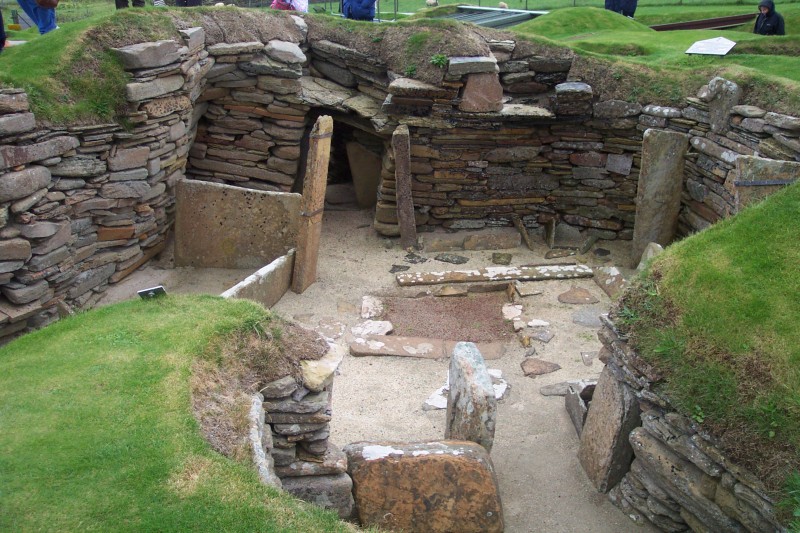
Photo: Dr. John F. Burka / Wikimedia Commons / CC BY-SA 3.0 Knap of Howar was occupied earlier than the similar houses at Skara Brae.
-
Orkney Mainland
Knap of Howar is an early Neolithic farmstead in the Orkney Islands.
What to look for
-
Linked stone houses
Two rounded stone houses are linked by a low passage, with sea-facing doorways that preserve the farmstead’s original arrangement.
-
Stone furniture
Fireplaces, beds, shelves, partition screens and a built cupboard survive in stone, allowing an exceptionally detailed Neolithic interior.
-
Midden protection
Midden material packed around the houses protected their walls to eaves height, preserving structures that exposed stone would have lost.
-
Roof postholes
Postholes inside the houses preserve the evidence for their lost timber roof frames, probably covered with thatch or turf.
Plan your visit
- Location
- 59.3494°N · 2.9107°W
- Access
- Open access
- Terrain
- Easy going
- Time needed
- About 45 minutes
- Best time
- Daylight hours
- What survives
- The two stone houses survive to about 1.6 metres, with their roofs gone but interior fittings largely intact.
- Facilities
- Facilities are limited on the island; check transport and local visitor guidance before travelling.
Opening & admission
Free to visit and open year-round.
- Historic Environment Scotland describes two linked Neolithic stone houses with surviving cupboards and stalls; check the official page for any temporary access notices.
Nearby places

Tomb or burial place · Prehistoric
Holm of Papa Westray Chambered Cairn
Orkney Islands
A chambered cairn twenty metres long: a burial tomb of stone-built compartments under a mound: on an uninhabited islet of twenty-one hectares off P…
- Easy path

Ancient place · Prehistoric
Quoygrew settlement, Westray
Orkney Islands
A medieval Norse settlement on Westray, begun as a small farmstead between about 900 and 1000.
- Near Westray
- Easy path

Settlement · Prehistoric
Links of Noltland
Orkney Islands
Links of Noltland is a settlement with late Stone Age and early Bronze Age, roughly 2500–800 BC, when metalworking spread, dwellings, protected by…
- Some walking

Building or ruin · Medieval
Noltland Castle
Orkney Islands
A castle of the later sixteenth century near Pierowall on Westray, never fully completed.
- Near Pierowall
Questions people ask
- How old is it?
- Radiocarbon dating shows occupation from 3800 BC to 2800 BC, which makes it earlier than the similar houses at Skara Brae and possibly the oldest preserved stone house in northern Europe.
- What survives inside?
- The stone furniture is largely intact — fireplaces, partition screens, beds and storage shelves — with walls standing to an eaves height of 1.6 metres and post holes marking the roof structure.
- How did the inhabitants live?
- Midden evidence shows they kept cattle, sheep and pigs, grew barley and wheat, gathered shellfish, and fished for species that must have been line-caught from boats.
- What does the name mean?
- Howar is thought to derive from the Old Norse haugr, meaning mounds or barrows — a Norse name for a site three thousand years older than any Norseman.
Sources
- Canmore site 2848
- Wikipedia: Knap of Howar
- Wikidata: Q1776885
- Historic Environment Scotland scheduled monument SM90195 — Knap of Howar,houses (accessed 2026-08-03)
Explore more: Settlements · Prehistoric · Orkney Islands
The Ancient Codex, in your pocket
Get the Pocket Codex app
Carry the directory with you — Knap of Howar and thousands of ancient places across Britain and Ireland, offline, wherever you roam.